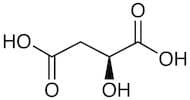
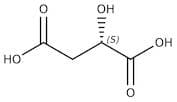
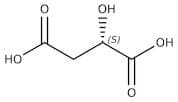
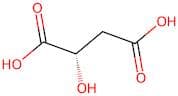
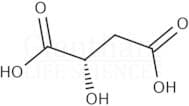
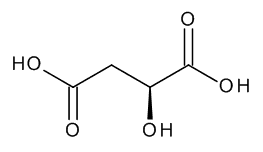
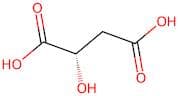
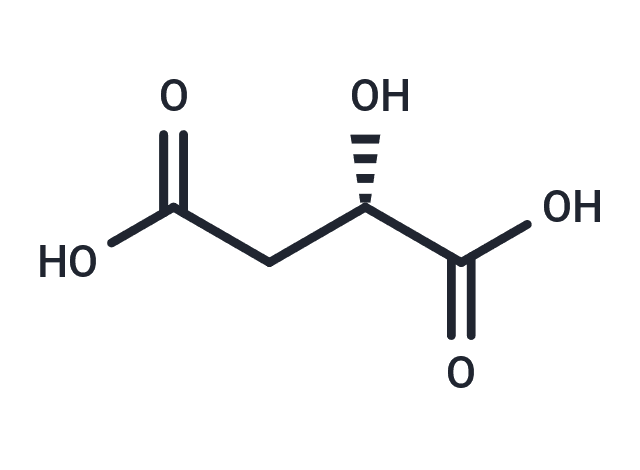
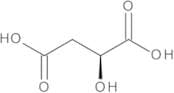
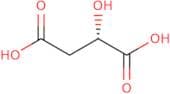
CAS 97-67-6
:Ácido L-málico
- (-)-(S)-Malic acid
- (-)-<span class="text-smallcaps">L</span>-Malic acid
- (-)-Hydroxysuccinic acid
- (-)-L-Malic acid
- (-)-Malic acid
- (2S)-2-Hydroxybutanedioic acid
- (2S)-2-Hydroxysuccinic acid
- (2S)-Malic acid
- (S)-2-Hydroxysuccinic acid
- <span class="text-smallcaps">L</span>-Apple acid
- Acide L-malique
- Apple acid
- Butanedioic acid, 2-hydroxy-, (2S)-
- Butanedioic acid, hydroxy-, (S)-
- L-Apfelsaure
- Malic Acid, L-
- Malic acid, <span class="text-smallcaps">L</span>-
- Nsc 9232
- S-2-Hydroxybutanedioic acid
- acido L-malico
- L-Hydroxysuccinic acid
- (S)-(-)-Hydroxysuccinic acid
- L-Maleic Acid
- (2S)-2-hydroxybutanedioate
- Butanedioic acid, hydroxy-, (2S)-
- (S)-HYDROXYBUTANEDIOIC ACID
- HYDROXYBUTANEDIOIC ACID
- L-(-)-APPLE ACID
- 1-HYDROXYSUCCINIC ACID
- L-HYDROXYBUTANEDIOIC ACID
- 2-HYDROXYSYCCINIC ACID
- (S)-2-HYDROXYBUTANEDICARBOXYLIC ACID
- L(-)-MALATE
- NATURAL APPLE ACID
- Ver más sinónimos
L-(-)-Malic Acid
CAS:Fórmula:C4H6O5Pureza:>98.0%(T)Forma y color:White to Almost white powder to crystalPeso molecular:134.09L-(-)-Malic acid, 99%
CAS:L-(-)-Malic acid is used as a food additive, Selective -amino protecting reagent for amino acid derivatives. Versatile synthon for the preparation of chiral compounds including -opioid receptor agonists, 1,25-dihydroxyvitamin D3 analogue, and phoslactomycin B. This Thermo Scientific Chemicals brandFórmula:C4H6O5Pureza:99%Forma y color:White, Powder or crystals or crystalline powderPeso molecular:134.09L-Malic acid, ≥99%
CAS:Thermo Scientific L-Malic acidFórmula:C4H6O5Pureza:99%Forma y color:White crystalline powderPeso molecular:134.09L-(-)-Malic acid, 97%
CAS:L-(-)-Malic acid is used as Selective -amino protecting reagent for amino acid derivatives. Versatile synthon for the preparation of chiral compounds including -opioid rece. It also acts as active ingredient in many sour or tart foods. It is used as synthesizing disincrustant and fluorescent whiteniFórmula:C4H6O5Pureza:97%Forma y color:White, Crystals or powder or crystalline powderPeso molecular:134.09L-(-)-Malic acid
CAS:Fórmula:C4H6O5Pureza:(Titration) ≥ 99.0%Forma y color:White to almost white powder or crystalsPeso molecular:134.09L-(-)-Malic acid
CAS:L-(-)-Malic acidFórmula:C4H6O5Pureza:98%Forma y color: white solidPeso molecular:134.09g/mol(S)-Malic acid
CAS:(S)-Malic acid ((S)-2-Hydroxysuccinic acid) is a naturally occurring dicarboxylic acid that is the source of the sweet and sour flavour of fruits.Fórmula:C4H6O5Pureza:99.41% - 99.72%Forma y color:SolidPeso molecular:134.09L-(-)-Malic Acid
CAS:Applications The naturally occuring isomer is the L-form which has been found in apples and many other fruits and plants. Selective α-amino protecting reagent for amino acid derivatives. Versatile synthon for the preparation of chiral compounds including κ-opioid receptor agonists, 1α,25-dihydroxyvitamin D3 analogue, and phoslactomycin B.
References Rindi, G., et al.: Biochem. J., 80, 214 (1961), Wolfgang, M., et al.: J. Biol. Chem., 281, 37265 (2006), Navarro, D., et al.: Metab. Brain Dis., 23, 115 (2008),Fórmula:C4H6O5Forma y color:WhitePeso molecular:134.09L-Malic acid
CAS:Fórmula:C4H6O5Pureza:98%Forma y color:White crystalline powderPeso molecular:134.087L-Malic acid
CAS:L-Malic acid is a dicarboxylic acid that is produced in plants and animals. It is an important intermediate in the citric acid cycle, which occurs in all aerobic organisms. L-Malic acid has many uses including as a building block for chemical synthesis, as a reagent for many different reactions, and as a speciality chemical. L-Malic acid is also used in the manufacture of pharmaceuticals and other chemicals. CAS No.: 97-67-6
Fórmula:C4H6O5Peso molecular:134.09 g/molRef: 3D-M-0850
-Unit-kgkgA consultar1kgA consultar5kgA consultar10kgA consultar25gA consultar2500gA consultarL-(-)-Malic acid
CAS:L-malic acid is a naturally occurring organic compound that can be found in many fruits and vegetables. It is an important intermediate in the citric acid cycle as well as a key component of the Krebs cycle. L-malic acid has been shown to have antiseizure and anti-inflammatory effects, and also inhibits the growth of bacteria such as Staphylococcus aureus. L-malic acid is synthesized from sodium carbonate and lactic acid by reacting with a mineral acid such as hydrochloric, sulfuric, or nitric acid. This reaction produces hydrogen gas, water, and l-malic acid. L-Malic Acid is also used for production of monoclonal antibodies against various targets, including human cells.
Fórmula:C4H6O5Forma y color:White Off-White PowderPeso molecular:134.09 g/mol