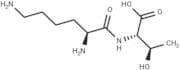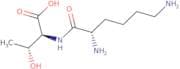
CAS 97791-84-9
:L-Treonina, L-lisil-
Descripción:
L-Treonina, L-lisil- es un dipéptido compuesto por los aminoácidos L-treonina y L-lisina. Se caracteriza por su estructura, que incluye el grupo amino, el grupo carboxilo y las cadenas laterales de ambos aminoácidos constituyentes. Este compuesto es típicamente soluble en agua debido a la presencia de grupos funcionales polares, que facilitan la formación de enlaces de hidrógeno. La L-treonina es un aminoácido esencial, lo que significa que debe obtenerse a través de la dieta, mientras que la L-lisina también es esencial y desempeña un papel crucial en la síntesis de proteínas, la producción de hormonas y la absorción de calcio. La forma de dipéptido puede exhibir actividades biológicas únicas, incluyendo roles potenciales en el metabolismo y funciones celulares. Además, puede estar involucrado en diversas vías bioquímicas, contribuyendo a la síntesis de proteínas y otras biomoléculas. El número CAS 97791-84-9 identifica de manera única este compuesto en bases de datos químicas, ayudando en su estudio y aplicación en campos como la bioquímica, la nutrición y la farmacéutica.
Fórmula:C10H21N3O4
Ordenar por
Pureza (%)
0
100
|
0
|
50
|
90
|
95
|
100
Encontrado 3 productos.
Lysyl threonine
CAS:Lysyl threonine is a dipeptide composed of lysine and threonine. It is an incomplete breakdown product of protein digestion or protein catabolism.Fórmula:C10H21N3O4Forma y color:SolidPeso molecular:247.29H-Lys-Thr-OH trifluroacetate
CAS:Please enquire for more information about H-Lys-Thr-OH trifluroacetate including the price, delivery time and more detailed product information at the technical inquiry form on this pageFórmula:C10H21N3O4•(C2HF3O2)xPureza:Min. 95%H-Lys-Thr-OH hydrochloride salt
CAS:H-Lys-Thr-OH hydrochloride salt is a synthetic amino acid that has been used in the synthesis of a cyclic peptide. The synthesis was achieved by metathesis reactions, which involved the reaction of an acid chloride with a chiral amine to form an ester. H-Lys-Thr-OH hydrochloride salt has been shown to have high binding constants to its targets and can be used as a selective reagent for the synthesis of virus proteins. It is also able to bind to carboxylate groups, which are common in wild type viruses and gene products. This reagent also has cleavage products, which can be used for efficient method for synthesizing cyclic peptides.
Fórmula:C10H21N3O4Pureza:Min. 95%Peso molecular:247.29 g/mol