CymitQuimica logo

CAS 98102-34-2

:

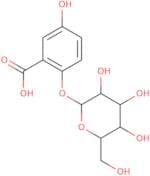
Ácido 2-(β-D-glucopiranosiloxi)-5-hidroxibenzoico

Descripción:
Ácido 2-(β-D-glucopiranosiloxi)-5-hidroxibenzoico, también conocido como glucósido de ácido salicílico, es un derivado glicosilado del ácido salicílico. Este compuesto presenta un grupo β-D-glucopiranosilo unido al grupo hidroxilo de la estructura del ácido salicílico, lo que contribuye a su solubilidad y actividad biológica. Típicamente aparece como un sólido blanco a blanco amarillento y es soluble en agua debido a la presencia del grupo glucopiranosilo. El compuesto exhibe propiedades antioxidantes y puede tener aplicaciones potenciales en farmacéuticos y cosméticos, particularmente por sus efectos antiinflamatorios y calmantes para la piel. Su estructura permite interacciones con varios sistemas biológicos, lo que lo hace de interés en la investigación relacionada con la bioquímica vegetal y la química medicinal. Además, puede estar involucrado en mecanismos de defensa de las plantas y se ha estudiado por sus posibles beneficios para la salud en humanos. Al igual que muchos compuestos fenólicos, también puede exhibir actividad antimicrobiana.
Fórmula:C13H16O9
InChI:InChI=1S/C13H16O9/c14-4-8-9(16)10(17)11(18)13(22-8)21-7-2-1-5(15)3-6(7)12(19)20/h1-3,8-11,13-18H,4H2,(H,19,20)/t8-,9-,10+,11-,13-/m1/s1
Clave InChI:InChIKey=GEZJVEGHJRPQEX-BZNQNGANSA-N
SMILES:O(C1=C(C(O)=O)C=C(O)C=C1)[C@@H]2O[C@H](CO)[C@@H](O)[C@H](O)[C@H]2O
Sinónimos:
  • Orbicularin
  • Benzoic acid, 2-(β-D-glucopyranosyloxy)-5-hydroxy-
  • 2-(β-D-Glucopyranosyloxy)-5-hydroxybenzoic acid
Ordenar por

Pureza (%)
0
100
|
0
|
50
|
90
|
95
|
100
Encontrado 1 productos.
  • 2-O-β-4C1-Glucopyranoside-2,5-dihydroxybenzoic acid

    CAS:
    <p>2-O-beta-4C1-Glucopyranoside-2,5-dihydroxybenzoic acid is a glycoside compound, which is a type of structural derivative where a sugar moiety is bonded to a non-carbohydrate functional group or aglycone. It is derived from specific plant or microbial sources through biochemical synthesis or extraction. The mode of action involves the hydrolysis of the glycosidic bond, mediated by specific enzymes, which releases the aglycone and the sugar component. This feature is crucial for its role in metabolic pathways where sugars are utilized or modified.<br><br>In scientific research, this compound is used in studying carbohydrate metabolism and enzyme activity, particularly those involving glycosidases. Due to its structural characteristics, it may serve as a model compound in understanding glycoside biosynthesis and degradation processes. Additionally, its potential applications in pharmaceuticals are being explored, especially in designing drugs that target enzymatic pathways. The compound's unique structure and reactivity make it a valuable tool in the field of biochemistry and molecular biology, offering insights into glycosidic bond interactions and transformations.</p>
    Fórmula:C13H16O9
    Pureza:Min. 95%
    Peso molecular:316.26 g/mol

    Ref: 3D-XG177981

    ne
    Descatalogado
    Producto descatalogado