Sustratos fluorogénicos
Se han encontrado 297 productos de "Sustratos fluorogénicos"
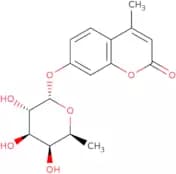
4-Methylumbelliferyl a-L-fucopyranoside
CAS:Fluorogenic substrate for fucosidaseFórmula:C16H18O7Pureza:Min. 95%Forma y color:White PowderPeso molecular:322.31 g/mol4-Methylumbelliferyl a-L-arabinofuranoside
CAS:Fluorogenic substrate for ?-arabinofuranosidase
Fórmula:C15H16O7Pureza:Min. 95%Forma y color:White PowderPeso molecular:308.28 g/mol6-Chloro-4-(trifluoromethyl)umbelliferyl β-D-cellotrioside
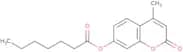
6-Chloro-4-(trifluoromethyl)umbelliferyl b-D-cellotrioside is a fluorogenic substrate for cellulases and beta-glucosidases. After hydrolisis, the fluorophore TFMU is released generating a blue fluorescence.Fórmula:C28H34ClF3O18Pureza:Min. 95%Forma y color:White to off-white powder.Peso molecular:751.01 g/mol4-Methylumbelliferyl heptanoate
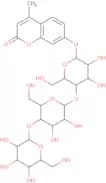
CAS:Lipase targeting MOSCERDAM® substrateFórmula:C17H20O4Pureza:Min. 95%Forma y color:White PowderPeso molecular:288.34 g/mol4-Methylumbelliferyl b-D-cellotrioside
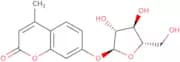
CAS:Fluorogenic cellulose analogueFórmula:C28H38O18Pureza:Min. 95%Forma y color:PowderPeso molecular:662.6 g/mol4-Methylumbelliferyl b-D-ribofuranoside
CAS:The 4-Methylumbelliferyl b-D-ribofuranoside is a top-notch fluorogenic substrate for glycosidase activity detection. Upon hydrolysis by enzymes, it generates a strongly fluorescent 4-methylumbelliferone molecule, enabling rapid assay results and real-time monitoring of enzymatic reactions. This product is suitable for many biological research applications, such as in vitro analysis, diagnostic testing, and drug discovery. With its high sensitivity and specificity, it delivers consistent and accurate results, making it an essential tool for scientists and researchers.Fórmula:C15H16O7Pureza:Min. 95%Forma y color:White PowderPeso molecular:308.28 g/mol4-Methylumbelliferyl palmitate
CAS:4-Methylumbelliferyl palmitate, commonly names as 4-MUP, is a fluorescent probe that binds to lipases, enzymes responsible to assist on the hydrolysis of fats. In diagnosis, 4-MUP is used for screening of lysosomal storage diseases (LSD) caused by a deficiency of a single enzyme involved in the metabolism of glycoproteins, lipids or mucopolysaccharides.
Fórmula:C26H38O4Pureza:Min. 95%Forma y color:White PowderPeso molecular:414.58 g/mol4-Methylumbelliferyl phosphate, free acid
CAS:A sensitive fluorogenic substrate for fluorometric and UV-spectrophotometric assays of phosphatases. It is used for the detection of C. perfringens because acid phosphatase is a highly specific indicator for C. perfringens.
Fórmula:C10H9O6PPeso molecular:256.15 g/molRef: 3D-M-5801
10gA consultar25gA consultar50gA consultar100gA consultar250gA consultar-Unit-ggA consultar4-Methylumbelliferyl N,N',N''-triacetyl-b-D-chitotrioside
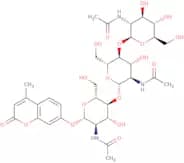
CAS:4-Methylumbelliferyl N,N',N''-triacetyl-beta-D-chitotrioside is a fluorogenic substrate for chitinase. After enzymatic cleaveage, free 4-methylumbelliferone (also known as hymecromone) is released, exhibiting blue fluorescence upon excitation with UV light. The strongest fluorescence of 4-methylumbelliferone requires deprotonation of the hydroxyl group (thus requires alkaline pH), with a maximal fluorescence intensity obtained with excitation at 350 to 370 nm and emission at 440 to 470 nm. The use of 4-methylumbelliferyl N,N',N''-triacetyl-beta-D-chitotriosideas a substrate for measuring the chitinase activity is used for fungal infection assays.Fórmula:C34H47N3O18Pureza:Min. 95.0 Area-%Forma y color:White Off-White PowderPeso molecular:785.75 g/molL-Histidine 7-amido-4-methylcoumarin hydrochloride
CAS:L-Histidine 7-amido-4-methylcoumarin hydrochloride is a synthetic peptide substrate used as a fluorogenic substrate for histidine aminopeptidase.Fórmula:C16H17ClN4O3Pureza:Min. 95%Peso molecular:348.79 g/mol4-Methylumbelliferyl 6-deoxy-2,3,4,6-tetra-O-acetyl-6-thio-β-D-glucopyranoside
4-Methylumbelliferyl 6-deoxy-2,3,4,6-tetra-O-acetyl-6-thio-beta-D-glucopyranoside is a fluorogenic substrate for beta-glucosidase. After enzymatic cleaveage, free 4-methylumbelliferone (also known as hymecromone) is released, exhibiting blue fluorescence upon excitation with UV light. The strongest fluorescence of 4-methylumbelliferone requires deprotonation of the hydroxyl group (thus requires alkaline pH), with a maximal fluorescence intensity obtained with excitation at 350 to 370 nm and emission at 440 to 470 nm. The use of 4-methylumbelliferyl 6-deoxy-2,3,4,6-tetra-O-acetyl-6-thio-beta-D-glucopyranosideas a substrate for measuring the beta-glucosidase activity is used for Gaucher disease diagnosis.Fórmula:C24H26O11SPureza:Min. 95%Forma y color:White to off-white solid.Peso molecular:522.52 g/molGlutaryl-glycyl-L-arginine 7-amido-4-methylcoumarin hydrochloride
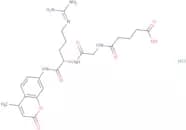
CAS:Glutaryl-glycyl-L-arginine 7-amido-4-methylcoumarin hydrochloride is a synthetic peptide substrate used as a fluorogenic substrate for aminopeptidase.
Fórmula:C23H30N6O7·HClPureza:Min. 95%Forma y color:PowderPeso molecular:538.98 g/mol4-Methylumbelliferyl caprylate
CAS:Fluorogenic substrate for esterase with C8 activity yielding a blue fluorescent solution upon cleavage. Used for the identification of Salmonella spp. based on the detection of caprylate esterase.Fórmula:C18H22O4Pureza:Min. 98 Area-%Peso molecular:302.37 g/molRef: 3D-M-5526
1gA consultar5gA consultar10gA consultar25gA consultar2500mgA consultar-Unit-ggA consultar4-Methylumbelliferyl acetate
CAS:Fluorogenic substrate for carboxylesteraseFórmula:C12H10O4Pureza:Min. 95%Forma y color:White PowderPeso molecular:218.21 g/mol4-Methylumbelliferyl b-D-cellotetraoside
CAS:A fluorogenic MOSCERDAM® substrate targeting cellulasesFórmula:C34H48O23Pureza:Min. 95%Forma y color:PowderPeso molecular:824.73 g/mol4-Methylumbelliferyl b-D-glucuronide trihydrate
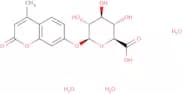
CAS:Fluorogenic substrate for beta-glucuronidase GUS
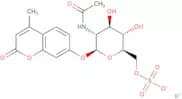
Fórmula:C16H22O12Pureza:Min. 98 Area-%Forma y color:White PowderPeso molecular:406.34 g/mol4-Methylumbelliferyl 2-acetamido-2-deoxy-β-D-glucopyranoside-6-sulfate potassium salt
CAS:4-Methylumbelliferyl 2-acetamido-2-deoxy-beta-D-glucopyranoside-6-sulfate potassium salt is a fluorogenic substrate for beta-N-acetylglucosaminidase. After enzymatic cleaveage, free 4-methylumbelliferone (also known as hymecromone) is released, exhibiting blue fluorescence upon excitation with UV light. The strongest fluorescence of 4-methylumbelliferone requires deprotonation of the hydroxyl group (thus requires alkaline pH), with a maximal fluorescence intensity obtained with excitation at 350 to 370 nm and emission at 440 to 470 nm. The use of 4-methylumbelliferyl 2-acetamido-2-deoxy-beta-D-glucopyranoside-6-sulfate potassium saltas a substrate for measuring the beta-N-acetylglucosaminidase activity is used for diagnosis of Mucopolysaccharidosis IIIB (MPS IIIB) (a rare lysosomal storage disorder) and Sanfilippo B syndrome screening.
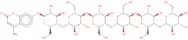
Fórmula:C18H20KNO11SPureza:Min. 95%Forma y color:White Off-White PowderPeso molecular:497.52 g/mol4-Methylumbelliferyl β-D-cellohexaoside
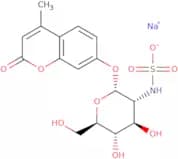
CAS:4-Methylumbelliferyl beta-D-cellohexaoside is a fluorogenic substrate for cellulase. After enzymatic cleaveage, free 4-methylumbelliferone (also known as hymecromone) is released, exhibiting blue fluorescence upon excitation with UV light. The strongest fluorescence of 4-methylumbelliferone requires deprotonation of the hydroxyl group (thus requires alkaline pH), with a maximal fluorescence intensity obtained with excitation at 350 to 370 nm and emission at 440 to 470 nm. The use of 4-methylumbelliferyl beta-D-cellohexaosideas a substrate for measuring the cellulase activity is used for detecting bacterial infection and gut microbiome analysis.Fórmula:C46H68O33Pureza:Min. 95%Forma y color:PowderPeso molecular:1,149.01 g/mol4-Methylumbelliferyl 2-deoxy-2-sulfamino-a-D-glucopyranoside sodium salt - Moscerdam™ biochemical purity
CAS:4-Methylumbelliferyl 2-deoxy-2-sulfamino-a-D-glucopyranoside sodium salt (M3A or MU-GlcNS) is a fluorogenic substrate of heparin sulfamidase, used in the diagnosis of Mucopolysaccharidosis III type A (MPS III A). MPS III A, also known as Sanfilippo syndrome type A, is caused by the deficiency of heparan N-sulfatase. Heparin sulfamidase in the assay desulfates MU-GlcNS to 4-methylumbelliferyl 2-amino-2-deoxy-α-D-glucopyranoside (MU-GlcNH2). To release fluorometrically measurable 4-methylumbelliferone (MU) and by-product glucosamine, MU-GlcNH2 is further hydrolysed by an enzyme such as yeast α-glucosidase during a second incubation.Fórmula:C16H18NO10SNaPureza:Min. 95 Area-%Forma y color:White PowderPeso molecular:439.37 g/mol4-Methylumbelliferyl-α-L-fucopyranoside
CAS:Fluorogenic substrate for α-L-Fucosidase yielding a blue fluorescent solution upon cleavage.
Fórmula:C16H18O7Peso molecular:322.32 g/mol