Enzima
Los inhibidores enzimáticos son moléculas que se unen a las enzimas y disminuyen su actividad. Estos inhibidores se utilizan ampliamente en la investigación para estudiar la cinética enzimática, la regulación y el papel de enzimas específicas en las vías metabólicas. Los inhibidores enzimáticos también son cruciales en el desarrollo de fármacos, ya que muchos agentes terapéuticos funcionan inhibiendo enzimas involucradas en procesos patológicos. Al dirigirse a las enzimas, estos inhibidores pueden modular las vías bioquímicas y ofrecer tratamientos potenciales para diversas enfermedades. En CymitQuimica, ofrecemos una amplia selección de inhibidores enzimáticos de alta calidad para apoyar su investigación en bioquímica, farmacología y descubrimiento de fármacos.
Subcategorías de "Enzima"
- Anhídrido carbónico(177 productos)
- Hidroxilasa(30 productos)
- MPO(2 productos)
- Reductasa(52 productos)
- Tirosinasa(67 productos)
Se han encontrado 3586 productos de "Enzima"
Ordenar por
Pureza (%)
0
100
|
0
|
50
|
90
|
95
|
100
Acetylcholinesterase, type VI-S, 200-1,000 units/mg protein
CAS:<p>Acetylcholinesterase is an enzyme that breaks down acetylcholine</p>Pureza:Min. 95%Forma y color:PowderCarbonic anhydrase inhibitor 12
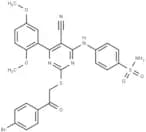
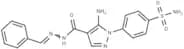
CAS:<p>CA Inhibitor 12 strongly blocks CA II (K_i 1.72 nM), also inhibits CA I (271 nM), shows anticancer effects.</p>Fórmula:C27H22BrN5O5S2Pureza:98%Forma y color:SolidPeso molecular:640.53hCAIX/XII-IN-8
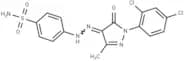
CAS:<p>hCAIX/XII-IN-8 (compound 3g) is a potent inhibitor of the human carbonic anhydrases (CAs) IX and XII, with inhibition constants (K i) of 8.5 nM for CA IX and 6.</p>Fórmula:C16H13Cl2N5O3SPureza:98%Forma y color:SolidPeso molecular:426.28hCAIX-IN-15
CAS:<p>hCAIX-IN-15 is a potent inhibitor of human carbonic anhydrase IX (hCA IX) with an inhibition constant (Ki) of 38.8 nM, exhibiting broad-spectrum anticancer</p>Fórmula:C18H14FN7O2SPureza:98%Forma y color:SolidPeso molecular:411.41CAXII-IN-1
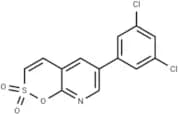
CAS:<p>CAXII-IN-1, antitumor, selectively inhibits CA XII with Ki of 3.8 nM for hCA XII and 56 nM for hCA IX.</p>Fórmula:C13H7Cl2NO3SForma y color:SolidPeso molecular:328.17ALP/Carbonic anhydrase-IN-1
CAS:<p>Compound 1e, also known as ALP/Carbonic anhydrase-IN-1, is a dual inhibitor targeting both carbonic anhydrase (CA) isozymes II, IX, and XII, as well as alkaline</p>Fórmula:C15H16N2Pureza:98%Forma y color:SolidPeso molecular:224.3COX-2-IN-30
CAS:<p>COX-2-IN-30, a benzenesulfonamide derivative, is an orally active, dual inhibitor of cyclooxygenase-2 (COX-2; IC50 = 49 nM) and cyclooxygenase-1 (COX-1; IC50 =</p>Fórmula:C17H16N6O3SPureza:98%Forma y color:SolidPeso molecular:384.41LX-1031
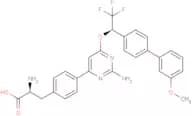
CAS:<p>LX-1031 is an effective inhibitor of tryptophan 5-hydroxylase. LX-1031 decreases serotonin (5-HT) synthesis peripherally.</p>Fórmula:C28H25F3N4O4Pureza:97.123% - 98.97%Forma y color:SolidPeso molecular:538.52hCAIX-IN-16
CAS:<p>hCAIX-IN-16 (Compound 12d), an inhibitor of hCA IX, exhibits inhibition constants (K i) of 190.0 nM for hCA IX and 187.9 nM for hCA XII.</p>Fórmula:C20H20N8O2SPureza:98%Forma y color:SolidPeso molecular:436.49N-Desethyl Brinzolamide oxalate
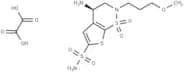
CAS:<p>N-Desethyl Brinzolamide oxalate functions as a dual inhibitor targeting Carbonic anhydrase II and Carbonic anhydrase IV, exhibiting inhibitory concentrations (IC50) of 1.28 nM and 128 nM, respectively [1].</p>Fórmula:C12H19N3O9S3Forma y color:SolidPeso molecular:445.49Diethyl-pythiDC
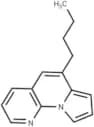
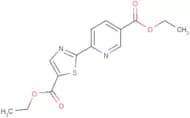
CAS:<p>Diethyl-pythiDC is an collagen prolyl 4-hydroxylase inhibitor.</p>Fórmula:C14H14N2O4SPureza:99.98%Forma y color:SolidPeso molecular:306.34Thioredoxin reductase from escherichia coli
CAS:<p>Thioredoxin reductase (TR, TrxR) (EC 1.8.1.9) is an enzyme that reduce thioredoxin using NADPH as a co-factor, and also contains FAD. One unit of thioredoxin reductase will raise increase light absorbance by 1.0 per minute at 412nm in the presence of thioredoxin and Ellman's reagent at pH 7.0 and 25 °C.</p>Pureza:Min. 95%Cholesterol oxidase from microorganisms
CAS:<p>Cholesterol oxidase (EC 1.1.3.6) is an enzyme that catalyzes the following reaction: cholesterol + O2 ⇌ cholest-4-en-3-one + H2O2One unit of cholesterol oxidase will convert 1.0 μmole of cholesterol into cholest-4-en-3-one per min at pH 7.5 and 25 °C. You can remove the build-up of hydrogen peroxide using catalase.</p>Pureza:Min. 95%Sulfatase, from helix pomatia ≥10,000 units/g solid
CAS:<p>Sulfatase from Helix pomatia is a highly potent enzyme that is capable of hydrolyzing sulfated compounds and sulfate esters. It has been widely used in various applications such as glucosinolate analysis, genistein extraction preparation, and regiospecificity studies. With a concentration of ≥10,000 units per gram of solid, this sulfatase offers exceptional enzymatic activity for sulfatase assays. It effectively catalyzes the hydrolysis of sulfated substrates, including p-nitrocatechol sulfate, naphthyl sulfate and phenyl sulfates.The enzyme can be incubated with the desired sample to facilitate the release of sulfate groups from sulfated compounds. Sulfatase from Helix pomatia is a valuable tool for researchers and scientists working in diverse fields requiring efficient and reliable enzymatic hydrolysis capabilities. Additionally the enzyme has been found to have industrial applications, such as in the bioconversion of industrial chemicals, where it can be used as a catalyst.</p>Forma y color:PowderGlycerol 3-phosphate oxidase, from pediococcus sp., 40-84U/mg
CAS:<p>Glycerol-3-phosphate oxidase (EC 1.1.3.21) is an enzyme that catalyzes the following reaction: glycerol-3-phosphate + O2 ⇌ dihydroxyacetone phosphate + H2O2 One unit of Glycerol-3-phosphate oxidase will generate 1.0 μmole H2O2 per min at 37°C, under the presence of O2 and the optimal pH. If required, you can remove the build-up of hydrogen peroxide using catalase.</p>Pureza:Min. 95%Phosphodiesterase II from bovine spleen
CAS:<p>Phosphodiesterase II from bovine spleen is an enzyme derived from the spleen of cattle, which serves as a crucial biological catalyst for the hydrolysis of phosphodiester bonds in nucleotide sequences. This enzyme's mode of action involves cleaving the phosphodiester linkages within nucleic acids, facilitating the breakdown of these macromolecules into smaller nucleotide units.</p>Pureza:Min. 95%Glycerokinase, cellulomonas species
CAS:<p>Glycerokinase (glycerol kinase, GP, ATP-glycerol 3-phosphotransferase; EC 2.7.1.30) is an enzyme that catalyzes the following reaction: ATP + glycerol ⇌ ADP + glycerol 3-phosphate One unit of Glycerokinase will convert 1.0 μmole of glycerol and ATP to glycerol 3-phosphate and ADP per min at pH 9.8 and 25 °C.</p>Forma y color:Powderp-Ethynylphenylalanine
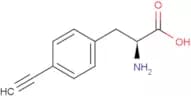
CAS:<p>p-Ethynylphenylalanine (4-Ethynyl-L-phenylalanine), a tryptophan hydroxylase (TPH) inhibitor, is competitive, effective, selective, and reversible, with a Ki of</p>Fórmula:C11H11NO2Pureza:97.57%Forma y color:SolidPeso molecular:189.21Triose phosphate isomerase
CAS:<p>Triose-phosphate isomerase (TPI, TIM; EC 5.3.1.1) is an enzyme that catalyzes the reversible isomerisation of dihydroxyacetone phosphate and D-glyceraldehyde 3-phosphate: DHAP ⇌ GADP The reaction mechanism involves the formation of an enediol intermediate. One unit of Triose-phosphate isomerase will convert 1.0 μmole glyceraldehyde 3-phosphate to dihydroxyacetone phosphate per min at pH 7.6 and 25 °C.</p>Pureza:Min. 95%Oxalate Oxidase, freeze-dried, from Wheat
CAS:<p>Oxalate Oxidase, freeze-dried, is an enzymatic preparation that serves as a catalyst in biochemical reactions. This enzyme is derived from wheat, a common plant source, ensuring a naturally occurring origin. Its primary mode of action is the oxidation of oxalate into carbon dioxide and hydrogen peroxide. This biochemical activity is significant in various scientific applications, specifically in the breakdown of oxalate, which plays a crucial role in metabolic and environmental processes.</p>Forma y color:Powder