Enzima
Subcategorías de "Enzima"
- Anhídrido carbónico(197 productos)
- Hidroxilasa(36 productos)
- MPO(2 productos)
- Reductasa(51 productos)
- Tirosinasa(71 productos)
Se han encontrado 3621 productos de "Enzima"
Protocatechuate 3,4-dioxygenase from pseudomonas sp.
CAS:Protocatechuate 3,4-dioxygenase is a bacterial enzyme, which is sourced from Pseudomonas sp. This enzyme operates by catalyzing the cleavage of aromatic rings in protocatechuate, a derivative of catechol. Its mode of action involves the incorporation of oxygen into protocatechuate, resulting in the formation of beta-carboxy-cis,cis-muconate. This reaction is crucial for the microbial degradation of aromatic compounds, thereby playing a significant role in the biodegradation pathways of lignin-derived aromatic pollutants.
Pureza:Min. 95%Glucosyltransferase Kit
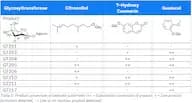
CAS:The kit contains 8 different Glucosyltransferases (GTases), which are enzymes that transfer glucose to another organic molecule (aglycon), establishing glycosidic linkage. UDP-glucose dependent GTases are part of the enzyme family of glucosyltransferases, they are versatile tools in glucosylation reactions. Different GTases have different substrate specificities, as shown on Table 1. The kit is especially designed for screening and finding the most well-suited GTase for your specific process. All GTases in the kit are also available individually for bulk purchase.
Peroxidase Kit, 2 peroxidases with different substrate specificities
Peroxidases can be utilized as enzymes catalyzing e.g. aromatic ring hydroxylation, epoxidation, halogenation, N- or S-oxidation, ether cleavage and alcohol/aldehyde oxidation reactions. The Peroxidase Kit contains 2 recombinant peroxidases of bacterial and fungal origin with a temperature optimum in the 20-40 °C range and pH optimum between pH 5 and 8.Pureza:Min. 95%Aldolase from rabbit muscle
CAS:One unit of aldolase (EC 4.1.2.13) will convert 1.0 µmol of Fructose-1,6-Diphosphate to Dihydroxyacetone phosphate and Glyceraldehyde-3-phosphate per min at 25 °C and pH 7.4. Lyophilized Powder.
Peso molecular:161 g/molRef: 3D-JAA02452
Producto descatalogadoEUCODIS® Nitrilhydratase 17, recombinant enzyme - ENH017
Nitrile hydratase 17 recombinantly expressed in E. coli comes in a freeze-dried formulation. Nitrile hydratases can be utilized to convert nitriles into their corresponding amides, e.g. to produce acrylamide from acrylonitrile. Additional applications include the removal of nitriles from industrial wastewater. Our nitrile hydratases have been tested for hydrolysis of the following substrates:cyclohexanecarbonitrile, cinnamonitrile, benzonitrile, methacrylonitrile, pivalonitrile.
EUCODIS® Nitrilhydratase 22, recombinant enzyme - ENH022
Nitrile hydratase 22 recombinantly expressed in E. coli comes in a freeze-dried formulation. Nitrile hydratases can be utilized to convert nitriles into their corresponding amides, e.g. to produce acrylamide from acrylonitrile. Additional applications include the removal of nitriles from industrial wastewater. Our nitrile hydratases have been tested for hydrolysis of the following substrates:cyclohexanecarbonitrile, cinnamonitrile, benzonitrile, methacrylonitrile, pivalonitrile.
Pureza:Min. 95%EUCODIS® Nitrilhydratase 21, recombinant enzyme - ENH021
Nitrile hydratase 21 recombinantly expressed in E. coli comes in a freeze-dried formulation. Nitrile hydratases can be utilized to convert nitriles into their corresponding amides, e.g. to produce acrylamide from acrylonitrile. Additional applications include the removal of nitriles from industrial wastewater. Our nitrile hydratases have been tested for hydrolysis of the following substrates:cyclohexanecarbonitrile, cinnamonitrile, benzonitrile, methacrylonitrile, pivalonitrile.
D-Ribulose 1,5-diphosphate carboxylase from spinach
CAS:D-Ribulose 1,5-diphosphate carboxylase, commonly known as RuBisCO, is an essential enzyme that catalyzes the first major step of carbon fixation, a process by which inorganic carbon from the atmosphere is converted into organic molecules. This enzyme is derived from spinach, a common model organism used in plant biology research due to its accessibility and well-characterized photosynthetic pathways.
Pureza:Min. 95%Urease from Canavalia ensiformis
CAS:Urease from Canavalia ensiformis (Jack bean urease, EC 3.5.1.5) is an enzyme that catalyses the following reaction: (NH2)2CO + H2O → CO2 + 2 NH3 One unit of urease will yield 1.0 µmole of NH3 from urea per min at pH 7.0 and 25 °C.
Peso molecular:480 g/molEUCODIS® Nitrilhydratase 20, recombinant enzyme - ENH020
Nitrile hydratase 20 recombinantly expressed in E. coli comes in a freeze-dried formulation. Nitrile hydratases can be utilized to convert nitriles into their corresponding amides, e.g. to produce acrylamide from acrylonitrile. Additional applications include the removal of nitriles from industrial wastewater. Our nitrile hydratases have been tested for hydrolysis of the following substrates:cyclohexanecarbonitrile, cinnamonitrile, benzonitrile, methacrylonitrile, pivalonitrile.
Pureza:Min. 95%EUCODIS® CalB02 ICE, engineered variant of Candida antarctica Lipase B, covalent immobilization on hydrophobic carrier - ELCB02ICE
Lipases belong to the family of esterases and naturally act on triglycerides at lipid-water interfaces. Lipases/esterases can be used as versatile tools in hydrolytic reactions, esterifications and transesterification reactions in industrial and food applications. The CalB02 ICE lipase has been immobilized on a hydrophobic carrier by a covalent linkage. The immobilized CalB02 lipase has a temperature optimum in the 40 - 50 °C range and pH optimum between pH 5 and 8.
EUCODIS® CalB01, engineered variant of Candida antarctica Lipase B - ELCB01
Lipases belong to the family of esterases and naturally act on triglycerides at lipid-water interfaces. Lipases/esterases can be used as versatile tools in hydrolytic reactions, esterifications and transesterification reactions in industrial and food applications. The CalB01 lipase has a temperature optimum in the 40 - 50 °C range and pH optimum between pH 5 and 8.
Aspartic acid proteinase
CAS:Aspartic acid proteinase is a type of proteolytic enzyme, which originates from various biological sources including humans, fungi, and plants. It is characterized by its action via two critical aspartic acid residues in the active site, which facilitate the hydrolysis of peptide bonds in proteins. This enzyme operates optimally in acidic environments, making it crucial in processes like digestion and protein processing within cellular compartments such as lysosomes.
Ref: 3D-JAA07379
Producto descatalogadoEUCODIS® CalB01 ICE, engineered variant of Candida antarctica Lipase B, covalent immobilization on hydrophobic carrier - ELCB01ICE
Lipases belong to the family of esterases and naturally act on triglycerides at lipid-water interfaces. Lipases/esterases can be used as versatile tools in hydrolytic reactions, esterifications and transesterification reactions in industrial and food applications. The CalB01 ICE lipase has been immobilized on a hydrophobic carrier by a covalent linkage. The immobilized CalB01 lipase has a temperature optimum in the 40 - 50 °C range and pH optimum between pH 5 and 8.EUCODIS® CalB02 IA, engineered variant of Candida antarctica Lipase B, immobilized by adsorption on hydrophobic carrier - ELCB02IA
Lipases belong to the family of esterases and naturally act on triglycerides at lipid-water interfaces. Lipases/esterases can be used as versatile tools in hydrolytic reactions, esterifications and transesterification reactions in industrial and food applications. The CalB02 IA lipase has been immobilized on a hydrophobic carrier by adsorption. The immobilized CalB02 lipase has a temperature optimum in the 40 - 50 °C range and pH optimum between pH 5 and 8.
Amylase protein
Alpha Amylase (Amylase, α-Amylase, 1,4-α-D-glucan glucanohydrolase, glycogenase, ptyalin; systematic name 4-α-D-glucan glucanohydrolase; EC 3.2.1.1, CAS Number [9000-90-2]) is an enzyme that catalyses hydrolysis of large polysacharides into smaller fragments. Alpha amylase targets alpha bonds of 1→4 glycosidic linkages of poly- and oligosaccharides with three or more D-glucose units. One unit of Alpha Amylase will catalyze the hydrolysis of 1.0 μmol of 2-chloro-4-nitrophenyl-α-D-maltotrioside to yield 2-chloro-4-nitrophenol per minute at 37°C. Human salivary Alpha Amylase is supplied as clear, colorless liquid solution at ≥2000U/mL, specific activity ≥200 U/mg protein. Store at -20°C on arrival.Pureza:Min. 95%Lipase Kit, 25 unique EUCODIS® lipases, recombinant - EL Kit
Lipases belong to the family of esterases and naturally act on triglycerides at lipid-water interfaces. Lipases/esterases can be used as versatile tools in hydrolytic reactions, esterifications and transesterification reactions in industrial and food applications. The Lipase kit contains 25 lipases with different pH and temperature optima and substrate specificity properties.
Creatinase
Creatinase is an enzyme (EC 3.5.3.3) that catalyzes the conversion of creatine to sarcosine and urea.Lipase 077, acidic lipase - recombinant
Lipase 77 recombinantly expressed in P. pastoris comes in a spray-dried formulation. It has its pH optimum at 4-5. Lipases belong to the family of esterases and naturally act on triglycerides at lipid-water interfaces catalyzing hydrolytic reactions, esterifications and transesterification reactions in industrial and food applications. Lipase 77 was shown to hydrolyze p-Nitrophenyl esters of butyrate and triglycerides.
L-Methionine γ-lyase
CAS:A pyridoxal phosphate-containing enzyme that converts L-methionine to α-ketobutyrate, ammonia and methyl mercaptan. Recombinant from e.coli source.
EC 4.4.1.11Pureza:Min. 95%