Transportador de membrana / canal de iones
Los inhibidores de transportadores de membrana y canales iónicos son compuestos que bloquean la función de proteínas responsables del transporte de iones, nutrientes y otras moléculas a través de las membranas celulares. Estos inhibidores son cruciales para estudiar la regulación de la homeostasis celular, la transducción de señales y la neurotransmisión. Los inhibidores de transportadores de membrana y canales iónicos también son importantes para desarrollar tratamientos para trastornos como la epilepsia, las enfermedades cardiovasculares y los síndromes metabólicos. En CymitQuimica, ofrecemos una amplia selección de inhibidores de alta calidad de transportadores de membrana y canales iónicos para apoyar su investigación en fisiología, neurociencia y farmacología.
Subcategorías de "Transportador de membrana / canal de iones"
- ABC(3 productos)
- ATPasa(93 productos)
- Receptor de adiponectina(5 productos)
- CFTR(64 productos)
- Receptor CGRP(51 productos)
- Canal de calcio(493 productos)
- Canal de cloruro(49 productos)
- Receptor GABA(336 productos)
- Transportador de monoamina(23 productos)
- Transportador de monocarboxilato(17 productos)
- NKCC(2 productos)
- NPC1L1(3 productos)
- Cotransportador de Na-K-Cl(8 productos)
- OAT(27 productos)
- OCT(7 productos)
- P-gp(53 productos)
- Canal de potasio(276 productos)
- Bomba de protones(39 productos)
- SGLT(30 productos)
- Canal de sodio(202 productos)
- Canal TRP / TRPV(92 productos)
Mostrar 13 subcategorías más
Se han encontrado 2270 productos de "Transportador de membrana / canal de iones"
Ordenar por
Pureza (%)
0
100
|
0
|
50
|
90
|
95
|
100
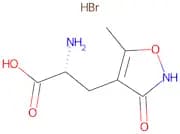
(RS)-AMPA hydrobromide
CAS:<p>AMPAR agonist</p>Fórmula:C7H11BrN2O4Pureza:98%Forma y color:SolidPeso molecular:267.08KV1.3-IN-2
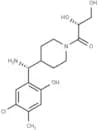
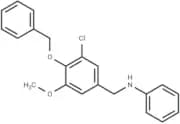
CAS:<p>KV1.3-IN-2 (Compound I) selectively inhibits the kv1.3 potassium channel without affecting the hERG channel. It is applicable in research related to immune-associated diseases such as psoriasis, rheumatoid arthritis, and systemic lupus erythematosus.</p>Fórmula:C16H23ClN2O4Forma y color:SolidPeso molecular:342.818Opakalim
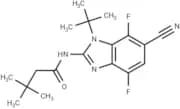
CAS:<p>Opakalim is an activator of potassium channels (potassium channel) and exhibits anticonvulsant activity.</p>Fórmula:C18H22F2N4OForma y color:SolidPeso molecular:348.39WS-898
<p>WS-898 boosts paclitaxel efficacy in resistant cells by inhibiting ABCB1; IC50: SW620/Ad300 - 5.0 nM, KB-C2 - 3.67 nM, HEK293/ABCB1 - 3.68 nM.</p>Fórmula:C33H25N7OSForma y color:SolidPeso molecular:567.66Blixeprodil
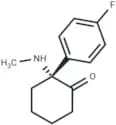
CAS:<p>Blixeprodil (GM-1020) is an orally active NMDA receptor antagonist with an affinity of Ki = 3.25 µM in rat cortical tissue. It inhibits NR1/2A-NMDAR-mediated currents in HEK293 cells with an IC50 of 1.192 µM. Blixeprodil demonstrates antidepressant effects in rat models and exhibits blood-brain barrier permeability.</p>Fórmula:C13H16FNOForma y color:SolidPeso molecular:221.271IAA65
CAS:<p>IAA65 is a potent inhibitor of T-type calcium channels, exhibiting an IC50 value of 18.9 μM, and holds potential for use in epilepsy research [1].</p>Fórmula:C16H13F6NO2Forma y color:SolidPeso molecular:365.27VU0463271 quarterhydrate
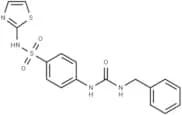
<p>VU0463271 quarterhydrate is a potent KCC2 antagonist, with an IC 50 of 61 nM [1].</p>Fórmula:C19H20N4O2S2Forma y color:SolidPeso molecular:387V-ATPase-IN-1
CAS:<p>V-ATPase-IN-1 (Compound 3b-03) is an inhibitor of Vacuolar-type H+-ATPases (V-ATPase), exhibiting an inhibition constant (IC50) of 194.80 μM and effectively targeting the V-ATPase subunit A with a dissociation constant (Kd) of 0.803 μM. This compound demonstrates insecticidal activity against M. separata (LC50 = 2.64 mM), aiding in the development of chemical insecticides.</p>Fórmula:C21H20ClNO2Forma y color:SolidPeso molecular:353.84(S)-Albuterol
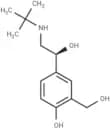
CAS:<p>(S)-Albuterol functions as a muscarinic receptor and phospholipase C activator, enhancing the intracellular free calcium concentration in airway smooth muscle cells.</p>Fórmula:C13H21NO3Forma y color:SolidPeso molecular:239.311Lubeluzole dihydrochloride
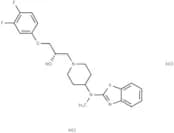
CAS:<p>Lubeluzole (dihydrochloride) acts as a neuroprotective agent by blocking neuronal voltage-gated sodium channels and also affects cardiac sodium channels, exhibiting both tonic and blocking effects. This compound is considered promising in the research of antiarrhythmic agents.</p>Fórmula:C22H27Cl2F2N3O2SForma y color:SolidPeso molecular:506.44Kv7.2/Kv7.3 activator-1
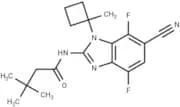
CAS:<p>Kv7.2/Kv7.3 Activator-1 (compound 517) serves as a powerful activator of the Kv7.2/Kv7.3 channels, exhibiting an EC50 value of less than 1 µM. It holds potential for use in neurological disease research.</p>Fórmula:C19H22F2N4OForma y color:SolidPeso molecular:360.40PF-05661014
CAS:<p>PF-05661014, a demethylated analogue of PF-06526290, selectively inhibits Nav1.3 and Nav1.7 currents by stabilizing the inactivated state through interaction with the D4 VSD. This compound is utilized in research focused on sodium channel modulation.</p>Fórmula:C17H16N4O3S2Forma y color:SolidPeso molecular:388.46CFTR corrector 16
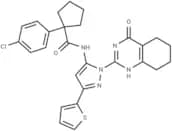
CAS:<p>CFTRcorrector 16 (Compound 39) is a corrector of the cystic fibrosis transmembrane conductance regulator (CFTR), utilized in the research of cystic fibrosis disease.</p>Fórmula:C27H26ClN5O2SForma y color:SolidPeso molecular:520.05SP100030 analogue 1
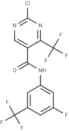
CAS:<p>SP100030 analogue 1 (compound 11) is a selective transcription activation (SITA) inhibitor within the SP100030 class, capable of inhibiting XPO1-dependent upregulation of IL2 in a Jurkat-based IL2-Luc reporter assay, with an EC50 of 137 nM.</p>Fórmula:C13H5ClF7N3OForma y color:SolidPeso molecular:387.64CFTR corrector 15
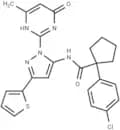
CAS:<p>CFTR Corrector 15 (Compound 4172) serves as a corrector for cystic fibrosis transmembrane conductance regulator (CFTR). When used in combination with VX-809, it addresses the folding defects of F508del-CFTR. CFTR Corrector 15 is also applicable in the research of cystic fibrosis.</p>Fórmula:C24H22ClN5O2SForma y color:SolidPeso molecular:479.98(2S,3S,11bR)-Dihydrotetrabenazine
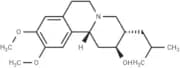
CAS:<p>(2S,3S,11bR)-Dihydrotetrabenazine ((2S,3S,11bR)-DHTBZ) is a highly selective inhibitor of vesicular monoamine transporter 2 (VMAT2) with a Ki value of 593 nM. It suppresses the vesicular transport of monoamine neurotransmitters, such as dopamine and serotonin, leading to reduced release into the synaptic cleft. This compound holds potential for research in Huntington's disease and other hyperkinetic movement disorders.</p>Fórmula:C19H29NO3Forma y color:SolidPeso molecular:319.44S 0960
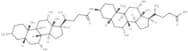
CAS:<p>S 0960 is a dimeric bile acid analogue, a specific inhibitor of the sodium-dependent bile salt transporter in the ileum, used in metabolic disease research.</p>Fórmula:C48H79NO8Pureza:99.32% - >99.99%Forma y color:SolidPeso molecular:798.14Caramboxin
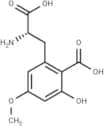
CAS:<p>Caramboxin, a neurotoxin, can induce acute kidney injury.</p>Fórmula:C11H13NO6Forma y color:SolidPeso molecular:255.22Dehydroindapamide
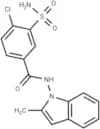
CAS:<p>Dehydroindapamide, an indole form of Indapamide, is utilized to quantify the turnover rate of Indapamide in CYP3A4, which is approximately 10 times higher than that of Indoline, with slightly enhanced affinity for CYP3A4.</p>Fórmula:C16H14ClN3O3SForma y color:SolidPeso molecular:363.82Perfluoroheptanesulfonic acid
CAS:<p>Perfluoroheptanesulfonic acid (1-Perfluoroheptanesulfonic acid; Perfluoroheptanesulphonic acid) is a perfluoroalkyl substance (PFAS). This compound has been detected in landfill leachate and has been shown to induce deformities in zebrafish larvae (EC50=168.1 μM). Exposure to PFHpS in fetuses can lead to reduced birth weight.</p>Fórmula:C7HF15O3SForma y color:SolidPeso molecular:450.12