Lipasa
Se han encontrado 107 productos de "Lipasa"
RHC 80267
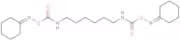
CAS:RHC 80267 (U-57908) is a selective inhibitor of DAGL (IC50 : 4 μM in canine platelets)Fórmula:C20H34N4O4Pureza:99.54%Forma y color:White SolidPeso molecular:394.51Atglistatin
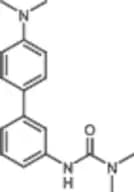
CAS:Atglistatin: ATGL inhibitor, IC50 ~0.7 μM, inhibits lipolysis, non-toxic up to 50 μM.Fórmula:C17H21N3OPureza:97.2% - 99.01%Forma y color:SolidPeso molecular:283.37Ref: TM-T1875
2mg38,00€5mg57,00€1mL*10mM (DMSO)63,00€10mg98,00€25mg178,00€50mg333,00€100mg525,00€500mg1.125,00€WWL70
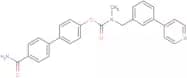
CAS:WWL70 is a selective alpha/beta hydrolase domain 6 inhibitors (IC50: 70 nM).Fórmula:C27H23N3O3Pureza:98.38% - 98.53%Forma y color:SolidPeso molecular:437.49XEN445
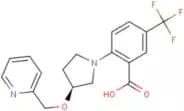
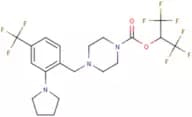
CAS:XEN445, a potent and selective endothelial lipase(EL) inhibitor (IC50=0.237 uM), exhibitis good ADME and PK properties.Fórmula:C18H17F3N2O3Pureza:99.47% - 99.6%Forma y color:SolidPeso molecular:366.33ABX-1431
CAS:ABX-1431 (Elcubragistat) is a selective and orally available CNS-penetrant monoacylglycerol lipase (MAGL/MGLL) inhibitor (IC50: 14 nM).Fórmula:C20H22F9N3O2Pureza:99.8% - 99.96%Forma y color:SolidPeso molecular:507.39Ibrolipim
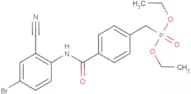
CAS:Ibrolipim (NO-1886) attenuates high glucose-induced endothelial dysfunction in cultured human umbilical vein endothelial cells via PI3K/Akt pathway.Fórmula:C19H20BrN2O4PPureza:98.04%Forma y color:SolidPeso molecular:451.25HSL-IN-3
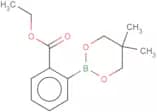
CAS:HSL-IN-3 (HSL inhibitor 3) is a boronic acid derivative that is an inhibitor of hormone-sensitive lipase(HSL).Fórmula:C14H19BO4Pureza:99.402%Forma y color:SolidPeso molecular:262.11JZL 184
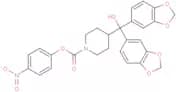
CAS:JZL 184 is a potent and selective inhibitor of MAGL with IC50 of 8 nM and 4 μM for inhibition of MAGL and FAAH in mouse brain membranes respectively.Fórmula:C27H24N2O9Pureza:97.56% - 99.31%Forma y color:SolidPeso molecular:520.49MJN110
CAS:MJN110 (Cravatt Reagent) is a potent and selective MAGL inhibitor. MJN110 Produces Opioid-Sparing Effects in a Mouse Neuropathic Pain Model.Fórmula:C22H21Cl2N3O4Pureza:99.406%Forma y color:SolidPeso molecular:462.33Lipase 001
CAS:Lipases belong to the family of esterases and naturally act on triglycerides at lipid-water interfaces. Lipases/esterases can be used as versatile tools in hydrolytic reactions, esterifications and transesterification reactions in industrial and food applications.
EUCODIS® Lipase 006, screening grade, recombinant, from microbial sources - EL006
Lipase 06 recombinantly expressed in E. coli comes in a freeze-dried formulation. It has its pH optimum at 7 and temp. optimum at 30-45°C. Lipases belong to the family of esterases and naturally act on triglycerides at lipid-water interfaces catalyzing hydrolytic reactions, esterifications and transesterification reactions in industrial and food applications. Lipase 06 was shown to hydrolyze p-Nitrophenyl esters of butyrate (91 % activity compared to octanoate), octanoate (100 %), laurate (13 %), palmitate (1 %), stearate (2 %), arachidate (0.3 %) and behenate (1 %).EUCODIS® Lipase 056, screening grade, recombinant, from microbial sources - EL056
Lipase 56 recombinantly expressed in E. coli comes in a spray-dried formulation. It has its pH optimum at 8 and temp. optimum at 40-50°C. Lipases belong to the family of esterases and naturally act on triglycerides at lipid-water interfaces catalyzing hydrolytic reactions, esterifications and transesterification reactions in industrial and food applications. Lipase 56 was shown to hydrolyze p-Nitrophenyl esters of butyrate (79 % activity compared to octanoate), octanoate (100 %), laurate (51 %), palmitate (29 %), stearate (15 %), arachidate (0.2 %) and behenate (0.1 %).Lipase 065
CAS:Lipases belong to the family of esterases and naturally act on triglycerides at lipid-water interfaces. Lipases/esterases can be used as versatile tools in hydrolytic reactions, esterifications and transesterification reactions in industrial and food applications.Lipase 004
CAS:Lipases belong to the family of esterases and naturally act on triglycerides at lipid-water interfaces. Lipases/esterases can be used as versatile tools in hydrolytic reactions, esterifications and transesterification reactions in industrial and food applications.Lipase 016
CAS:Lipases belong to the family of esterases and naturally act on triglycerides at lipid-water interfaces. Lipases/esterases can be used as versatile tools in hydrolytic reactions, esterifications and transesterification reactions in industrial and food applications.
Lipase 070
CAS:Lipases belong to the family of esterases and naturally act on triglycerides at lipid-water interfaces. Lipases/esterases can be used as versatile tools in hydrolytic reactions, esterifications and transesterification reactions in industrial and food applications.Lipase 020
CAS:Lipases belong to the family of esterases and naturally act on triglycerides at lipid-water interfaces. Lipases/esterases can be used as versatile tools in hydrolytic reactions, esterifications and transesterification reactions in industrial and food applications.Lipase 067
CAS:Lipases belong to the family of esterases and naturally act on triglycerides at lipid-water interfaces. Lipases/esterases can be used as versatile tools in hydrolytic reactions, esterifications and transesterification reactions in industrial and food applications.
Lipase 056
CAS:Lipases belong to the family of esterases and naturally act on triglycerides at lipid-water interfaces. Lipases/esterases can be used as versatile tools in hydrolytic reactions, esterifications and transesterification reactions in industrial and food applications.
EUCODIS® Lipase 020, screening grade, recombinant, from microbial sources - EL020
Lipase 20 recombinantly expressed in P. pastoris comes in a spray-dried formulation. It has its pH optimum at 7-8. Lipases belong to the family of esterases and naturally act on triglycerides at lipid-water interfaces catalyzing hydrolytic reactions, esterifications and transesterification reactions in industrial and food applications. Lipase 20 was shown to hydrolyze p-Nitrophenyl esters of butyrate (3 % activity compared to octanoate), octanoate (100 %), laurate (85 %), palmitate (52 %), stearate (29 %), arachidate (22 %) and behenate (8 %).