Beta amiloide
Beta amyloid inhibitors are compounds that specifically target and inhibit the formation or aggregation of beta-amyloid peptides, which are critically involved in the pathogenesis of Alzheimer's disease. The accumulation of beta-amyloid plaques in the brain is one of the key pathological features of Alzheimer's, contributing to neuronal dysfunction, synaptic loss, and cognitive decline. By preventing the aggregation of beta-amyloid, these inhibitors are being actively researched as potential therapeutic agents aimed at slowing down or even halting the progression of Alzheimer's disease. At CymitQuimica, we offer a variety of high-quality beta-amyloid inhibitors to support your research in neurodegenerative disorders, protein aggregation, and the development of Alzheimer's therapies.
Se han encontrado 276 productos para "Beta amiloide".
Filtrar por
Porcentaje de pureza
0
100
|
0
|
50
|
90
|
95
|
100
- Precio más bajo
- Precio más alto
- Pureza más baja
- Pureza más alta
- Entrega estimada más rápida
β-Amyloid(1-42), human, Ala-13C3,15N trifluoroacetic acid
β-Amyloid(1-42), human, Ala-13C3,15N trifluoroacetic acid is a β-Amyloid (1-42), human marked with 13C and 15N. This unprocessed HFIP peptide comprises 42 amino acids and is a brain-permeable amyloid fragment, useful for researching Alzheimer's and Down syndrome. In monomer form, β-Amyloid (1-42), human provides antioxidant and neuroprotective effects. Upon HFIP monomerization and DMSO solvent preparation, it forms soluble oligomers (AβOs) at 4°C, which exhibit synaptotoxicity and neurotoxicity, while at 37°C it forms insoluble fibrils with lower neurotoxicity, involved in oxidative damage. Aβ42 oligomers interact with neuronal surface receptors such as PrPc, mGluR5, and NMDA receptor, activating signaling pathways that induce oxidative stress, calcium imbalance, synaptotoxicity, leading to neuronal dysfunction and death.QSH peptide
CAS:The QSH peptide is a polypeptide that specifically binds to Aβ1-42, and is employed in the synthesis of siRNA delivery complexes. It is applicable in research related to Alzheimer's disease (AD).Fórmula:C62H95N21O18Forma y color:SolidPeso molecular:1422.55Amyloid β-Protein (1-46)
CAS:Amyloid β-Protein (1-46) is a segment of the Aβ peptide.Fórmula:C223H347N59O65SForma y color:SolidPeso molecular:4923.53817Amyloid β-Protein (16-22)
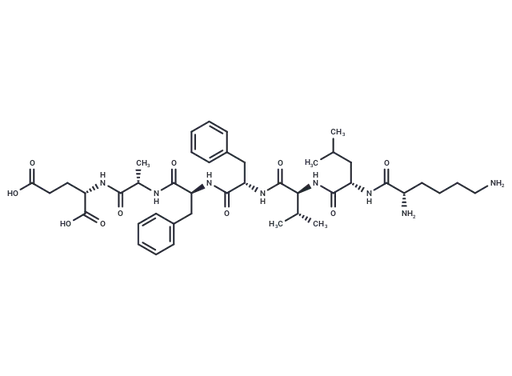
CAS:Amyloid β-Protein (16-22) is a segment of the Aβ peptide.Fórmula:C43H64N8O10Peso molecular:853.02APP669-711
APP669-711 is a peptide fragment comprising amino acids 669 to 711 of the amyloid precursor protein (APP). This peptide serves as a biomarker in Alzheimer's disease (AD) research and is useful for diagnosing amyloid deposition in the brain.Fórmula:C210H325N57O61S2Peso molecular:4685.35229Davunetide acetate
Davunetide acetate is derived from activity-dependent neuroprotective protein existing in the mammalian CNS.Fórmula:C38H64N10O14Pureza:99.52% - 99.78%Forma y color:SolidPeso molecular:884.97(Gln22)β-Amyloid (1-40) human
(Gln22)β-Amyloid (1-40) human is a peptide containing amyloid β-protein (Aβ), which can be utilized in Alzheimer's disease research.Fórmula:C194H296N54O57SPeso molecular:4326.16441Aducanumab
CAS:Aducanumab (BIIB037) is an IgG1 antibody targeting amyloid beta to treat Alzheimer's; it's brain-permeable.Pureza:95% - 97.7% (SDS-PAGE); 98.1% (SEC-HPLC)Forma y color:Transparent LiquidPeso molecular:145.93 kDa (Predicted)β-Amyloid (10-20)
CAS:Amyloid β-Protein (10-20) is a fragment of Amyloid-β peptide, maybe used in the research of neurological disease.Amyloid β protein fragment containing the α-Fórmula:C71H99N17O16Pureza:98%Forma y color:Lyophilized PowderPeso molecular:1446.65β-Amyloid (33-40)
CAS:β-Amyloid (33-40) is a peptide comprising amino acids 33 to 40 of the beta-amyloid protein.Fórmula:C32H58N8O9SPureza:98%Forma y color:SolidPeso molecular:730.92Amilo-5MER sodium salt
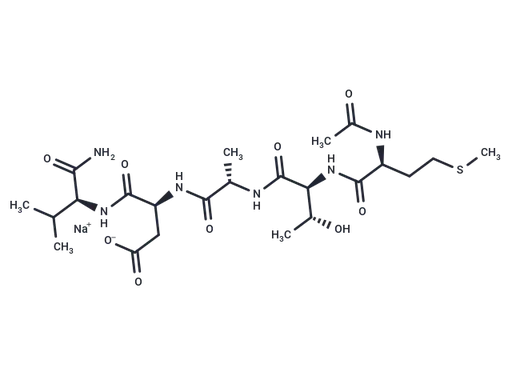
Amilo-5MER sodium salt is an oral SAA inhibitor that reduces IL-6 and IL-1β release and is used in inflammation research.Fórmula:C23H39N6NaO9SPureza:99.28%Peso molecular:598.65β-Amyloid (22-35)
CAS:β-Amyloid (22-35) is a 14-aa peptide, shows aggregates and induces neurotoxicity in the hippocampal cells.Fórmula:C59H102N16O21SPureza:98%Forma y color:SolidPeso molecular:1403.62Nivegacetor
CAS:Nivegacetor(RG6289) is a selective and orally administrable γ-secretase regulator that can affect the production of amyloid-β in cerebrospinal fluid.Fórmula:C23H25F2N7O2Pureza:99.84%Forma y color:Yellow SolidPeso molecular:469.49CCKBR agonist-1
CAS:CCKBRagonist-1 (Compound 3r1) is a selective agonist for the cholecystokinin B receptor (CCKBR) that preferentially activates the Gq protein, with an EC50 of 35 pM. It significantly enhances neuronal survival at an EC50 of 37 pM. CCKBRagonist-1 improves cognitive decline in mice by upregulating α-secretase (ADAM10) and the calcium signaling molecule PLCB4, reduces the number of amyloid β (Aβ) plaques, and promotes long-term potentiation (LTP). This compound is useful for Alzheimer's disease research.Fórmula:C32H39BrN6O7Peso molecular:699.6Glimepiride-D4-1
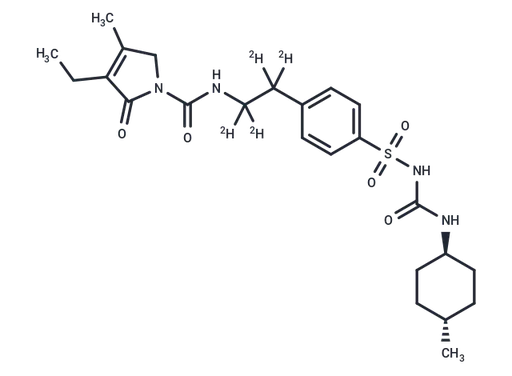
CAS:Glimepiride-D4-1 is the deuterated form of Glimepiride. Glimepiride (T0127) (Glimperide) is an antidiabetic compound belonging to the medium- to long-acting sulfonylurea class, with an ED50 of 182 μg/kg.Fórmula:C24H34N4O5SPeso molecular:494.64(Gly22)-amyloid β-protein(1-40)
CAS:Amyloid beta-protein(1-40) Arctic variant (Ab40ARC (E22G)), featuring a glycine at position 22 (Gly22), is a peptide utilized in Alzheimer's disease research [1Forma y color:Solid(Pyr3)-Amyloid β-Protein (3-42)
CAS:(Pyr3)-Amyloid β-Protein (3-42) is the predominant amyloid β peptide structure found deposited in the brains of individuals with Alzheimer's disease and Down syndrome. It is thought that (Pyr3)-Amyloid β-Protein (3-42) accumulates in the brain, leading to the formation of insoluble amyloid β-peptide deposits.Fórmula:C196H299N53O55SForma y color:SolidPeso molecular:4307.194985-TAMRA-Amyloid β-Protein (1-40)
CAS:5-TAMRA-Amyloid β-Protein (1-40) is a TAMRA-labeled variant of Amyloid β-Protein (1-40), featuring an absorption/emission spectrum at 544/572 nm [1].Forma y color:SolidDonanemab (Mouse IgG2a)
Donanemab (Mouse IgG2a) is a mouse-derived IgG2a monoclonal antibody targeting a specific N-terminal epitope of amyloid-β (Aβ) associated with Alzheimer’s disease. Donanemab not only prevents the deposition and accumulation of Aβ plaques but also targets existing amyloid plaques to promote the clearance of amyloid burden in the brain. Donanemab can be used in research on Alzheimer’s disease.Pureza:95%Peso molecular:146.3 kDa (Predicted)1H-Indole-3-carboxylic acid, 5-[2-hydroxy-3-[[2-hydroxy-1,1-bis(hydroxymethyl)ethyl]amino]propoxy]-2-methyl-1-(4-methylphenyl)-, ethyl ester
CAS:Compound 5936-0108对β-淀粉样蛋白可能具有调节作用。Fórmula:C26H34N2O7Pureza:99.33%Forma y color:SoildPeso molecular:486.5574