PKA
La proteína quinasa A (PKA) es una enzima clave en la cascada de señalización de los GPCR, activada por el AMP cíclico (cAMP) en respuesta a diversas señales extracelulares. La PKA regula una amplia gama de procesos celulares, incluidos el metabolismo, la expresión génica y el crecimiento celular. La desregulación de la actividad de la PKA está asociada con diversas enfermedades, como el cáncer, trastornos metabólicos y afecciones cardiovasculares. Los moduladores de PKA son herramientas valiosas en la investigación dirigida a comprender las vías de señalización de GPCR y desarrollar nuevas estrategias terapéuticas. En CymitQuimica, ofrecemos una selección de moduladores de PKA de alta calidad para apoyar su investigación en transducción de señales, regulación celular y mecanismos de enfermedades.
Se han encontrado 63 productos para "PKA".
Ordenar por
Pureza (%)
0
100
|
0
|
50
|
90
|
95
|
100
Malantide acetate(86555-35-3 free base)
Malantide acetate is a dodecapeptide phosphorylated by cyclic AMP-dependent protein kinase (PKA), and increases PKA activity.Malantide is a synthetic peptideFórmula:C74H128N22O23Pureza:>99.99%Forma y color:SolidPeso molecular:1693.97H-89 dihydrochloride
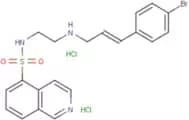
CAS:H-89 dihydrochloride (5-Isoquinolinesulfonamide) is a potent inhibitor of protein kinase A (PKA; IC50: 0.14 μM, Ki: 48 nM).Fórmula:C20H20BrN3O2S·2HClPureza:98.22% - >99.99%Forma y color:SolidPeso molecular:519.28Ref: TM-T6250
5mg37,00€1mL*10mM (DMSO)50,00€10mg55,00€25mg101,00€50mg192,00€100mg326,00€200mg485,00€500mg772,00€Metadoxine
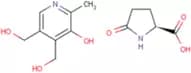
CAS:Metadoxine (Metadoxil) is a neurotransmitter stimulant.Fórmula:C8H11NO3·C5H7NO3Pureza:99.19%Forma y color:Off-White PowderPeso molecular:298.29H-8 hydrochloride
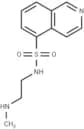
CAS:H-8 hydrochloride is a reversible and ATP-competitive PKA inhibitor. It can be used to study metabolic diseases.Fórmula:C12H17Cl2N3O2SPureza:99.93%Forma y color:White To Off-White Crystalline SolidPeso molecular:338.256-Bn-cAMP
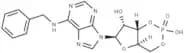
CAS:6-Bn-cAMP is a selective activator of cAMP-dependent protein kinase (PKA) that does not activate Epac. Compared to cAMP, 6-Bn-cAMP enhances hydrolytic stability against PDE, esterases, and amidases, and significantly increases membrane permeability.Fórmula:C17H18N5O6PForma y color:SolidPeso molecular:419.338-Chloro-cAMP sodium
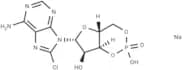
CAS:8-Chloro-cAMP sodium is a cAMP analog that induces growth arrest and modulates cAMP-dependent PKA activity. This compound also exhibits anticancer activity.Fórmula:C10H10ClN5NaO6PForma y color:SolidPeso molecular:385.638-MA-cAMP
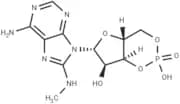
CAS:8-MA-cAMP (8-Methylamino-cAMP) is a cyclic adenosine monophosphate analog that acts as a site-selective PKA agonist, exhibiting similar affinity for the B site of both Type I and Type II protein kinase A. When used in conjunction with analogs that preferentially target site A, such as 8-piperidinyl cAMP, 8-MA-cAMP facilitates selective stimulation of Type I enzymes.Fórmula:C11H15N6O6PForma y color:SolidPeso molecular:358.25BGC201531
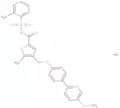
CAS:BGC201531 (AP-1531) is a EP4 antagonist for the treatment of acute migraine.Fórmula:C26H28N2O6SPureza:98.51% - 99.33%Forma y color:SolidPeso molecular:496.58Rp-cAMPS triethylammonium salt
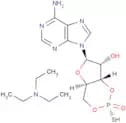
CAS:Rp-cAMPS triethylammonium salt is a competitive inhibitor of cAMP-dependent protein kinase I and II.Fórmula:C16H27N6O5PSPureza:98%Forma y color:SolidPeso molecular:446.46FMP-API-1
CAS:FMP-API-1 is an inhibitor of the A-kinase anchoring protein (AKAP)-PKA interaction. It binds to the allosteric site of the PKAR subunit, enhancing the activity of PKA and AQP2 in PKA knockout cell lines of the renal cortex collecting duct (mpkCCD cells). FMP-API-1 holds potential for studying nephrogenic diabetes insipidus (NDI).Fórmula:C13H14N2O2Forma y color:SolidPeso molecular:230.262PET-cGMP
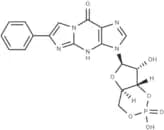
CAS:PET-cGMP is an analogue of cyclic guanosine monophosphate and functions as a potent, selective agonist for PKGI. It exhibits an EC50 of 3.8 nM for PKGIβ and 193 nM for PKGII.Fórmula:C18H16N5O7PForma y color:SolidPeso molecular:445.3238-Br-cGMP-AM
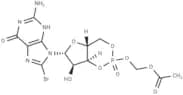
CAS:8-Br-cGMP-AM, a derivative of 8-Br-cGMP, acts as an activator of PKG (cGMP-dependent protein kinase), inducing various biological effects such as vasodilation and platelet inhibition. This compound is utilized in the research of cardiovascular diseases.Fórmula:C13H15BrN5O9PForma y color:SolidPeso molecular:496.16Protein kinase inhibitor 7
CAS:Protein kinase inhibitor 7 functions as an inhibitor of protein kinase A (PKA) and protein kinase C (PKC). It impacts the autocrine motility factor (AMF) signaling pathway without affecting cell motility.Fórmula:C12H15N3O2SPeso molecular:265.33