Antibacteriano
Los inhibidores antibacterianos son compuestos que atacan las células bacterianas, inhibiendo su crecimiento o matándolas directamente. Estos inhibidores son esenciales en el desarrollo de tratamientos para infecciones bacterianas y se utilizan ampliamente en la investigación para estudiar la fisiología bacteriana, los mecanismos de resistencia y la eficacia de nuevos agentes antibacterianos. En CymitQuimica, ofrecemos una gama de inhibidores antibacterianos para apoyar su investigación en microbiología, enfermedades infecciosas y desarrollo de medicamentos.
Se han encontrado 3207 productos de "Antibacteriano"
Ordenar por
Pureza (%)
0
100
|
0
|
50
|
90
|
95
|
100
InhA-IN-7
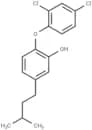
CAS:<p>InhA-IN-7 (Compound 11), a derivative of Triclocan, shows inhibitory activity against enoyl-acyl carrier protein reductase (InhA) with an IC50 of 96 nM. It effectively inhibits the proliferation of both wildtype and mutant strains of Mycobacterium tuberculosis, exhibiting minimum inhibitory concentrations (MICs) ranging from 19 to 75 μM [1].</p>Fórmula:C17H18Cl2O2Forma y color:SolidPeso molecular:325.23Antifungal agent 27
<p>Antifungal agent 27 shows moderate action against MRSA, weak against C. albicans, with MICs of 8 μg/mL and 32 μg/mL, respectively.</p>Fórmula:C18H23N5OSForma y color:SolidPeso molecular:357.47Antibacterial agent 281
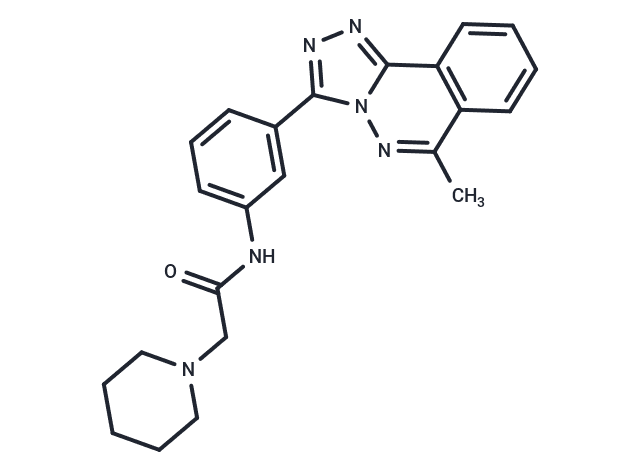
CAS:Antibacterialagent 281 (Compound 95,186) effectively inhibits the growth of GAS by binding to the ligand-binding pocket of SPs0871, competing with the ligand. It exhibits concentration-dependent growth inhibition against Streptococcus pyogenes (S. pyogenes).Fórmula:C23H24N6OForma y color:SolidPeso molecular:400.48Citric acid-13C2
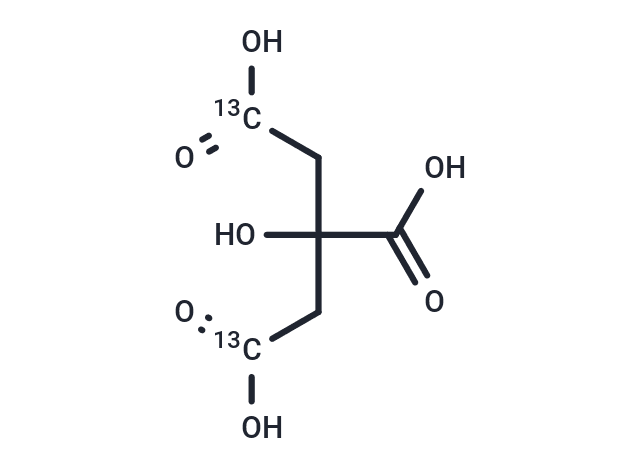
CAS:Citric acid-13C2 is a 13C-labeled form of citric acid. Citric acid serves as a preservative and food additive. It induces apoptosis in HaCaT cells and causes cell cycle arrest at the G2/M and S phases. Additionally, citric acid contributes to liver oxidative damage by reducing antioxidant enzyme activity. It also functions as an acidulant, emulsifier, chelating agent, and buffer, with extensive applications across multiple industries.Fórmula:C6H8O7Forma y color:SolidPeso molecular:194.11NusB-IN-1
NusB-IN-1 (22r) is an oral bacterial rRNA inhibitor, effective against MRSA and VRSA.Fórmula:C21H16N2O3Forma y color:SolidPeso molecular:344.36Antibacterial agent 88
Antibacterial agent 88 is an effective antibacterial agent against B. subtilis (MIC: 4 μg/ml) with MIC values of ≤0.0156 μg/mL for MRSA, MRSE and S. aureus.Fórmula:C31H44N2O6SForma y color:SolidPeso molecular:572.76MRL-436
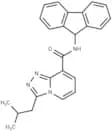
CAS:MRL-436 is an RNA polymerase inhibitor with antibacterial activity. Its effectiveness depends on the β' subunit and the 622nd residue of the RNAP ω subunit. MRL-436 can inhibit Rifampicin-resistant RNA polymerase derivatives and shows antibacterial activity against Rifampicin-resistant strains.Fórmula:C24H22N4OForma y color:SolidPeso molecular:382.46Antitubercular agent-16
Compound 5q is a potent antitubercular with low MIC90 values (0.40-23.51 μg/mL) against M. tuberculosis strains, showing minimal cytotoxicity.Fórmula:C21H27N3SForma y color:SolidPeso molecular:353.52Elongation factor P-IN-2
Elongation factor P-IN-2, a β-lysine derivative, is a potent EFP inhibitor reducing E. coli growth.Fórmula:C16H35N3O2Forma y color:SolidPeso molecular:301.47Antibacterial agent 90
Antibacterial agent 90 (6n), a pleuromutilin derivative, targets Gram-positive pathogens and Mycoplasma pneumoniae.Fórmula:C30H42N2O6Forma y color:SolidPeso molecular:526.66Squalamine lactate
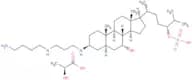
CAS:Squalamine lactate is an aminosterol compound discovered in the tissues of the dogfish shark, with antimicrobial activity.Fórmula:C37H71N3O8SPureza:98%Forma y color:SolidPeso molecular:718.04VEGFR-2/DHFR-IN-2
VEGFR-2/DHFR-IN-2 inhibits VEGFR-2 & DHFR (IC50: 0.623 & 9.085 μM), toxic to C26, HepG2, MCF7 cells (IC50: 3.59-8.38 μM), promising for cancer study.Fórmula:C21H21NO4Forma y color:SolidPeso molecular:351.4Rf470 TFA
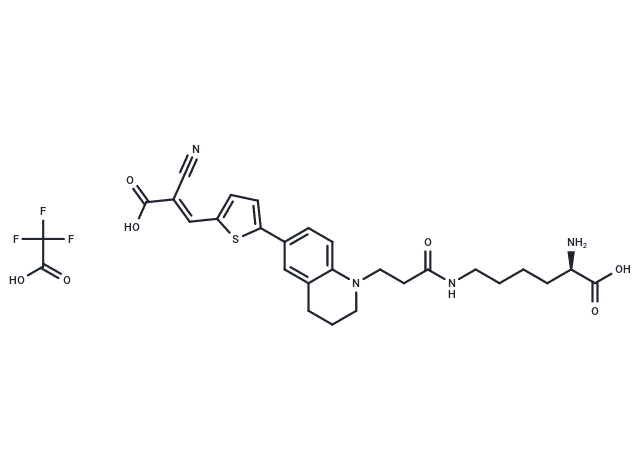
CAS:Rf470 (Rotor NO.4) TFA is an FMR-probe-D-lysine conjugate (Max Ex: 470 nM; Max Em: 640 nM) that can be covalently integrated into bacterial peptidoglycan. In its free state, Rf470 TFA exhibits weak fluorescence, which significantly increases upon integration into peptidoglycan by transpeptidase catalysis. This fluorescence change allows Rf470 TFA to be used for real-time monitoring of peptidoglycan biosynthesis, detecting transpeptidase activity, and screening antibiotics.Fórmula:C28H31F3N4O7SForma y color:SolidPeso molecular:624.63RmlA-IN-2
RmlA-IN-2: Strong RmlA blocker, hinders l-rhamnose synthesis & alters bacterial wall permeability (IC50: 0.303 μM).Fórmula:C22H26BrN5O4SForma y color:SolidPeso molecular:536.44Antibacterial agent 118
Antibacterial agent 118, potent against various mycobacteria, has MIC values ranging from 10.2 to 163.0 μM. Useful in TB research.Fórmula:C19H21N5O2SForma y color:SolidPeso molecular:383.47Cefoxazole
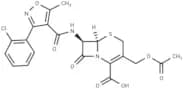
CAS:Cefoxazole is a β-lactam antibiotic featuring an isoxazole structure, known for its antibacterial activity. It can be utilized in the study of infectious diseases.Fórmula:C21H18ClN3O7SForma y color:SolidPeso molecular:491.902LpxC-IN-10
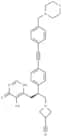
CAS:LpxC-IN-10 is a selective LpxC inhibitor with an MIC of 0.5 μg/mL against E. coli and K. pneumoniae and is capable of being used to study bacterial infections.Fórmula:C30H31N5O3Forma y color:SolidPeso molecular:509.6Antibacterial agent 279
CAS:Antibacterialagent 279 (compound A12) is an effective antibacterial agent. It inhibits the SOS response of Pseudomonas aeruginosa.Fórmula:C9H11NO2SForma y color:SolidPeso molecular:197.25ROS inducer 9
CAS:<p>ROS inducer 9 (compound 4e) is an antibacterial agent with a minimum inhibitory concentration (MIC) of 0.25 μg/mL against Escherichia coli. It eradicates bacteria by inhibiting GSH activity and increasing ROS levels. Additionally, ROS inducer 9 exhibits low toxicity toward red blood cells and RAW 264.7 cells.</p>Fórmula:C26H26BrF4N3O3Forma y color:SolidPeso molecular:584.401Gougerotin
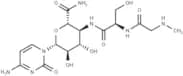
CAS:Gougerotin is an inhibitor of protein synthesis.Fórmula:C16H25N7O8Forma y color:SolidPeso molecular:443.41