Oligosacáridos
Subcategorías de "Oligosacáridos"
- Glicósidos de aminoetilo, glicósidos de aminopropilo(14 productos)
- Glicanos enlazantes de Asn(33 productos)
- Oligosacáridos biotinados(13 productos)
- Grupos sanguíneos y antígenos de Lewis(11 productos)
- Oligosacáridos de tipo sanguíneo(13 productos)
- Celooligosacáridos(1 productos)
- Ciclodextrinas(183 productos)
- Disacáridos(190 productos)
- Oligosacáridos de epítopo(19 productos)
- Fructooligosacáridos(2 productos)
- Oligosacáridos funcionales(556 productos)
- Oligosacáridos funcionalizados(1 productos)
- Galactosamina(41 productos)
- Galactosa(261 productos)
- Galb (1-3) GalNAc(21 productos)
- Serie Ganglio(11 productos)
- Serie Globo e Isoglobo(17 productos)
- Glucosamina(128 productos)
- Ácidos glucurónicos(52 productos)
- Glicoproteínas, Glicopéptidos(59 productos)
- Glicosaminoglicano(26 productos)
- Oligosacáridos de la leche materna(22 productos)
- O-glicanos marcados(9 productos)
- Oligosacáridos marcados(36 productos)
- LacNAc(53 productos)
- Series Lacto y Neolacto(14 productos)
- Lacto-N-biosa(10 productos)
- Lactooligosacáridos(7 productos)
- Oligosacáridos unidos al linker(19 productos)
- Maltooligosacáridos(6 productos)
- Oligosacáridos de leche(31 productos)
- N-glicanos(149 productos)
- Glucósidos naturales(177 productos)
- Oligosacáridos naturales(103 productos)
- O-glicano(18 productos)
- Building Blocks de Oligosacáridos(7 productos)
- Reemplazo de oligosacáridos(2 productos)
- Oligosacáridos por componente de azúcar(225 productos)
- Oligosis(24 productos)
- Otros Oligosacáridos(14 productos)
- Oligómeros de PEG(33 productos)
- Azúcares fosfatados(17 productos)
- Azúcares protegidos(526 productos)
- Reactivos para la síntesis de oligosacáridos(254 productos)
- Ser, Thr Glucanos de unión(9 productos)
- Oligosacáridos sialilados(3 productos)
- Esfingoglucolípidos(42 productos)
- Aminoácidos de azúcar, péptidos de azúcar(20 productos)
- Antígenos de azúcar(31 productos)
- Building Blocks de Azúcares por Oligosacáridos objetivo(225 productos)
- Conjugados de azúcar(100 productos)
- Azúcares sulfatados(16 productos)
- Tetrasacáridos(34 productos)
- Trisacáridos y superiores(95 productos)
- Xilooligosacáridos(5 productos)
Se han encontrado 2296 productos de "Oligosacáridos"
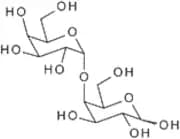
4-O-(a-D-Galactopyranosyl)-D-galactopyranose
CAS:Used as enzyme substrates, analytical standards and for in vitro diagnosticsFórmula:C12H22O11Pureza:Min. 97 Area-%Forma y color:White PowderPeso molecular:342.3 g/molChitobiose octaacetate
CAS:Octacetylated chitobiose derivativeFórmula:C28H40N2O17Pureza:Min. 95%Forma y color:White PowderPeso molecular:676.62 g/mol6'-O-Sulfated Lewis X
6'-O-Sulfated Lewis X is a synthetic, sulfated, monosaccharide that is modified with fluorine and methyl groups. It is used in the synthesis of oligosaccharides and polysaccharides. 6'-O-Sulfated Lewis X has been found to be effective in the prevention of glycosylation and sugar formation. This compound can also be used for click modification, as well as for modifying proteins or DNA. The CAS number is 59037-07-4.
Fórmula:C20H35NO18SPureza:Min. 95%Forma y color:PowderPeso molecular:609.55 g/mol4-O-(2,3,4,6-Tetra-O-acetyl-b-D-glucopyranosyl)-1,2,3,6-tetra-O-acetyl-b-D-thioglucopyranose
CAS:4-O-(2,3,4,6-Tetra-O-acetyl-b-D-glucopyranosyl)-1,2,3,6-tetra-O-acetyl-b-D-thioglucopyranose is a glycosylated saccharide that belongs to the group of complex carbohydrates. The glycosylation of 4-O-(2,3,4,6,-Tetra-O-acetyl b -D -glucopyranosyl)-1,2,3,6,-tetra -O -acetyl b -D -thioglucopyranose is achieved by the enzymatic reaction of an acetate donor and an acceptor molecule in the presence of glucose 1 phosphate (G1P) and UDP sugar pyrophosphorylase. It has been modified by methylation with dimethyl sulphate in the presence ofFórmula:C28H38O18SPureza:Min. 95%Peso molecular:694.66 g/molRutinose
CAS:Rutinose is a naturally occurring polyphenol found in many plants, including the leaves and bark of rue plants. It is a glycoside derivative that has been shown to inhibit human colorectal adenocarcinoma cells (HL-60) by binding to DNA and inhibiting RNA synthesis. Rutinose also has been shown to have anti-inflammatory effects and has been used in the treatment of metabolic disorders such as diabetes mellitus. Rutinose is a bioactive compound with antioxidant properties that may be related to its ability to bind metal ions, including calcium ions at physiological pH levels. Rutinose also has been shown to have a signal peptide sequence that targets it for secretion into the blood stream, where it may act on brain functions.Fórmula:C12H22O10Pureza:Min. 90%Forma y color:White PowderPeso molecular:326.3 g/molD-Cello-oligosaccharides
This mixture contains all the members of the series up to DP9Pureza:Min. 90 Area-%Forma y color:White PowderNeocarrabiose
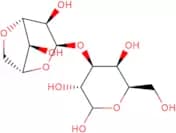
CAS:Neocarrabiose is a low-energy, hydrogen-bonded sugar that has an optimum concentration of 0.5 M. It is found in the basic structure of oligosaccharides and belongs to group p2. Structural analysis has revealed that Neocarrabiose has a denaturation temperature of 98 °C. Clinical studies have shown that Neocarrabiose may be effective in treating influenza virus, although it is not currently approved for this use. Neocarrabiose can be used as a molecule to form intramolecular hydrogen bonds in organic synthesis and magnetic resonance spectroscopy.Fórmula:C12H20O10Pureza:Min. 95%Forma y color:White Off-White PowderPeso molecular:324.28 g/mol2-Acetamido-4-O-{2-acetamido-4-O-[[3-O-[2-O-(2-acetamido-2-deoxy-β-D-glucopyranosyl)-α-D-mannopyranosyl]-6-O-[2-O-(2-acetamido-2-deo xy-β-D-glucopyranosyl)-α-D-mannopyranosyl]-β-D-mannopyranosyl]]-2-deoxy-β-D-glucopyranosyl}-2-deoxy-β-D-thioglucopyra
2-Acetamido-4-O-{2-acetamido-4-O-[3-O-[2-O-(2-acetamido-2,6-dideoxygalactopyranosyl)-a,D]-mannopyranosyl]-6 -O-[2 - O-(2 - acetamido - 2, 6 - dideoxygalactopyranosyl) - a, D] - mannopyranosyl} - 2 - deoxy - b, D]glucopyranosyl} - 2 - deoxyglucose is a synthetic carbohydrate that belongs to the group of oligosaccharides. It is a complex carbohydrate consisting of six glucose molecules linked by alpha (1→4) glycosidic bonds. The chemical name for this molecule is Custom synthesis and it has CAS No. 91471-04-8. This product can be modified through methylation, glycosFórmula:C50H84N4O35SPureza:Min. 95%Peso molecular:1,333.27 g/mol1,3-α-1,6-α-D-Mannotriose
CAS:Intermediate for synthesis of N-acetyllactosaminic glycans
Fórmula:C18H32O16Pureza:Min. 95 Area-%Forma y color:White Off-White PowderPeso molecular:504.44 g/mol2,2',2''-Triaminotriethylamine-bis(thiogalactopyranosyl acetamide)
2,2',2''-Triaminotriethylamine-bis(thiogalactopyranosyl acetamide) is a fluorinated sugar that can be used as a building block in glycosylation and oligosaccharide synthesis. It has been shown to be useful for the preparation of complex carbohydrates with desired properties such as high purity.Fórmula:C22H42N4O12S2Pureza:Min. 95%Peso molecular:618.72 g/molBlood group A pentasaccharide type II
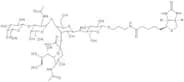
CAS:A antigen pentasaccharide Type I I, possible use in antiviral developmentFórmula:C34H58N2O25Pureza:Min. 90 Area-%Forma y color:PowderPeso molecular:894.82 g/molGM1-Pentasaccharide labelled by biotin
GM1 pentasaccharide biotin (sodium salt) has a core tetrasaccharide structure (Galβ1,3GalNAcβ1,4Galβ1,4Glc) with sialic acid linked α2,3 to the inner galactose residue and biotin linked β to position 1 on the reducing glucose moiety (Ledeen, 2009). The parent ganglioside GM1 is abundant in all mammalian brains, where it covers 10%-20% of the total ganglioside mixture. It is found in epithelial membranes and is a key element for bacterial toxicity and viral infection as it is the intestinal receptor for cholera toxin the B-subunits of heat-labile toxin, rotavirus, and simian virus 40. GM1 ganglioside functions as a neurotrophic and neuroprotective compound and has been used therapeutically for diabetic and peripheral neuropathies. GM1 ganglioside also has the ability to bind amyloid-β proteins and is involved in Alzheimerâs pathogenesis (Chiricozzi, 2020).Fórmula:C50H83N5O31SPureza:Min. 95%Forma y color:White PowderPeso molecular:1,282.28 g/mol2,3,6,2',3',4',6'-Hepta-O-acetyl-a-D-lactosyl bromide
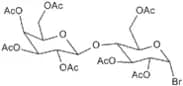
CAS:2,3,6,2',3',4',6'-Hepta-O-acetyl-a-D-lactosyl bromide is a chemical substance that absorbs infrared radiation and reflects light. It is used as an infrared reflector in India to improve the efficiency of solar panels.Fórmula:C26H35BrO17Forma y color:White Off-White PowderPeso molecular:699.45 g/mol3'-Sialyl Lewis X, sodium salt
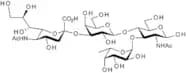
CAS:Sialyl Lewis X (SLeX) is a carbohydrate antigen, related to cell adhesion and it has been shown that inhibition of SLeX synthesis leads to decreased adhesion of trophoblast cells to endometrial epithelial cells (Collins, 2006). Sialyl Lewis X is displayed on the terminus of glycolipids that are present on the surface of white blood cells and it has been shown that SLeX has an important role in inflamation processes. The inital adhesion of white blood cells to a site of injury is mediated by E-selectins which are specific for SLeX. Cell-cell recognition between leukocytes and endothelial cells in blood is believed to occur in part through interactions between lectins and oligosaccharide ligands. SLeX is frequently expressed in human cancer cells and primary tumors. It has been demonstrated that SLeX was involved in the adhesion of tumor cells to vascular endothelium. The potential role of SLeX in the tumor metastatic process has been supported by several clinical studies (Liang, 2016).Fórmula:C31H51N2NaO23Pureza:Min. 95%Forma y color:White PowderPeso molecular:842.73 g/mol4'-O-(2-Acetamido-2-deoxy-3-O-(b-D-galactopyranosyl)-b-D-galactopyanosyl)-b-D-lactose
4'-O-(2-Acetamido-2-deoxy-3-O-(b-D-galactopyranosyl)-b-D-galactopyanosyl) -b-D-lactose is a modified saccharide that belongs to the group of polysaccharides. It has a CAS number and can be custom synthesized by our company. This product is classified as a carbohydrate, sugar, or synthetic. It can be used in click modification, modification, or glycosylation reactions. 4'-O-(2-Acetamido-2-deoxy-3-O-(b-D-galactopyranosyl)-b -D -galactopyanosyl) -b -D -lactose is also fluorinated with trifluoromethanesulfonic acid and can be used for complex carbohydrate synthesis.Fórmula:C26H45NO21Pureza:Min. 95%Forma y color:White PowderPeso molecular:707.63 g/mol1,4-β-D-Xylotriose
CAS:1,4-β-D-Xylotriose is a pentose sugar that is the main component of hemicellulose. It is found in plant cell walls and has been studied using surface methodology to determine the covalent linkages and structure of 1,4-β-D-Xylotriose. Xylotrioses are also used as a substrate for enzyme reactions and have shown to have a number of enzymatic activities, including glycosidases, cellulases, xylanases, and arabinofuranosidases. Xylotrioses are also part of complex enzyme models that can be used to study disulfide bonds. Xylotrioses are polymers that are important for structural analysis due to the presence of β-1,4 links. The genome DNA has been found to contain many genes coding for xylanase enzymes.Fórmula:C15H26O13Pureza:Min. 95 Area-%Forma y color:White PowderPeso molecular:414.36 g/molMethyl 4-O-(b-D-galactopyranosyl)-D-glucopyranoside
CAS:Methyl 4-O-(b-D-galactopyranosyl)-D-glucopyranoside is a cell death inducer that induces apoptosis in cancer cells. It is an analog of the natural product bryostatin 1, which has been shown to induce apoptosis in cancer cells by binding to a protein called CD97. This compound induces apoptosis by binding to CD97, inhibiting the formation of ATP, and activating caspases. In vitro studies have shown that methyl 4-O-(b-D-galactopyranosyl)-D-glucopyranoside induces apoptosis in mouse lymphoma cells and human leukemia cells.
Fórmula:C13H24O11Pureza:Min. 95%Forma y color:White PowderPeso molecular:356.32 g/mol1,4-β-D-Mannopentaose
CAS:Isolated from ivory-nut mannan hydrolysates
Fórmula:C30O26H52Pureza:Min. 95%Forma y color:PowderPeso molecular:828.72 g/mol1,5-α-L-Arabinotriose
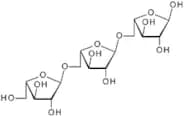
CAS:1,5-α-L-Arabinotriose is a sugar that is found in the cell walls of plants. It is a trisaccharide composed of three L-arabinose units linked by α-(1→5) bonds. 1,5-α-L-Arabinotriose has been shown to be adsorbed on cellulose acetate and can be used to measure the molecular weight of the adsorbate. This sugar also undergoes optical rotations when it interacts with some dyes such as germanium tetrachloride. 1,5-α-L-Arabinotriose has many uses including: as a solute in chloride ion chromatography; as an absorbent in filtration experiments; and as a parameter for calculating thermodynamics for reactions involving hydrogen transfer.Fórmula:C15H26O13Pureza:Min. 95 Area-%Forma y color:Clear LiquidPeso molecular:414.36 g/molLacto-N-fucopentaose II
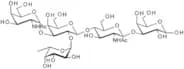
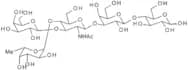
CAS:Major milk pentasaccharide; reduces respiratory and gastrointestinal pathologiesFórmula:C32H55NO25Pureza:Min. 95 Area-%Forma y color:White PowderPeso molecular:853.77 g/mol