Tintes, colorantes y tinciones
Los colorantes, tintes y tinturas son herramientas esenciales en biología molecular, cruciales para visualizar y estudiar el ADN, los cromosomas y los núcleos celulares. Estos compuestos permiten a los investigadores resaltar componentes celulares específicos, facilitando la observación y el análisis detallados bajo el microscopio. En esta categoría, encontrará una amplia gama de colorantes y tintes de alta calidad utilizados en diversas técnicas de tinción, incluyendo colorantes fluorescentes para análisis de ADN y cromosomas, tintes histológicos para muestras de tejido y tintes específicos para estructuras celulares. Estas herramientas son indispensables en la investigación genética, citología, histología y diagnósticos, proporcionando claridad y contraste en las muestras biológicas. En CymitQuimica, ofrecemos una selección completa de colorantes, tintes y tinturas para apoyar su investigación en biología molecular y asegurar resultados precisos y fiables en sus estudios.
Subcategorías de "Tintes, colorantes y tinciones"
- Tintes ácidos(49 productos)
- Azobencenos(270 productos)
- Tintes azoicos(7 productos)
- Tintes básicos(27 productos)
- Tintes de cumarina(71 productos)
- Tintes de cianina, tintes de escuarilio(53 productos)
- Tintes DCM(4 productos)
- Diariolethenes(12 productos)
- Tintes de dipirrometeno(26 productos)
- Tintes Directos(17 productos)
- Tintes dispersos(2 productos)
- Sensibilizadores de colorantes(12 productos)
- Tintes(416 productos)
- Tinturas y colorantes(911 productos)
- Generating Insoluble Dyes(14 productos)
- Generating Soluble Dyes(11 productos)
- Hexaarilbiimidazol(4 productos)
- Indicadores(575 productos)
- Tintes mordantes(10 productos)
- Tintes de infrarrojo cercano (NIR)(28 productos)
- Tintes de aceite(15 productos)
- Otras tinciones y tintes(2 productos)
- Tintes de perileno(17 productos)
- Tintes fotocromáticos(40 productos)
- Tintes de ftalocianina, tintes de porfirina(101 productos)
- Tintes de quinacridona(8 productos)
- Espiropiranos(16 productos)
- Tinciones y tintes(243 productos)
- Tinciones y tintes para microscopía(5 productos)
- Tintes de tina(5 productos)
- Tintes de xanteno(65 productos)
Mostrar 23 subcategorías más
Se han encontrado 755 productos de "Tintes, colorantes y tinciones"
Ordenar por
Pureza (%)
0
100
|
0
|
50
|
90
|
95
|
100
Fuchsin, for flagella staining, certified
CAS:<p>Please enquire for more information about Fuchsin, for flagella staining, certified including the price, delivery time and more detailed product information at the technical inquiry form on this page</p>Fórmula:C20H20ClN3Pureza:Min. 95%Forma y color:PowderPeso molecular:337.8 g/molWeak Acid Yellow 3G
CAS:<p>Weak Acid Yellow 3G is a benzyl ester of an aliphatic polyhydric alcohol. It is a clear, amber liquid with a pH of 6.5-7.5 and can be used in the production of microspheres and monomers for organic solvent extraction and surface treatment. When diluted with water, it has an alkaline reaction system. This product is soluble in aliphatic hydrocarbons, alcohols and ethers, but insoluble in water and most other common solvents. Weak Acid Yellow 3G can be used as a surfactant and surface active agent to simplify reactions systems by removing the need for additional reagents or solvents.</p>Fórmula:C39H26Cl4N8Na2O8S2Pureza:Min. 95%Peso molecular:986.6 g/molSolvent Red 149
CAS:<p>Solvent Red 149 is an organic solvent that is used in the development of photographic emulsions. It has a low average particle diameter, high thermal expansion, and low volatility. Solvent Red 149 has been used as a sensor for environmental pollution. This compound has been shown to inhibit polymerization reactions by acting as an inhibitor of an essential step in the process. The hydroxyl group on the molecule can be used for authenticating purposes because it reacts with sulfuric acid to form a red dye.</p>Fórmula:C23H22N2O2Pureza:Min. 95%Forma y color:PowderPeso molecular:358.43 g/molC.I.Disperse Orange 32
CAS:<p>Please enquire for more information about C.I.Disperse Orange 32 including the price, delivery time and more detailed product information at the technical inquiry form on this page</p>Pureza:Min. 95%Bromocresol green, sodium salt
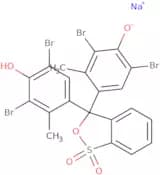
CAS:<p>Bromocresol green is a dye that is used in biological assays to measure the kinetics of fluorescence. It is a type of tryptophan-releasing compound that releases a yellowish-green light when it absorbs light at wavelengths between 350 and 450 nm. Bromocresol green has been quantified by measuring the intensity of the fluorescence emission as a function of time. This can be done visually or using an instrument called a fluorometer, which detects changes in light intensity over time. Bromocresol green can be used to detect the presence of amino acid residues in proteins through protonation reactions with their tryptophan residues and subsequent quenching with acetonitrile. The bromocresol green dye is also used in lithographic printing, where it serves as an acceptor for electrons from an arene (aromatic hydrocarbon). This process generates energy for lithography and also provides contrast between regions with different electron densities.</p>Fórmula:C21H14Br4O5SNaForma y color:PowderPeso molecular:721 g/molPigment Blue 10
CAS:<p>Pigment Blue 10 is a cationic dye that belongs to the class of quaternary ammonium compounds. It is often used in textile and leather processing as a cross-linking agent and as an auxiliary agent for pigmenting. Pigment Blue 10 has good light resistance, high solubility in organic solvents, and low toxicity. It is also used in radiation curing processes, such as epoxy resin, acrylate resin, polyester resin, and silicone rubber. Pigment Blue 10 can be used with salt compounds or aliphatic hydrocarbons to form a film on surfaces or objects. It has been shown to have biodegradable properties when mixed with other substances.</p>Pureza:Min. 95%C.I.Acid green 54
CAS:<p>Please enquire for more information about C.I.Acid green 54 including the price, delivery time and more detailed product information at the technical inquiry form on this page</p>Pureza:Min. 95%Disperse Red 9
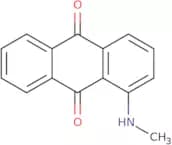
CAS:<p>Disperse Red 9 is a dye that is used in analytical chemistry to measure the amount of hydrogen bonding interactions. It has a linear regression analysis and molecular modeling to determine its molecular structure. Disperse Red 9 is also used for toxicity studies and the determination of various chemical structures. The mechanism of the reaction between Disperse Red 9 and hydrogen is intramolecular hydrogen bonding, which can be seen by nmr spectra. Disperse Red 9 has been shown to have toxic effects on animals, as well as other side-effects such as skin irritation. This dye has an intramolecular hydrogen bond with a cationic surfactant, which makes it soluble in water.</p>Fórmula:C15H11NO2Pureza:Min. 95%Forma y color:Red PowderPeso molecular:237.25 g/molPatent Blue V sodium salt
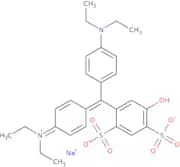
CAS:<p>C.I. Acid Blue 3 is a synthetic, water-soluble dye that has been used in analytical chemistry for the detection of metal hydroxides and other metal ions. The dye can be activated by radiation or by heating to produce a bright blue color that is stable under acidic conditions. C.I. Acid Blue 3 has been shown to cause toxicity in animals, and may have potential carcinogenic effects in humans due to its ability to cross the blood-brain barrier and accumulate in the brain. The molecular weight of this compound is approximately 464 g/mol and it has a molecular formula of C 18 H 20 N 2 NaO 7 S 2 .</p>Fórmula:C27H32N2O7S2•xNaForma y color:Blue PowderPeso molecular:582.67 g/molAcid fuchsin calcium
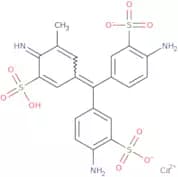
CAS:<p>Acid fuchsin is a water-soluble, non-toxic, acidic dye that is used in histology to stain connective tissue and mucous membranes. It is used as an indicator for calcium in the presence of acid phosphatase. Acid fuchsin can be detected by light microscopy when it is stained on a section of tissue or cells. This dye can be used with immunocytochemistry or cytogenetics to assess the morphology of cells and tissues. The staining intensity varies according to the concentration of the acid fuchsin solution, which can be quantified by measuring the absorbance at 510 nm. A reference range for this measurement would be 0.1 - 1 μg/ml (10 - 100 μM).</p>Fórmula:C20H19N3O9S3·xCaForma y color:PowderPeso molecular:541.58 g/molDBCO-Cy3 ditriethylamine
CAS:<p>Please enquire for more information about DBCO-Cy3 ditriethylamine including the price, delivery time and more detailed product information at the technical inquiry form on this page</p>Fórmula:C50H54N4O11S3•(C6H15N)2Pureza:Min. 95%Peso molecular:1,185.56 g/molC.I.Food Red 7:1
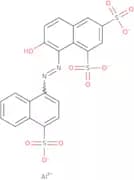
CAS:<p>C.I.Food Red 7:1 is a copper salt pigment that is used as a food coloring agent. It has bactericidal activity and is known to be synergistic with famotidine, erythromycin, hydrochloric acid, and dry extract. C.I.Food Red 7:1 also has chemical stability and can be used as a cross-linking agent for chondroitin sulfate in the production of pharmaceuticals.</p>Fórmula:C20H11AlN2O10S3Pureza:Min. 95%Peso molecular:562.48 g/molC.I.Reactive violet 5
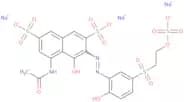
CAS:<p>C.I. Reactive Violet 5 is a dye that is used in the textile industry and for the detection of bacterial strains in biological samples. The dye is a 4-hydroxycinnamic acid derivative that has been shown to have a hydrophobic effect on bacteria, which may be due to its chemical structure and ability to form hydrogen bonds with water molecules. C.I. Reactive Violet 5 also binds to colloidal gold particles, making it an excellent stain for biological samples such as activated sludge wastewater treatment samples where bacteria are abundant.</p>Fórmula:C20H16N3Na3O15S4Pureza:Min. 95%Forma y color:PowderPeso molecular:735.6 g/molFast Sulphon Black F
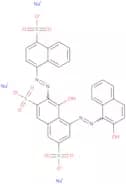
CAS:<p>Fast Sulphon Black F is a stable, water-soluble dye that can be used for electrochemical measurements. It is an irreversible oxidation agent that has been shown to oxidize organic solvents and metal ions. The kinetic of the reaction with sodium salts was found to be first order in Fast Sulphon Black F and second order in sodium salt. This dye also has a potential use as a redox indicator in wastewater treatment systems. Fast Sulphon Black F is soluble in organic solvents, which may make it useful for optical sensors.</p>Fórmula:C30H20N4O11S3•Na3Pureza:(%) Min. 95%Forma y color:PowderPeso molecular:777.67 g/molPigment Red 202
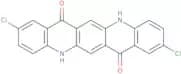
CAS:<p>Pigment Red 202 is a red pigment with a molecular weight of 536. It has a hydroxyl group and two nitrogen atoms, which are responsible for the molecule's stability. Pigment Red 202 has been used as a cross-linking agent in the production of polyester resins or polyurethane coatings because it can form hydrogen bonds. It is also used as an additive to paper and paint to control the rate of drying. Pigment Red 202 is available in crystalline polymorphs, including alpha, beta, gamma, delta, and epsilon forms.</p>Fórmula:C20H10Cl2N2O2Pureza:Min. 95%Forma y color:PowderPeso molecular:381.21 g/molC.I.Basic Yellow 21
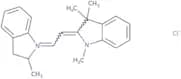
CAS:<p>Basic Yellow 21 is a dye that belongs to the class of phthalo-quinones. It is used in the manufacture of colored fabrics and various other products, such as paints and plastics. Basic Yellow 21 is also used in the treatment of bladder cancer. The dye reacts with DNA to form adducts that inhibit the transcription of DNA into RNA, which may lead to carcinogenesis.</p>Pureza:Min. 95%Direct black 168
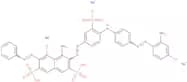
CAS:<p>Direct black 168 is a synthetic coal tar dye that is used in many industries, including the textile industry. It is used as a colorant and dyeing assistant in the production of textiles and paper. Direct black 168 is also used as an antifungal agent, light source, and optical brightener.</p>Fórmula:C34H27N9Na3O11S3Forma y color:Brown PowderPeso molecular:902.8 g/molC.I.Reactive Red 108
CAS:<p>Please enquire for more information about C.I.Reactive Red 108 including the price, delivery time and more detailed product information at the technical inquiry form on this page</p>Pureza:Min. 95%Food black 1
CAS:<p>Food Black 1 is a food additive that is used to dye foods and beverages. It is a dark-colored dye, which can be used to color products such as cakes, soft drinks, ice cream, and cheese. Food Black 1 has been shown to have genotoxic effects and carcinogenic potential in rats; however there are no studies that show it has any carcinogenic properties in humans. There are some concerns about the safety of Food Black 1 in terms of its long-term toxicity, but these have not been confirmed by independent research studies. There are no known cases of adverse reactions to this additive.</p>Fórmula:C28H21N5O14S4•Na4Pureza:Min. 95%Forma y color:Brown PowderPeso molecular:871.72 g/molC.I.Acid Red 52
CAS:<p>C.I.Acid Red 52 is a fluorescent dye that is used as a probe for the study of wastewater treatment processes. The fluorescence intensity of C.I. Acid Red 52 increases when it binds to an adsorbent material such as activated carbon, due to the adsorption process. It has also been used extensively in polymerase chain reaction (PCR) applications as a synchronous fluorescence quencher, and has been shown to inhibit ubiquitin ligases in biological samples with high specificity. In addition, this dye has been found to have carcinogenic potential in animal studies and may react with substances present in the matrix solution during analytical methods, leading to errors in the measured data.BR></p>Fórmula:C27H29N2O7S2NaForma y color:Purple PowderPeso molecular:580.65 g/mol