Señalización citoesquelética
Los inhibidores de la señalización del citoesqueleto son compuestos que interrumpen las vías de señalización que regulan el citoesqueleto, crucial para la forma celular, la motilidad, la división y el transporte intracelular. Estos inhibidores se utilizan para estudiar la dinámica de las proteínas del citoesqueleto, como la actina y la tubulina, y su papel en procesos como la migración celular, la adhesión y la metástasis del cáncer. Los inhibidores de la señalización del citoesqueleto son valiosos en la investigación sobre biología celular, cáncer y neurobiología. En CymitQuimica, ofrecemos una amplia gama de inhibidores de la señalización del citoesqueleto de alta calidad para apoyar su investigación en estas áreas.
Se han encontrado 1382 productos de "Señalización citoesquelética"
Ordenar por
Pureza (%)
0
100
|
0
|
50
|
90
|
95
|
100
HSN748
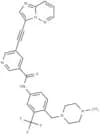
CAS:<p>HSN748 is an analog of ponatinib and acts as a multi-kinase inhibitor. It exhibits inhibitory activity against kinases such as FLT3, ABL1, RET, PDGFRα/β, MNK1, and MNK2. HSN748 can suppress the growth of chronic myeloid leukemia and acute myeloid leukemia cell lines, making it a useful compound in leukemia research.</p>Fórmula:C27H24F3N7OForma y color:SolidPeso molecular:519.521KY-02327 acetate
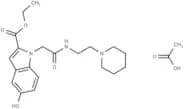
<p>KY-02327 acetate inhibits Dvl-CXXC5, stabilizes Wnt/β-catenin signaling, and enhances osteoblast differentiation.</p>Fórmula:C22H31N3O6Forma y color:SolidPeso molecular:433.5TPI-287
CAS:<p>TPI 287: synthetic taxane; may halt cancer by stabilizing microtubules, blocking cell division, inducing apoptosis.</p>Fórmula:C46H63NO15Forma y color:SolidPeso molecular:869.99Latrunculins A
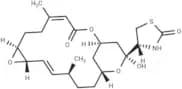
CAS:<p>Latrunculins A is a novel marine toxin, disrupts microfilament organization in cultured cells.</p>Fórmula:C22H31NO6SForma y color:SolidPeso molecular:437.55HG-7-86-01
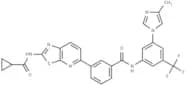
CAS:<p>HG-7-86-01 is a selective type II tyrosine kinase inhibitor with antiproliferative activity against mutant T315I- Bcr-Abl for chronic myeloid leukemia (CML).</p>Fórmula:C28H21F3N6O2SPureza:99.07%Forma y color:SolidPeso molecular:562.57PI3K-IN-29
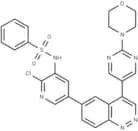
CAS:<p>PI3K-IN-29: Strong PI3K block, inhibits Akt phosphorylation. IC50: U87MG 0.264µM, HeLa 2.04µM, HL60 1.14µM.</p>Fórmula:C27H22ClN7O3SForma y color:SolidPeso molecular:560.03FAK inhibitor 7
CAS:<p>FAK inhibitor7, a potent FAK inhibitor, demonstrates an IC50 of 3.58 nM. This compound effectively inhibits downstream signaling cascades of FAK (such as Src and AKT), which leads to cell cycle arrest at the G0/G1 phase and induces cytotoxic autophagy in ovarian cancer cells. Additionally, FAK inhibitor7 has been shown to suppress tumor metastasis and growth in ovarian cancer mouse models.</p>Fórmula:C32H37N7O3Forma y color:SolidPeso molecular:567.68Tubulin inhibitor 16
<p>Tubulin inhibitor 16 is a potent tubulin inhibitor with antiproliferative activity. Tubulin inhibitor 16 exhibits cytotoxicity in HepG2 cells [1].</p>Fórmula:C16H12FNO2Forma y color:SolidPeso molecular:269.27HSP90-IN-32
CAS:<p>HSP90-IN-32, a carboxy-terminus inhibitor of Hsp90C, exhibits antiproliferative activity in various cell lines including SKMel173, SKMel103, SKMel19, and A375, with IC50 values of 1.01 μM, 0.782 μM, 0.607 μM, and 1.413 μM, respectively. This compound holds potential for research in anticancer agents.</p>Fórmula:C33H40N2O4Forma y color:SolidPeso molecular:528.68Tau ligand-1
CAS:<p>Tau ligand-1 (Compound 75) is a ligand of aggregated tau protein that can penetrate the blood-brain barrier. In tissues affected by Alzheimer's disease, progressive supranuclear palsy, corticobasal degeneration, and Pick's disease, Tau ligand-1 shows high affinity for aggregated tau protein, with equilibrium dissociation constants (KD) ranging from 1 to 3.8 nM. It holds potential as a positron emission tomography (PET) tracer for imaging studies of tau-related diseases within the central nervous system.</p>Fórmula:C17H16FN3OForma y color:SolidPeso molecular:297.327Hsp90-IN-37
CAS:<p>Hsp90-IN-37 (Z-2) is an inhibitor of heat shock protein 90 (Hsp90), demonstrating a 69% inhibition rate on Hsp90 enzyme activity. It exhibits antitumor properties.</p>Fórmula:C12H15N3O2Forma y color:SolidPeso molecular:233.266ZLY06
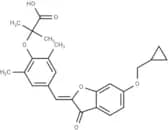
CAS:<p>ZLY06 is a dual agonist of peroxisome proliferator-activated receptors (PPAR) δ and γ with oral activity (PPAR δ: EC50=341 nM; PPARγ: EC50=237 nM). It mediates the upregulation of CD36 and induces hepatic lipid accumulation by inhibiting the phosphorylation of AKT1. Moreover, ZLY06 significantly improves glucose and lipid metabolism without increasing body weight, primarily by enhancing the β-oxidation of fatty acids and reducing hepatic lipid synthesis, thereby alleviating fatty liver disease.</p>Fórmula:C25H26O6Forma y color:SolidPeso molecular:422.47C086
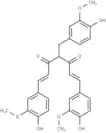
CAS:<p>C086 is a novel and potent Hsp90 inhibitor that suppresses cell cycle progression, induces apoptosis, and exhibits anti-metastatic properties by modulating various mechanisms in different cell types.</p>Fórmula:C29H28O8Forma y color:SolidPeso molecular:504.53GSK3335103
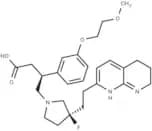
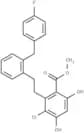
CAS:<p>GSK3335103 is a non-peptide, orally active inhibitor of αvβ6 integrin (pIC50=8), employed in the study of pulmonary fibrosis.</p>Fórmula:C27H36FN3O4Forma y color:SolidPeso molecular:485.59POSH-IN-2
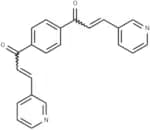
CAS:<p>POSH-IN-2 (MIDI) is a mitochondrial fission inhibitor and a DRP1 inhibitor that effectively prevents mitochondrial fragmentation caused by cellular stress and genetic mitochondrial damage. It covalently interacts with DRP1-C367 to target the interaction of DRP1 with multiple receptors.</p>Fórmula:C22H16N2O2Forma y color:SolidPeso molecular:340.37KUNG65
CAS:<p>KUNG65 acts as a selective Grp94 inhibitor, demonstrating a target dissociation constant (K_d) of 540 nM. It exhibits a minimum selectivity of 73-fold compared to other Hsp90 isoforms.</p>Fórmula:C23H20ClFO4Forma y color:SolidPeso molecular:414.85Nic-15
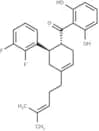
CAS:<p>Nic-15 (compound 4n) serves as an anti-constrictive agent targeting the low vascular characteristics of pancreatic tumors. These characteristics enable cancer cells to adapt to the nutrient-deficient tumor microenvironment and develop resistance to treatment. Nic-15 modulates the PI3K/Akt/mTOR pathway and alleviates ER stress induced by Gemcitabine. It significantly inhibits migration and colony formation in MIA PaCa-2 and PANC-1 pancreatic cancer cells. When used in combination with Gemcitabine, Nic-15 effectively addresses resistance issues in pancreatic tumors. In xenograft models in vivo, Nic-15 notably enhances the efficacy of Gemcitabine.</p>Fórmula:C25H26F2O3Forma y color:SolidPeso molecular:412.47Mps1-IN-8
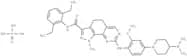
CAS:<p>Mps1-IN-8, a Mps1 inhibitor, can be utilized in the study of various tumors [1].</p>Fórmula:C35H47N8O6PForma y color:SolidPeso molecular:706.77Si306
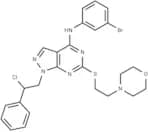
CAS:<p>Si306, an Src inhibitor, exhibits antitumor activity by reducing the phosphorylation of focal adhesion kinase (FAK) and the expression of epidermal growth factor receptor (EGFR), thereby inhibiting the invasion of human glioblastoma (GBM).</p>Fórmula:C25H26BrClN6OSForma y color:SolidPeso molecular:573.94Alfalone
CAS:<p>Alfalone (compound 9ia) is an antimitotic agent. It induces cleavage arrest and initiates the formation of tubercular eggs.</p>Fórmula:C17H14O5Forma y color:SolidPeso molecular:298.29