Haluros orgánicos
Subcategorías de "Haluros orgánicos"
Se han encontrado 20442 productos de "Haluros orgánicos"
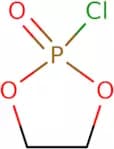
2-Chloro-1,3,2-dioxaphospholane-2-oxide
CAS:2-Chloro-1,3,2-dioxaphospholane-2-oxide is a reactive compound that has inhibitory properties. It is used in the synthesis of biocompatible polymers and can be used as a phase transition temperature regulator. This molecule has been studied using FTIR spectroscopy and in vitro assays. It has also been shown to react with fatty acids to form a molecule with low energy. 2-Chloro-1,3,2-dioxaphospholane-2-oxide reacts with hydrogen chloride to form benzyl groups, which may be due to its nucleophilic attack on the chlorine atom. 2CPDO is an organic compound that is part of the molecule class known as phospholanes.Fórmula:C2H4ClO3PPureza:Min. 95%Peso molecular:142.48 g/mol3-[(Dimethylamino)methyl]benzoic acid hydrochloride
CAS:Please enquire for more information about 3-[(Dimethylamino)methyl]benzoic acid hydrochloride including the price, delivery time and more detailed product information at the technical inquiry form on this pageFórmula:C10H13NO2Pureza:Min. 95%Peso molecular:179.22 g/mol3-[4-(2-Chlorophenyl)-9-methyl-6H-thieno[3,2-f][1,2,4]triazolo[4,3-a][1,4]diazepin-2-yl]-2-propyn-1-ol
CAS:Producto controladoPlease enquire for more information about 3-[4-(2-Chlorophenyl)-9-methyl-6H-thieno[3,2-f][1,2,4]triazolo[4,3-a][1,4]diazepin-2-yl]-2-propyn-1-ol including the price, delivery time and more detailed product information at the technical inquiry form on this pageFórmula:C18H13ClN4OSPureza:Min. 95%Peso molecular:368.84 g/mol2-Aminomethyl-4-(4-fluorobenzyl)morpholine
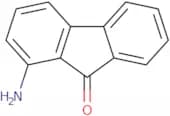
CAS:2-Aminomethyl-4-(4-fluorobenzyl)morpholine (2AMFM) is a prokinetic agent that has been shown to be effective as a treatment for gastrointestinal motility disorders. This drug binds to the 5HT4 receptors, which are found on the enteric nervous system and in the gut. 2AMFM has been shown to increase the frequency of contractions in rat ileum and small intestine preparations. It also increases gastric emptying time and decreases postprandial acidity in dogs. 2AMFM is an enantiomeric mixture of two chiral molecules that are mirror images of each other. The racemic mixture is synthesized by reacting 2-aminomethyl-4-(4-fluorobenzyl)morpholine with chloroacetic acid ethyl ester.Fórmula:C12H17FN2OPureza:Min. 95%Forma y color:Clear LiquidPeso molecular:224.27 g/mol1-Amino-9-fluorenone
CAS:1-Amino-9-fluorenone is a hydrogen bond acceptor molecule that has been shown to have anticancer activity and rate enhancement. The 1-Amino-9-fluorenone binds to the DNA of cancer cells, inhibiting cell growth and proliferation. This molecule also interacts with the cellular membrane by reversible binding, which leads to an increase in the concentration of intracellular nitric oxide (NO). This increase in NO levels inhibits the growth of cancer cells by blocking their ability to produce ATP. 1-Amino-9-fluorenone has been shown to inhibit hCT116 human colon cancer cells.
Fórmula:C13H9NOPureza:Min. 95%Peso molecular:195.22 g/molDichlorotitanium Diisopropoxide
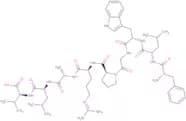
CAS:Producto controladoDichlorotitanium Diisopropoxide is a novel reagent for the asymmetric synthesis of amides. The reaction mechanism is based on the formation of a chloride-containing titanium enolate from titanium tetrachloride and an amine. This enolate reacts with another molecule of titanium tetrachloride to form the desired amide. Dichlorotitanium Diisopropoxide has been used in the preparation of polymers, such as poly(vinyl chloride) and poly(methyl methacrylate). It has also been used to produce organic compounds, such as chloroform, dichloromethane, and chlorobenzene. The stereoselectivity can be controlled by changing the solvent used in this reaction.nowiki>END>>Fórmula:C6H14Cl2O2TiPureza:Min. 95%Peso molecular:236.95 g/molMAGE-3 Antigen (271-279) (human) trifluoroacetate salt
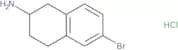
CAS:ALPHA FACTOR SIGNALING PEPTIDEFórmula:C53H79N13O10Pureza:Min. 95%Peso molecular:1,058.28 g/mol6-Bromo-1,2,3,4-tetrahydronaphthalen-2-ylamine hydrochloride
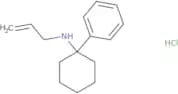
CAS:Producto controladoPlease enquire for more information about 6-Bromo-1,2,3,4-tetrahydronaphthalen-2-ylamine hydrochloride including the price, delivery time and more detailed product information at the technical inquiry form on this pageFórmula:C10H12BrN·HClPureza:Min. 95%Peso molecular:262.57 g/molN-Allyl-1-phenylcyclohexanamine hydrochloride
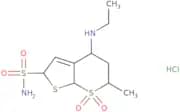
CAS:Producto controladoPlease enquire for more information about N-Allyl-1-phenylcyclohexanamine hydrochloride including the price, delivery time and more detailed product information at the technical inquiry form on this pageFórmula:C15H21NPureza:Min. 95%Peso molecular:215.33 g/molDorzolamide hydrochloride related compound A
CAS:Please enquire for more information about Dorzolamide hydrochloride related compound A including the price, delivery time and more detailed product information at the technical inquiry form on this pageFórmula:C10H16N2O4S3·HClPureza:Min. 95%Peso molecular:360.9 g/molAllylpalladium(II) chloride dimer
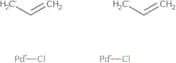
CAS:Allylpalladium(II) chloride dimer is a homogeneous catalyst that can be used for the asymmetric synthesis of organosilicon compounds. It is an allylation agent and has been shown to react with certain nitrogen-containing compounds to form a palladium nitride complex. This compound is also a good transport agent, due to its high solubility in organic solvents. Allylpalladium(II) chloride dimer has been shown to be effective in the production of cancer chemotherapeutic agents, including chlorambucil, as well as anti-inflammatory drugs such as ibuprofen. This catalyst has also been used for cross-coupling reactions with alkyl bromides and iodides. A major drawback of this catalyst is that it often leads to an isolated yield of the product, which can be improved by using a solvent or by adding water or alcohols.
Fórmula:C6H10Cl2Pd2Pureza:95%NmrPeso molecular:365.89 g/mol4-Iodotoluenedifluoride
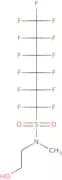
CAS:4-Iodotoluenedifluoride is a molecule that can be produced by the Friedel-Crafts reaction of iodotoluene with sulfoxides. It has been shown to be a bioactive molecule and an efficient method for the stereoselective synthesis of sulfoxides. 4-Iodotoluenedifluoride is also used in the synthesis of phenoxy compounds, which have been shown to have anti-inflammatory properties. The phenoxy group can be replaced with fluorine, which increases the lipophilicity of these molecules and makes them useful for lipid lowering drugs. These molecules are also capable of inhibiting cholesterol biosynthesis and increasing density lipoprotein (HDL).Fórmula:C7H7F2IPureza:Min. 95%Peso molecular:256.03 g/molTridecafluoro-N-(2-Hydroxyethyl)-N-Methylhexanesulphonamide
CAS:Please enquire for more information about Tridecafluoro-N-(2-Hydroxyethyl)-N-Methylhexanesulphonamide including the price, delivery time and more detailed product information at the technical inquiry form on this pageFórmula:C9H8F13NO3SPureza:Min. 95%Peso molecular:457.21 g/molN-[3-Fluoro-4-[(methylamino)carbonyl]phenyl]-2-methylalanine
CAS:Please enquire for more information about N-[3-Fluoro-4-[(methylamino)carbonyl]phenyl]-2-methylalanine including the price, delivery time and more detailed product information at the technical inquiry form on this pageFórmula:C12H15FN2O3Pureza:Min. 95%Peso molecular:254.26 g/mol4-Chloro-2-(methyl-phenyl-sulfamoyl)-benzoic acid methylester
CAS:4-Chloro-2-(methyl-phenyl-sulfamoyl)-benzoic acid methylester is an industrial chemical that is used in the production of other chemicals. It can be produced by the esterification of 4-chlorophenylacetic acid with methyl phenyl sulfonyl chloride, followed by diazotization and chlorination. This chemical also has the ability to form a condensation product with hydrazine.Fórmula:C15H14ClNO4SPureza:Min. 95%Peso molecular:339.79 g/molMethyl 3-(3-bromophenyl)-3-oxopropanoate
CAS:Please enquire for more information about Methyl 3-(3-bromophenyl)-3-oxopropanoate including the price, delivery time and more detailed product information at the technical inquiry form on this pageFórmula:C10H9BrO3Pureza:Min. 95%Peso molecular:257.08 g/mol1-(Chloroacetyl)-4-(2-fluorophenyl)piperazine
CAS:Producto controladoPlease enquire for more information about 1-(Chloroacetyl)-4-(2-fluorophenyl)piperazine including the price, delivery time and more detailed product information at the technical inquiry form on this page
Fórmula:C12H14ClFN2OPureza:Min. 95%Peso molecular:256.7 g/mol1,1-Dichlorodimethyl ether
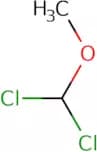
CAS:1,1-Dichlorodimethyl ether is a chemical compound that is used as an intermediate in the synthesis of trifluoroacetic acid from hydrochloric acid and methanol. This chemical has also been shown to inhibit inflammation by inhibiting the release of inflammatory cytokines, including epidermal growth factor (EGF) and interleukin-8 (IL-8). It may be used to treat chronic cough and chronic bronchitis. 1,1-Dichlorodimethyl ether inhibits the production of EGF by blocking the binding of EGF to its receptor on the surface of cells. The molecule also has an inhibitory effect on IL-8 production via inhibition of protein kinase C. The 1,1-dichlorodimethyl group is a reactive oxygen species that can react with other molecules such as DNA or proteins, leading to damage or even cell death.Fórmula:C2H4Cl2OPureza:Min. 95%Peso molecular:114.96 g/mol1,3-Bis(2,6-diisopropylphenyl)imidazolium chloride
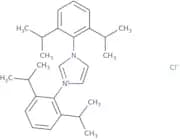
CAS:1,3-Bis(2,6-diisopropylphenyl)imidazolium chloride is an organic compound that is used as a solvent. It was originally synthesized by reacting triethyl orthoformate with 2,6-diisopropylaniline. This reaction formed the corresponding imidazolium salt. The synthesis of this compound was later improved by using ring-opening polymerization of glycolide and furfural. 1,3-Bis(2,6-diisopropylphenyl)imidazolium chloride is mainly used to extract estradiol from urine samples in clinical laboratories.Fórmula:C27H37ClN2Pureza:Min. 95%Forma y color:White PowderPeso molecular:425.05 g/mol1-(3-Chloropropyl)theobromine
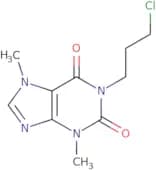
CAS:Producto controlado1-(3-Chloropropyl)theobromine is the reaction product of acetylacetone with carbonate and water. It is a high-yielding remedy for cerebral thrombosis and other alkali burns. The chemical formula for 1-(3-chloropropyl)theobromine is C10H14ClO2. It is soluble in water, which makes it an excellent antidote for alkali burns. Acetylacetone reacts with carbonate to produce the alkanol, which then reacts with water to form 1-(3-chloropropyl)theobromine. This chemical has been found to be an effective treatment for cerebral thrombosis and other alkali burns due to its ability to react with both water and blood clots.
Fórmula:C10H13ClN4O2Pureza:Min. 95%Peso molecular:256.69 g/mol

![3-[(Dimethylamino)methyl]benzoic acid hydrochloride](/_next/image/?url=https%3A%2Fstatic.cymitquimica.com%2Fproducts%2F3D%2Fthumb-webp%2FFD124093.webp&w=3840&q=75)
![3-[4-(2-Chlorophenyl)-9-methyl-6H-thieno[3,2-f][1,2,4]triazolo[4,3-a][1,4]diazepin-2-yl]-2-propyn-…](/_next/image/?url=https%3A%2Fstatic.cymitquimica.com%2Fproducts%2F3D%2Fthumb-webp%2FFC20335.webp&w=3840&q=75)


![N-[3-Fluoro-4-[(methylamino)carbonyl]phenyl]-2-methylalanine](/_next/image/?url=https%3A%2Fstatic.cymitquimica.com%2Fproducts%2F3D%2Fthumb-webp%2FFF99416.webp&w=3840&q=75)