Hidracinas
Las hidrazinas son compuestos orgánicos caracterizados por la presencia de un grupo hidrazina (N2H4). Estos compuestos se utilizan en diversas reacciones químicas, incluyendo como intermediarios en productos farmacéuticos y agroquímicos. En CymitQuimica, ofrecemos una amplia selección de hidrazinas de alta calidad para apoyar sus aplicaciones de investigación e industriales, asegurando resultados fiables y eficientes. Nuestra selección incluye hidrazinas adecuadas para una amplia gama de síntesis químicas y requisitos experimentales.
Se han encontrado 1359 productos de "Hidracinas"
Ordenar por
Pureza (%)
0
100
|
0
|
50
|
90
|
95
|
100
[3-(Trifluoromethyl)cyclopentyl]hydrazine Hydrochloride
CAS:Producto controladoFórmula:C6H11F3N2•HClForma y color:NeatPeso molecular:168.16+(36.46)N'-(1-Methylazepan-4-yl)benzohydrazine
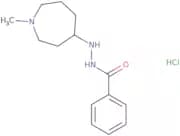
CAS:Please enquire for more information about N'-(1-Methylazepan-4-yl)benzohydrazine including the price, delivery time and more detailed product information at the technical inquiry form on this pageFórmula:C14H22ClN3OPureza:Min. 95%Peso molecular:283.8 g/mol2-Fluoro-5-hydrazinylpyridine
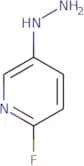
CAS:Please enquire for more information about 2-Fluoro-5-hydrazinylpyridine including the price, delivery time and more detailed product information at the technical inquiry form on this pageFórmula:C5H6FN3Pureza:Min. 95%Peso molecular:127.12 g/molEltrombopag olamine
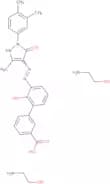
CAS:Eltrombopag olamine is an orally active drug that belongs to the class of thiazolidinones. It has been used for the treatment of thrombocytopenia in patients with chronic liver disease and myelodysplastic syndrome. Eltrombopag olamine inhibits platelet aggregation by binding to glycoprotein IIb/IIIa receptors on the surface of platelets. The drug is a prodrug that is metabolized in vivo to its active form, eltrombopag. This conversion is catalysed by CYP3A4 and CYP2D6 enzymes and can be inhibited by drugs that inhibit these enzymes, such as trifluoroacetic acid and hydroxyl group-containing compounds. Eltrombopag olamine binds to erythrocytes, which may be due to its ability to form intramolecular hydrogen bonds with nitrogen atoms. The synthesis of eltFórmula:C25H22N4O4•(C2H7NO)2Pureza:Min. 95%Forma y color:PowderPeso molecular:564.63 g/molFmoc-4-hydrazinobenzoic acid
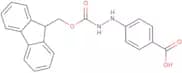
CAS:Please enquire for more information about Fmoc-4-hydrazinobenzoic acid including the price, delivery time and more detailed product information at the technical inquiry form on this pageFórmula:C22H18N2O4Pureza:Min. 95%Peso molecular:374.39 g/mol1-Methyl-1-phenylhydrazine
CAS:1-Methyl-1-phenylhydrazine (MPH) is a chemical crosslinking agent that has been shown to be an efficient method for the production of hydrogels. It is a fast and efficient method for the production of hydrogels, which are three dimensional networks of macromolecules that form strong gels. MPH can react with aminosulfonyl groups on proteins to form a covalent bond, which leads to the formation of stable cross-links in hydrogels. It also has been shown to have immunosuppressive effects and may be used as an active substance in autoimmune diseases.Fórmula:C7H10N2Pureza:Min. 95.0%Peso molecular:122.17 g/mol4-(Methylsulfonyl)phenylhydrazine hydrochloride
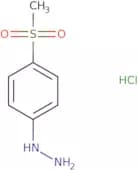
CAS:4-(Methylsulfonyl)phenylhydrazine hydrochloride is a sulfone that is used as a radiopharmaceutical agent. It can be used in the diagnosis of Alzheimer's disease and other neurodegenerative diseases. 4-(Methylsulfonyl)phenylhydrazine hydrochloride binds to carbonic anhydrase I and II, which are membrane-bound enzymes that catalyze the reversible hydration of carbon dioxide. This inhibition leads to increased blood pressure and decreased production of platelets, which can lead to thrombocytopenia. The inhibitory potency of 4-(methylsulfonyl)phenylhydrazine hydrochloride on Cox-1 and Cox-2 has been shown to be similar to that of aspirin, but it is more selective for Cox-2.Fórmula:C7H10N2O2S•HClPureza:Min. 95%Forma y color:PowderPeso molecular:222.69 g/mol1-(2-Phthalazin-1-ylhydrazino)phthalazine
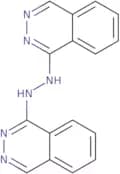
CAS:1-(2-Phthalazin-1-ylhydrazino)phthalazine is a chromatographic method for the separation of hydralazine from hydralazine hydrochloride. The method is based on the formation of a dimer between the two compounds. The parameters were optimized to provide linearity, runtime, and injected volume. This preparative method has been validated and postulated as an efficient way to separate these two drugs. The liquid chromatography was validated using bulk drug samples.Fórmula:C16H12N6Pureza:Min. 95%Peso molecular:288.31 g/mol7-Chloro-5-(2-chlorophenyl)-2-hydrazinyl-3H-1,4-benzodiazepine
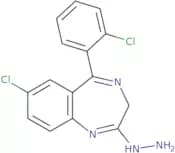
CAS:Producto controladoPlease enquire for more information about 7-Chloro-5-(2-chlorophenyl)-2-hydrazinyl-3H-1,4-benzodiazepine including the price, delivery time and more detailed product information at the technical inquiry form on this pageFórmula:C15H12Cl2N4Pureza:Min. 95%Peso molecular:319.19 g/mol4-Hydrazino-N-methyl benzene methanesulfonamide, hydrochloride (1:1)
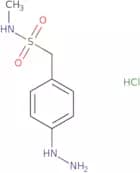
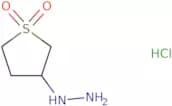
CAS:Please enquire for more information about 4-Hydrazino-N-methyl benzene methanesulfonamide, hydrochloride (1:1) including the price, delivery time and more detailed product information at the technical inquiry form on this pageFórmula:C8H14ClN3O2SPureza:Min. 95%Peso molecular:251.73 g/mol(1,1-Dioxidotetrahydro-3-thienyl)hydrazine hydrochloride
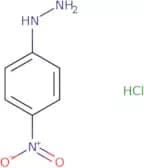
CAS:Please enquire for more information about (1,1-Dioxidotetrahydro-3-thienyl)hydrazine hydrochloride including the price, delivery time and more detailed product information at the technical inquiry form on this pageFórmula:C4H10N2O2SPureza:Min. 95%Peso molecular:150.2 g/mol4-Nitrophenylhydrazine hydrochloride
CAS:4-Nitrophenylhydrazine hydrochloride is an organic compound that belongs to the class of hydrazines. It is a colorless solid that has a melting point of 202-204 °C. 4-Nitrophenylhydrazine hydrochloride is used in the synthesis of other compounds, such as trifluoroacetic acid and nucleophilic compounds. The chemical structure can be analyzed using nuclear magnetic resonance (NMR) spectroscopy, which shows that this compound contains amines and nitro groups. 4-Nitrophenylhydrazine hydrochloride is also soluble in water due to its acidic nature. This compound reacts with bases and alcohols to form salts, such as monosodium salt.
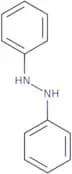
Fórmula:C6H7N3O2·HClPureza:Min. 95%Forma y color:PowderPeso molecular:189.6 g/mol1,2-Diphenylhydrazine
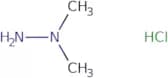
CAS:1,2-Diphenylhydrazine is an organic compound that is used as an antimicrobial agent. It has a typical chemical structure with a phenyl and hydrazine group. The hydrazine group can be substituted with other functional groups to produce different derivatives. 1,2-Diphenylhydrazine is synthesized by the reaction of phenyldiazonium chloride and benzene in the presence of hydrochloric acid. This reaction produces azobenzene as a byproduct, which reacts with hydrazine to form 1,2-diphenylhydrazine. The synthesis of 1,2-diphenylhydrazine occurs through two main mechanisms: 1) A nucleophilic substitution mechanism involving the attack of hydroxide ion on the carbonyl group of azobenzene followed by addition of hydrazine to form intermediate B and subsequent decomposition to form 1,2-diphenylFórmula:C12H12N2Pureza:Min. 95%Peso molecular:184.24 g/mol1,1-DimethylhydrazineHCl
CAS:Producto controlado1,1-DimethylhydrazineHCl is a drug that inhibits the growth of cancer cells. It is an inhibitor drug for CDK4 and CDK6, which are enzymes essential for DNA replication. 1,1-DimethylhydrazineHCl has been shown to inhibit the growth of cervical cancer cells in mice by inhibiting the epidermal growth factor receptor (EGFR). This inhibition prevents the activation of EGFR and subsequent downstream signaling pathways. 1,1-DimethylhydrazineHCl also inhibits HIV infection by inhibiting viral reverse transcriptase activity. This inhibition prevents the synthesis of viral DNA, which is required for viral replication.Fórmula:C2H9ClN2Pureza:Min. 95%Peso molecular:96.56 g/mol(2-Chlorobenzyl)hydrazine dihydrochloride
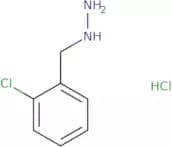
CAS:Please enquire for more information about (2-Chlorobenzyl)hydrazine dihydrochloride including the price, delivery time and more detailed product information at the technical inquiry form on this pageFórmula:C7H9ClN2Pureza:Min. 95%Peso molecular:156.61 g/molHydrazine acetate
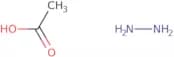
CAS:Producto controladoHydrazine acetate is an organic solution that has a glycoconjugate. It is also found in uridine, hydrogen bond and serine protease. Hydrazine acetate has been shown to have a benzyl group and carbonyl group. Hydrazine acetate interacts with trifluoroacetic acid and particle. This drug can be used for the treatment of autoimmune diseases, such as rheumatoid arthritis, and infectious diseases such as HIV/AIDS. Hydrazine acetate has shown high values for growth factor activity, which may be due to its ability to inhibit the enzyme ns3 protease in the synthesis of proinflammatory cytokines.Fórmula:C2H4O2·H4N2Pureza:Min. 95%Forma y color:White PowderPeso molecular:92.1 g/mol4-(Fmoc-hydrazino)-benzoylaminomethyl resin (200-400 mesh)
Please enquire for more information about 4-(Fmoc-hydrazino)-benzoylaminomethyl resin (200-400 mesh) including the price, delivery time and more detailed product information at the technical inquiry form on this pagePureza:Min. 95%3-Trifluoromethyl phenylhydrazine hydrochloride
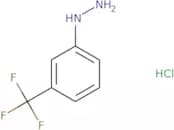
CAS:3-Trifluoromethyl phenylhydrazine HCl is a fine chemical that can be used as a versatile building block in the synthesis of complex compounds. It has been shown to be a useful intermediate for the preparation of research chemicals, reaction components and speciality chemicals. 3-Trifluoromethyl phenylhydrazine HCl belongs to CAS No. 3107-33-3 and can be used as a reagent in organic synthesis. The compound is high quality with a purity of over 99%.Fórmula:C7H8ClF3N2Pureza:Min. 95%Forma y color:PowderPeso molecular:212.6 g/mol4-Isopropylphenylhydrazine hydrochloride
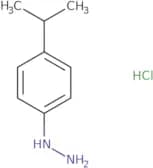
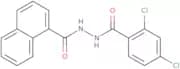
CAS:4-Isopropylphenylhydrazine, hydrochloride (IPH) is a chemical compound that has been shown to induce rearrangements in the indolenines. IPH can also be used as a nucleophile. IPH is regioselective and stereoselective for the indole ring system. It has shown to react with nucleophiles such as alcohols, amines, and thiols.Fórmula:C9H14N2•HClPureza:Min. 95%Forma y color:PowderPeso molecular:186.68 g/mol1-(2,4-Dichlorobenzoyl)-2-(1-naphthoyl)hydrazine
CAS:Please enquire for more information about 1-(2,4-Dichlorobenzoyl)-2-(1-naphthoyl)hydrazine including the price, delivery time and more detailed product information at the technical inquiry form on this pageFórmula:C18H12Cl2N2O2Pureza:Min. 95%Peso molecular:359.21 g/mol
![[3-(Trifluoromethyl)cyclopentyl]hydrazine Hydrochloride](/_next/image/?url=https%3A%2Fstatic.cymitquimica.com%2Fproducts%2FTR%2Fthumb-webp%2FT791610.webp&w=3840&q=75)