Química Orgánica Sintética
La química orgánica sintética es una rama de la química centrada en el diseño y la construcción de moléculas orgánicas a través de reacciones químicas controladas. Este campo juega un papel crucial en el desarrollo de productos farmacéuticos, agroquímicos, polímeros y materiales avanzados. En CymitQuimica, ofrecemos una gama completa de reactivos, catalizadores y building blocks de alta pureza, esenciales para la química orgánica sintética. Nuestro catálogo incluye una variedad de compuestos funcionalizados, grupos protectores, auxiliares quirales y reactivos de acoplamiento, todos rigurosamente probados para garantizar calidad y consistencia. Al proporcionar materiales de alta calidad, apoyamos a los investigadores y profesionales de la industria en la consecución de transformaciones sintéticas precisas y eficientes, facilitando el descubrimiento y desarrollo de entidades químicas innovadoras y estructuras orgánicas complejas. Nuestros productos permiten avances en química medicinal, ciencia de materiales y biología química, impulsando el progreso tanto en aplicaciones de investigación como industriales.
Subcategorías de "Química Orgánica Sintética"
- Ácidos y reactivos sintéticos(15.019 productos)
- Building Blocks(257.045 productos)
- Reacciones de formación de enlaces C-C(885 productos)
- Grupos Protectores(2.696 productos)
- Reactivos para la introducción o modificación de grupos funcionales(1.021 productos)
Se han encontrado 207 productos de "Química Orgánica Sintética"
Ordenar por
Pureza (%)
0
100
|
0
|
50
|
90
|
95
|
100
Potassium dicyanoaurate(I); 99.95% (metals basis)
CAS:Fórmula:KAu(CN)2Pureza:≥ 99.95% (trace metals basis)Forma y color:White crystalline powder or crystalsPeso molecular:288.10Potassium tetracyanoaurate(III); 99.95% (metals basis)
CAS:Fórmula:KAu(CN)4Forma y color:White crystalline powderPeso molecular:340.14Potassium tetracyanopalladate(II) hydrate, 99.95% (metals basis)
CAS:Fórmula:K2Pd(CN)4·xH2OPeso molecular:288.72Potassium dicyanoaurate(I)
CAS:Fórmula:C2AuKN2Pureza:≥ 99.9%Forma y color:White crystalline powder or crystalsPeso molecular:288.1Trihexyl(tetradecyl)phosphonium chloride, min. 95% CYPHOS IL 101
CAS:<p>Trihexyl(tetradecyl)phosphonium chloride, min. 93% CYPHOS® IL 101</p>Fórmula:(C6H13)3(C14H29)PClPureza:min. 95%Forma y color:colorless liq.Peso molecular:519.31Bis(2-cyanoethyl)-N,N-diisopropyl Phosphoramidite
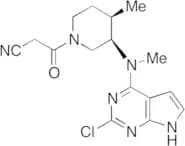
CAS:Producto controlado<p>Applications A useful phosphorylating reagent.<br> Not a dangerous good if item is equal to or less than 1g/ml and there is less than 100g/ml in the package<br></p>Fórmula:C12H22N3O2PForma y color:NeatPeso molecular:271.30N-Methyl-N-(3R,4R)-1-cyanoacetyl-4-methylpiperidin-3-yl-2-chloro-7-deazapurine-6-amine
CAS:Producto controlado<p>Applications N-Methyl-N-(3R,4R)-1-cyanoacetyl-4-methylpiperidin-3-yl-2-chloro-7-deazapurine-6-amine is a Tasocitinib (Tofacitinib [T528000]) impurity.<br></p>Fórmula:C16H19ClN6OForma y color:NeatPeso molecular:346.8152-Amino-4-cyano-5-imidazolecarboxamide
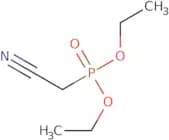
CAS:<p>Applications 2-Amino-4-cyano-5-imidazolecarboxamide (cas# 125815-68-1) is a compound useful in organic synthesis.<br></p>Fórmula:C5H5N5OForma y color:NeatPeso molecular:151.13Diethylcyanomethylphosphonate
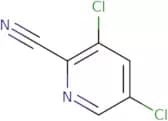
CAS:<p>Diethylcyanomethylphosphonate is a hydrochloric acid salt of diethylcyanomethylphosphonic acid. It is used in the asymmetric synthesis of many organic molecules, including pharmaceuticals, and has been shown to have antiviral properties. Diethylcyanomethylphosphonate binds to the receptor on the surface of cells and inhibits their growth. This may be due to its ability to block the binding of sodium ions to cell receptors. The drug also prevents hydroxyl group metabolism and has been shown to be active against infectious diseases such as HIV and malaria.</p>Fórmula:C6H12NO3PPureza:Min. 95%Forma y color:Colorless Clear LiquidPeso molecular:177.14 g/mol3,5-Dichloro-2-cyanopyridine
CAS:3,5-Dichloro-2-cyanopyridine is an organic compound that can be synthesized in a scalable manner. It is used to make pharmaceuticals and agrochemicals and it also has potential applications in pollution control. 3,5-Dichloro-2-cyanopyridine can be made by the reaction of cuprous cyanide with chlorocarbonyl compounds in organic solvents. This synthesis yields a product with high purity which can then be purified using chromatography. The synthesis is scalable and does not produce any side products or waste because the reactants are inexpensive, commercially available, and the product is stable under most conditions.Fórmula:C6H2N2Cl2Pureza:Min. 95%Forma y color:White PowderPeso molecular:173 g/mol5-Amino-3-cyano-4-iodo-1-[2,6-dichloro-4-(trifluoromethyl)phenyl]pyrazole
CAS:Please enquire for more information about 5-Amino-3-cyano-4-iodo-1-[2,6-dichloro-4-(trifluoromethyl)phenyl]pyrazole including the price, delivery time and more detailed product information at the technical inquiry form on this pageFórmula:C11H4Cl2F3IN4Pureza:Min. 95%Peso molecular:446.98 g/mol2,3-Dichloro-5,6-dicyanobenzoquinone
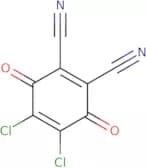
CAS:2,3-Dichloro-5,6-dicyanobenzoquinone is a chemical compound with the molecular formula C12H4Cl2O2. It is used as a chemical intermediate in the production of dyes and pesticides. 2,3-Dichloro-5,6-dicyanobenzoquinone has been shown to have cytotoxic properties against lung fibroblasts in a model system that mimics the human body's reaction to this compound. The mechanism of action is thought to involve the formation of reactive oxygen species that leads to DNA damage. 2,3-Dichloro-5,6-dicyanobenzoquinone also has antiestrogenic activity and has been shown to be active against MDA-MB-231 breast cancer cells. The activation energies for these reactions are 7.8 kcal/mol for carbonyl group elimination and 8.1 kcal/mol for hydFórmula:C8Cl2N2O2Forma y color:Yellow PowderPeso molecular:227 g/molXylene cyanol FF
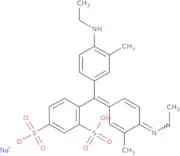
CAS:Xylene cyanol FF is a monoclonal antibody that specifically binds to the human and simian virus 40 (SV40) large T-antigen, which is a protein encoded by the SV40 genome. It is used in the diagnosis of HIV infection. The interaction between Xylene cyanol FF and SV40 large T-antigen activates caspase-3, leading to apoptosis. This binding also leads to cell lysis and DNA intercalation.Fórmula:C25H27N2NaO6S2Pureza:Min. 95%Forma y color:PowderPeso molecular:538.61 g/mol2,6-Dichloro-3-cyano-5-fluoropyridine
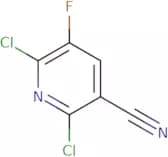
CAS:2,6-Dichloro-3-cyano-5-fluoropyridine is an inorganic compound that is a salt. It has the chemical formula CHClFNO and a molecular weight of 215.4 g/mol. The compound is soluble in water and ethanol, but insoluble in ether. It has a melting point of about -60 degrees Celsius. The compound can react with amines to form 2,6-dichloro-3-(2H)-pyridinone, which can be converted into other compounds via chlorinating or hydrolyzing the imidazole ring. This compound reacts with ethyl bromoacetate to form a monosodium salt at temperatures between 0 and 60 degrees Celsius. 2,6-Dichloro-3-cyano-5-fluoropyridine also reacts with chlorine to produce dichlorofluoropyridine, which can be oxidized by nitricFórmula:C6HCl2FN2Pureza:Min. 98 Area-%Forma y color:PowderPeso molecular:190.99 g/molTetrabutylammoniumcyanoborohydride
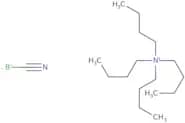
CAS:Tetrabutylammoniumcyanoborohydride (TBAB) is a reducing agent that is used in the synthesis of halides and oligosaccharides. It can be used to reduce carboxylic acids, such as sodium formate, to aldehydes or ketones. TBAB reacts with an alkoxy radical to produce trifluoroacetic acid, which can be converted back into TBAB by adding sodium formate. Tetrabutylammoniumcyanoborohydride has been shown to have chemoselective effects on cancer cells and control experiments have shown that it does not affect healthy cells.Fórmula:C17H39BN2Pureza:Min. 95%Forma y color:PowderPeso molecular:282.32 g/mol







![5-Amino-3-cyano-4-iodo-1-[2,6-dichloro-4-(trifluoromethyl)phenyl]pyrazole](/_next/image/?url=https%3A%2Fstatic.cymitquimica.com%2Fproducts%2F3D%2Fthumb-webp%2FFA99521.webp&w=3840&q=75)