Building Blocks
Esta sección contiene productos fundamentales para la síntesis de compuestos orgánicos y biológicos. Building blocks son los materiales de partida esenciales utilizados para construir moléculas complejas a través de diversas reacciones químicas. Desempeñan un papel crítico en el descubrimiento de fármacos, la ciencia de materiales y la investigación química. En CymitQuimica, ofrecemos una gama diversa de building blocks de alta calidad para apoyar sus investigaciones innovadoras y proyectos industriales, asegurando que tenga los componentes esenciales para una síntesis exitosa.
Subcategorías de "Building Blocks"
- Ácidos borónicos y derivados del ácido borónico(5.786 productos)
- Building Blocks quirales(1.246 productos)
- Building Blocks de hidrocarburos(6.107 productos)
- Building Blocks orgánicos(61.079 productos)
Se han encontrado 205461 productos de "Building Blocks"
Ordenar por
Pureza (%)
0
100
|
0
|
50
|
90
|
95
|
100
N-[1-(4-Methylbenzenesulfonyl)piperidin-4-ylidene]hydroxylamine
CAS:Versatile small molecule scaffold
Fórmula:C12H16N2O3SPureza:Min. 95%Peso molecular:268.33 g/mol3-Fluoro-3-(3-fluorophenyl)cyclobutane-1-carboxylic acid
CAS:Versatile small molecule scaffoldFórmula:C11H10F2O2Pureza:Min. 95%Peso molecular:212.19 g/mol3-Methyl-4-propyl-4H-1,2,4-triazole
CAS:Versatile small molecule scaffold
Fórmula:C6H11N3Pureza:Min. 95%Peso molecular:125.17 g/mol1-(4-Amino-3-ethylpiperidin-1-yl)-2-methylpropan-1-one hydrochloride
CAS:Versatile small molecule scaffoldFórmula:C11H23ClN2OPureza:Min. 95%Peso molecular:234.76 g/molRef: 3D-YGC02922
Producto descatalogado5-[4-(Trifluoromethyl)phenyl]pyrrolidin-3-ol hydrochloride
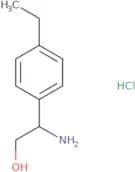
CAS:Versatile small molecule scaffoldFórmula:C11H13ClF3NOPureza:Min. 95%Peso molecular:267.67 g/mol2-Amino-2-(4-ethylphenyl)ethan-1-ol hydrochloride
CAS:Versatile small molecule scaffold
Fórmula:C10H16ClNOPureza:Min. 95%Peso molecular:201.69 g/mol3-[2-(4-Methoxypyrrolidin-2-yl)-1H-imidazol-4-yl]pyridine trihydrochloride
CAS:Versatile small molecule scaffold
Fórmula:C13H19Cl3N4OPureza:Min. 95%Peso molecular:353.7 g/mol3-[3-(Benzyloxy)phenyl]-3-hydroxy-2,2-dimethylpropanoic acid
CAS:Versatile small molecule scaffold
Fórmula:C18H20O4Pureza:Min. 95%Peso molecular:300.3 g/mol[5-(Aminomethyl)-2-fluorophenyl]methanol hydrochloride
CAS:Versatile small molecule scaffoldFórmula:C8H11ClFNOPureza:Min. 95%Peso molecular:191.63 g/mol[1-(Ethoxymethyl)cyclobutyl]methanol
CAS:Versatile small molecule scaffold
Fórmula:C8H16O2Pureza:Min. 95%Peso molecular:144.21 g/mol2-[N-(2-Phenylethyl)acetamido]acetic acid
CAS:Versatile small molecule scaffold
Fórmula:C12H15NO3Pureza:Min. 95%Peso molecular:221.25 g/mol3-{[3-(Thiophen-3-yl)-1,2,4-oxadiazol-5-yl]methyl}thiomorpholine hydrochloride
CAS:Versatile small molecule scaffold
Fórmula:C11H14ClN3OS2Pureza:Min. 95%Peso molecular:303.8 g/molRef: 3D-YGC02770
Producto descatalogado2-Methylpyrrolidine-2-carboxylic acid hydrochloride
CAS:2-Methylpyrrolidine-2-carboxylic acid hydrochloride is a research chemical that has various characteristics and applications. It is used as a proton pump inhibitor, which means it helps reduce the production of stomach acid by blocking the action of the gastric proton pump. This can be beneficial in treating conditions such as gastroesophageal reflux disease (GERD) and peptic ulcers.Fórmula:C6H12ClNO2Pureza:Min. 95%Peso molecular:165.62 g/molN-(2-Aminoethyl)-2,5-dimethylthiophene-3-sulfonamide hydrochloride
CAS:Versatile small molecule scaffold
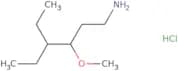
Fórmula:C8H15ClN2O2S2Pureza:Min. 95%Peso molecular:270.8 g/mol4-Ethyl-3-methoxyhexan-1-amine hydrochloride
CAS:Versatile small molecule scaffold
Fórmula:C9H22ClNOPureza:Min. 95%Peso molecular:195.73 g/mol2-Amino-1-methylcyclopentane-1-carboxylic acid hydrochloride
CAS:Versatile small molecule scaffold
Fórmula:C7H14ClNO2Pureza:Min. 95%Peso molecular:179.64 g/mol2-[(3-Bromophenyl)methanesulfonyl]acetic acid
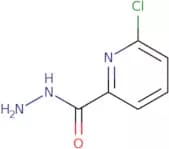
CAS:2-[(3-Bromophenyl)methanesulfonyl]acetic acid is a white crystalline solid that inhibits ion channels by binding to the ligand-binding site of the channel protein. It is a research tool that can be used to study ion channel proteins and their interactions with other proteins, such as antibodies and peptides. 2-[(3-Bromophenyl)methanesulfonyl]acetic acid has been shown to inhibit ligand-gated ion channels, including nicotinic acetylcholine receptors and GABAA receptors. This inhibitor also binds to voltage-gated ion channels, inhibiting sodium and potassium currents.Fórmula:C9H9BrO4SPureza:Min. 95%Peso molecular:293.14 g/mol6-Chloropyridine-2-carbohydrazide
CAS:Versatile small molecule scaffold
Fórmula:C6H6ClN3OPureza:Min. 95%Peso molecular:171.58 g/mol2-[(5-Methyl-1,2-oxazol-3-yl)methyl]propanedioic acid
CAS:Versatile small molecule scaffold
Fórmula:C8H9NO5Pureza:Min. 95%Peso molecular:199.2 g/mol2-Chloro-5-methanesulfonylthiophene
CAS:Versatile small molecule scaffold
Fórmula:C5H5ClO2S2Pureza:Min. 95%Peso molecular:196.7 g/mol
![N-[1-(4-Methylbenzenesulfonyl)piperidin-4-ylidene]hydroxylamine](/_next/image/?url=https%3A%2Fstatic.cymitquimica.com%2Fproducts%2F3D%2Fthumb-webp%2FYLB17031.webp&w=3840&q=75)


![5-[4-(Trifluoromethyl)phenyl]pyrrolidin-3-ol hydrochloride](/_next/image/?url=https%3A%2Fstatic.cymitquimica.com%2Fproducts%2F3D%2Fthumb-webp%2FYGC02918.webp&w=3840&q=75)
![3-[2-(4-Methoxypyrrolidin-2-yl)-1H-imidazol-4-yl]pyridine trihydrochloride](/_next/image/?url=https%3A%2Fstatic.cymitquimica.com%2Fproducts%2F3D%2Fthumb-webp%2FYGC02903.webp&w=3840&q=75)
![3-[3-(Benzyloxy)phenyl]-3-hydroxy-2,2-dimethylpropanoic acid](/_next/image/?url=https%3A%2Fstatic.cymitquimica.com%2Fproducts%2F3D%2Fthumb-webp%2FYGC02878.webp&w=3840&q=75)
![[5-(Aminomethyl)-2-fluorophenyl]methanol hydrochloride](/_next/image/?url=https%3A%2Fstatic.cymitquimica.com%2Fproducts%2F3D%2Fthumb-webp%2FYGC02839.webp&w=3840&q=75)
![[1-(Ethoxymethyl)cyclobutyl]methanol](/_next/image/?url=https%3A%2Fstatic.cymitquimica.com%2Fproducts%2F3D%2Fthumb-webp%2FYGC02833.webp&w=3840&q=75)
![2-[N-(2-Phenylethyl)acetamido]acetic acid](/_next/image/?url=https%3A%2Fstatic.cymitquimica.com%2Fproducts%2F3D%2Fthumb-webp%2FYGC02784.webp&w=3840&q=75)
![3-{[3-(Thiophen-3-yl)-1,2,4-oxadiazol-5-yl]methyl}thiomorpholine hydrochloride](/_next/image/?url=https%3A%2Fstatic.cymitquimica.com%2Fproducts%2F3D%2Fthumb-webp%2FYGC02770.webp&w=3840&q=75)
![2-[(3-Bromophenyl)methanesulfonyl]acetic acid](/_next/image/?url=https%3A%2Fstatic.cymitquimica.com%2Fproducts%2F3D%2Fthumb-webp%2FYDA28812.webp&w=3840&q=75)
![2-[(5-Methyl-1,2-oxazol-3-yl)methyl]propanedioic acid](/_next/image/?url=https%3A%2Fstatic.cymitquimica.com%2Fproducts%2F3D%2Fthumb-webp%2FYDA03434.webp&w=3840&q=75)