


Building Blocks
Esta sección contiene productos fundamentales para la síntesis de compuestos orgánicos y biológicos. Building blocks son los materiales de partida esenciales utilizados para construir moléculas complejas a través de diversas reacciones químicas. Desempeñan un papel crítico en el descubrimiento de fármacos, la ciencia de materiales y la investigación química. En CymitQuimica, ofrecemos una gama diversa de building blocks de alta calidad para apoyar sus investigaciones innovadoras y proyectos industriales, asegurando que tenga los componentes esenciales para una síntesis exitosa.
Subcategorías de "Building Blocks"
- Ácidos borónicos y derivados del ácido borónico(5.756 productos)
- Building Blocks quirales(1.242 productos)
- Building Blocks de hidrocarburos(6.095 productos)
- Building Blocks orgánicos(61.051 productos)
Se han encontrado 199813 productos de "Building Blocks"
Ordenar por
Pureza (%)
0
100
|
0
|
50
|
90
|
95
|
100
[1-(1-Amino-2-methylpropyl)cyclopent-3-en-1-yl]methanol hydrochloride
CAS:<p>Versatile small molecule scaffold</p>Fórmula:C10H20ClNOPureza:Min. 95%Peso molecular:205.72 g/mol2-[({12-Oxo-7-thia-9,11-diazatricyclo[6.4.0.0,2,6]dodeca-1(8),2(6),9-trien-10-yl}methyl)sulfanyl]acetic acid
CAS:<p>Versatile small molecule scaffold</p>Fórmula:C12H12N2O3S2Pureza:Min. 95%Peso molecular:296.4 g/molMethyl 4-methyl-3-{[(4-methyl-1H-imidazol-5-yl)methyl]amino}benzoate
CAS:<p>Versatile small molecule scaffold</p>Fórmula:C14H17N3O2Pureza:Min. 95%Peso molecular:259.3 g/molMethyl 3-[imino(methyl)oxo-λ⁶-sulfanyl]benzoate
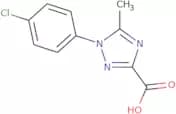
CAS:<p>Versatile small molecule scaffold</p>Fórmula:C9H11NO3SPureza:Min. 95%Peso molecular:213.3 g/mol1-(4-Chlorophenyl)-5-methyl-1H-1,2,4-triazole-3-carboxylic acid
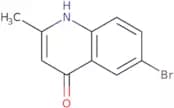
CAS:<p>Versatile small molecule scaffold</p>Fórmula:C10H8ClN3O2Pureza:Min. 95%Peso molecular:237.65 g/mol6-Bromo-2-methylquinolin-4-ol
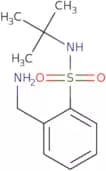
CAS:<p>Versatile small molecule scaffold</p>Fórmula:C10H8BrNOPureza:Min. 95%Peso molecular:238.08 g/mol2-(Aminomethyl)-N-tert-butylbenzene-1-sulfonamide
CAS:<p>Versatile small molecule scaffold</p>Fórmula:C11H18N2O2SPureza:Min. 95%Peso molecular:242.34 g/mol3-{[4-(Trifluoromethyl)phenyl]methyl}oxolan-3-amine hydrochloride
CAS:<p>Versatile small molecule scaffold</p>Fórmula:C12H15ClF3NOPureza:Min. 95%Peso molecular:281.7 g/molRef: 3D-DXC60411
Producto descatalogado2-{[3-(Dimethylamino)propyl]sulfanyl}aniline
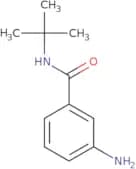
CAS:<p>Versatile small molecule scaffold</p>Fórmula:C11H18N2SPureza:Min. 95%Peso molecular:210.34 g/mol3-Amino-N-(tert-butyl)benzamide
CAS:<p>Versatile small molecule scaffold</p>Fórmula:C11H16N2OPureza:Min. 95%Peso molecular:192.26 g/molQuinoline-5-carbonitrile
CAS:<p>Quinoline-5-carbonitrile is a cyanide compound that can be used in the synthesis of heterocyclic compounds. The reaction between quinoline and 5-cyanovaleric acid produces 6-nitroquinoline, which is then converted to dimethyl sulfoxide by alcoholysis. This reaction product can then be used to synthesize an amide or nucleophile. Quinoline-5-carbonitrile reacts with potassium in the presence of bifunctional hydrazide to produce a cyanide ion, which can be hydrolyzed by an acid to release hydrogen cyanide gas. This experiment has been shown as a model for reactions involving cyano compounds.</p>Fórmula:C10H6N2Pureza:Min. 95%Peso molecular:154.17 g/mol3-Boc-3-azabicyclo[3.2.1]octan-8-amine
CAS:<p>Versatile small molecule scaffold</p>Fórmula:C12H22N2O2Pureza:Min. 95%Peso molecular:226.32 g/mol2-Bromo-3,3,3-trifluoro-1-propene
CAS:Producto controlado<p>2-Bromo-3,3,3-trifluoro-1-propene is a chemical compound that has been synthesized in an asymmetric reaction. The reactant is bromopropane and the product is 2,2,2-trifluoropropene. The methylene group on the propene molecule is activated by the nucleophilic attack of a fluoride ion from hydrogen fluoride to form a cavity with a highly strained bond. The kinetic study of this reaction revealed that the activation energy for the reaction is 42 kJ/mol. Palladium-catalyzed coupling reactions are catalyzed by palladium and require nonpolar solvents such as toluene or dichloromethane. This type of reaction has been shown to be exothermic with an isolated yield of 1%.</p>Fórmula:C3H2BrF3Pureza:Min. 95%Forma y color:Colorless PowderPeso molecular:174.95 g/mol
![[1-(1-Amino-2-methylpropyl)cyclopent-3-en-1-yl]methanol hydrochloride](/_next/image/?url=https%3A%2Fstatic.cymitquimica.com%2Fproducts%2F3D%2Fthumb-webp%2FJBD31750.webp&w=3840&q=75)

![2-[({12-Oxo-7-thia-9,11-diazatricyclo[6.4.0.0,2,6]dodeca-1(8),2(6),9-trien-10-yl}methyl)sulfanyl]a…](/_next/image/?url=https%3A%2Fstatic.cymitquimica.com%2Fproducts%2F3D%2Fthumb-webp%2FZEB92070.webp&w=3840&q=75)
![Methyl 4-methyl-3-{[(4-methyl-1H-imidazol-5-yl)methyl]amino}benzoate](/_next/image/?url=https%3A%2Fstatic.cymitquimica.com%2Fproducts%2F3D%2Fthumb-webp%2FQCC36887.webp&w=3840&q=75)
![Methyl 3-[imino(methyl)oxo-λ⁶-sulfanyl]benzoate](/_next/image/?url=https%3A%2Fstatic.cymitquimica.com%2Fproducts%2F3D%2Fthumb-webp%2FCRB73086.webp&w=3840&q=75)
![3-{[4-(Trifluoromethyl)phenyl]methyl}oxolan-3-amine hydrochloride](/_next/image/?url=https%3A%2Fstatic.cymitquimica.com%2Fproducts%2F3D%2Fthumb-webp%2FDXC60411.webp&w=3840&q=75)
![2-{[3-(Dimethylamino)propyl]sulfanyl}aniline](/_next/image/?url=https%3A%2Fstatic.cymitquimica.com%2Fproducts%2F3D%2Fthumb-webp%2FBAA13477.webp&w=3840&q=75)
![3-Boc-3-azabicyclo[3.2.1]octan-8-amine](/_next/image/?url=https%3A%2Fstatic.cymitquimica.com%2Fproducts%2F3D%2Fthumb-webp%2FFDC76351.webp&w=3840&q=75)
