Building Blocks
Esta sección contiene productos fundamentales para la síntesis de compuestos orgánicos y biológicos. Building blocks son los materiales de partida esenciales utilizados para construir moléculas complejas a través de diversas reacciones químicas. Desempeñan un papel crítico en el descubrimiento de fármacos, la ciencia de materiales y la investigación química. En CymitQuimica, ofrecemos una gama diversa de building blocks de alta calidad para apoyar sus investigaciones innovadoras y proyectos industriales, asegurando que tenga los componentes esenciales para una síntesis exitosa.
Subcategorías de "Building Blocks"
- Ácidos borónicos y derivados del ácido borónico(5.778 productos)
- Building Blocks quirales(1.243 productos)
- Building Blocks de hidrocarburos(6.098 productos)
- Building Blocks orgánicos(61.042 productos)
Se han encontrado 204339 productos de "Building Blocks"
Ordenar por
Pureza (%)
0
100
|
0
|
50
|
90
|
95
|
100
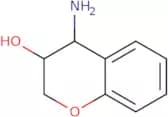
rac-(3R,4R)-4-Amino-3,4-dihydro-2H-1-benzopyran-3-ol
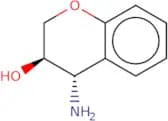
CAS:<p>Versatile small molecule scaffold</p>Fórmula:C9H11NO2Pureza:Min. 95%Peso molecular:165.19 g/molrac-(3R,4S)-4-Amino-3,4-dihydro-2H-1-benzopyran-3-ol
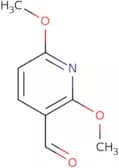
CAS:Versatile small molecule scaffoldFórmula:C9H11NO2Pureza:Min. 95%Peso molecular:165.2 g/mol2,6-Dimethoxypyridine-3-carbaldehyde
CAS:2,6-Dimethoxypyridine-3-carbaldehyde is a chemical that is used in the production of other chemicals. It is also used as an antifungal agent in vitro. 2,6-Dimethoxypyridine-3-carbaldehyde is activated by irradiation with ultraviolet light. The yield and reactivity are increased when it is used in the presence of catalysts such as thiosemicarbazide. Candida albicans and Aspergillus parasiticus can be inhibited by this compound at low concentrations. 2,6-Dimethoxypyridine-3-carbaldehyde has been shown to inhibit growth of Aspergillus on a petri dish, but not Candida albicans cells. This may be due to its inability to cross the cell membrane or because Candida albicans cells are able to synthesize their own pyridoxine (vitamin B6).Fórmula:C8H9NO3Pureza:Min. 95%Peso molecular:167.16 g/mol6-(2-Bromoacetyl)-3,4-dihydro-2H-1,4-benzoxazin-3-one
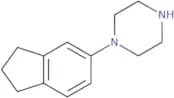
CAS:Versatile small molecule scaffoldFórmula:C10H8BrNO3Pureza:Min. 95%Peso molecular:270.08 g/mol1-(2,3-Dihydro-1H-inden-5-yl)piperazine
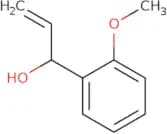
CAS:Producto controlado<p>Versatile small molecule scaffold</p>Fórmula:C13H18N2Pureza:Min. 95%Peso molecular:202.3 g/mol1-(2-Methoxyphenyl)prop-2-en-1-ol
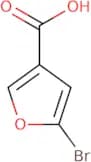
CAS:Versatile small molecule scaffoldFórmula:C10H12O2Pureza:Min. 95%Peso molecular:164.2 g/mol2-Bromofuran-4-carboxylic acid
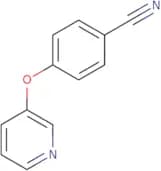
CAS:2-Bromofuran-4-carboxylic acid is a heterocyclic compound that has been reported in the synthesis of dioxaspiro[5.5]undecane frameworks. It is also found in the synthesis of butenolides and intramolecular reactions. The synthetic studies on 2-bromofuran-4-carboxylic acid have shown that it can be used as a building block for heterocycles with novel structures.Fórmula:C5H3BrO3Pureza:Min. 95%Peso molecular:190.98 g/mol4-(Pyridin-3-yloxy)benzonitrile
CAS:Versatile small molecule scaffoldFórmula:C12H8N2OPureza:Min. 95%Peso molecular:196.2 g/mol4-[(5-Bromopyridin-2-yl)oxy]benzoic acid
CAS:Versatile small molecule scaffoldFórmula:C12H8BrNO3Pureza:Min. 95%Peso molecular:294.1 g/mol4-[(4-Methylpyridin-2-yl)oxy]benzoic acid
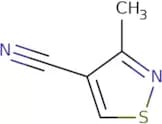
CAS:<p>Versatile small molecule scaffold</p>Fórmula:C13H11NO3Pureza:Min. 95%Peso molecular:229.2 g/mol3-Methylisothiazole-4-carbonitrile
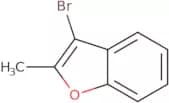
CAS:Versatile small molecule scaffoldFórmula:C5H4N2SPureza:Min. 95%Peso molecular:124.16 g/mol3-Bromo-2-methylbenzofuran
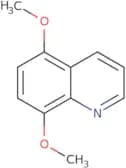
CAS:<p>3-Bromo-2-methylbenzofuran is a chiral compound that has been shown to stabilize the DNA of irradiated, homochiral DNA. It is also used as an intermediate in the synthesis of other compounds. 3-Bromo-2-methylbenzofuran has a high melting point, which makes it difficult to purify. The compound crystallizes unsymmetrically and fluoresces. It can undergo photochromism and isomerization under ultraviolet light. 3-Bromo-2-methylbenzofuran has a low solubility in water and can be toxic if inhaled or ingested. This compound exhibits fluorescence properties, which may be due to its ability to absorb light at wavelengths longer than 400 nm and emit light at wavelengths shorter than 400 nm.</p>Fórmula:C9H7BrOPureza:Min. 95%Peso molecular:211.06 g/mol5,8-dimethoxyquinoline
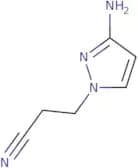
CAS:<p>5,8-dimethoxyquinoline is a nitrate that is used in the synthesis of heterocyclic compounds. It can be prepared by alkylation of 5,8-dimethoxybenzaldehyde with methyl iodide and sodium nitrite in the presence of ethanol or by the reaction of 2-nitropropane with benzaldehyde. The n-oxide of this compound has been shown to have activity against solid tumours and human lung carcinoma cell lines. 5,8-Dimethoxyquinoline reacts with dimethylhydrazone to form an unstable carbonyl intermediate which undergoes a 1,2-shift in nmr chemical shift.</p>Fórmula:C11H11NO2Pureza:Min. 95%Peso molecular:189.21 g/mol3-(3-Amino-1H-pyrazol-1-yl)propanenitrile
CAS:<p>Versatile small molecule scaffold</p>Fórmula:C6H8N4Pureza:Min. 95%Peso molecular:136.15 g/mol3-[(4-Chlorophenyl)sulfanyl]-5-nitroaniline
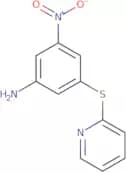
CAS:Versatile small molecule scaffoldFórmula:C12H9ClN2O2SPureza:Min. 95%Peso molecular:280.73 g/mol3-Nitro-5-(pyridin-2-ylsulfanyl)aniline
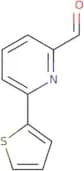
CAS:<p>Versatile small molecule scaffold</p>Fórmula:C11H9N3O2SPureza:Min. 95%Peso molecular:247.28 g/mol6-(2-Thienyl)-2-pyridinecarboxaldehyde
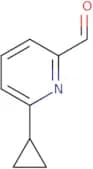
CAS:6-(2-Thienyl)-2-pyridinecarboxaldehyde is an experimental compound that has not been tested in humans. It is a liquid at room temperature, with a boiling point of 230°C. 6-(2-Thienyl)-2-pyridinecarboxaldehyde can be injected intravenously, intramuscularly, or subcutaneously. The compound has shown promise in preliminary experiments as a chemotherapeutic agent against cancer and chronic viral infections.Fórmula:C10H7NOSPureza:Min. 95%Peso molecular:189.23 g/mol6-Cyclopropyl-2-pyridinecarboxaldehyde
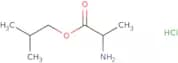
CAS:Versatile small molecule scaffoldFórmula:C9H9NOPureza:Min. 95%Peso molecular:147.17 g/mol2-Methylpropyl (2S)-2-aminopropanoate hydrochloride
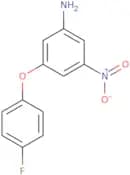
CAS:Versatile small molecule scaffoldFórmula:C7H16ClNO2Pureza:Min. 95%Peso molecular:181.66 g/mol3-(4-Fluorophenoxy)-5-nitroaniline
CAS:<p>Versatile small molecule scaffold</p>Fórmula:C12H9FN2O3Pureza:Min. 95%Peso molecular:248.21 g/mol

![4-[(5-Bromopyridin-2-yl)oxy]benzoic acid](/_next/image/?url=https%3A%2Fstatic.cymitquimica.com%2Fproducts%2F3D%2Fthumb-webp%2FICA83585.webp&w=3840&q=75)
![4-[(4-Methylpyridin-2-yl)oxy]benzoic acid](/_next/image/?url=https%3A%2Fstatic.cymitquimica.com%2Fproducts%2F3D%2Fthumb-webp%2FICA83587.webp&w=3840&q=75)
![3-[(4-Chlorophenyl)sulfanyl]-5-nitroaniline](/_next/image/?url=https%3A%2Fstatic.cymitquimica.com%2Fproducts%2F3D%2Fthumb-webp%2FIIA03897.webp&w=3840&q=75)