Building Blocks
Esta sección contiene productos fundamentales para la síntesis de compuestos orgánicos y biológicos. Building blocks son los materiales de partida esenciales utilizados para construir moléculas complejas a través de diversas reacciones químicas. Desempeñan un papel crítico en el descubrimiento de fármacos, la ciencia de materiales y la investigación química. En CymitQuimica, ofrecemos una gama diversa de building blocks de alta calidad para apoyar sus investigaciones innovadoras y proyectos industriales, asegurando que tenga los componentes esenciales para una síntesis exitosa.
Subcategorías de "Building Blocks"
- Ácidos borónicos y derivados del ácido borónico(5.756 productos)
- Building Blocks quirales(1.242 productos)
- Building Blocks de hidrocarburos(6.095 productos)
- Building Blocks orgánicos(61.037 productos)
Se han encontrado 196139 productos de "Building Blocks"
Ordenar por
Pureza (%)
0
100
|
0
|
50
|
90
|
95
|
100
(2E)-3-[2-(Allyloxy)phenyl]acrylic acid
CAS:<p>Versatile small molecule scaffold</p>Fórmula:C12H12O3Pureza:Min. 95%Peso molecular:204.22 g/mol8-ethynylisoquinoline
CAS:<p>Versatile small molecule scaffold</p>Fórmula:C11H7NPureza:Min. 95%Peso molecular:153.18 g/mol2-(2-Chlorophenyl)cyclohexan-1-one
CAS:<p>Versatile small molecule scaffold</p>Fórmula:C12H13ClOPureza:Min. 95%Peso molecular:208.68 g/mol3-(1-Methyl-1H-1,2,3,4-tetrazol-5-yl)propan-1-amine
CAS:<p>Versatile small molecule scaffold</p>Fórmula:C5H11N5Pureza:Min. 95%Peso molecular:141.2 g/moltert-Butyl N-(3-amino-2-methylbutan-2-yl)carbamate
CAS:<p>Versatile small molecule scaffold</p>Fórmula:C10H22N2O2Pureza:Min. 95%Peso molecular:202.3 g/mol3,4-Dimethyl-6H,7H-[1,2]oxazolo[5,4-b]pyridin-6-one
CAS:<p>Versatile small molecule scaffold</p>Fórmula:C8H8N2O2Pureza:Min. 95%Peso molecular:164.16 g/molBicyclo[3.3.1]nonan-3-amine hydrochloride
CAS:<p>Versatile small molecule scaffold</p>Fórmula:C9H18ClNPureza:Min. 95%Peso molecular:175.7 g/molEthyl 2-cyclopropanecarbonyl-4-oxopentanoate
CAS:<p>Versatile small molecule scaffold</p>Fórmula:C11H16O4Pureza:Min. 95%Peso molecular:212.2 g/molEthyl 2-amino-4-(5-methyl-2-thienyl)thiophene-3-carboxylate
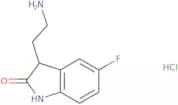
CAS:<p>Versatile small molecule scaffold</p>Fórmula:C12H13NO2S2Pureza:Min. 95%Peso molecular:267.37 g/mol3-(2-Aminoethyl)-5-fluoro-2,3-dihydro-1H-indol-2-one hydrochloride
CAS:<p>Versatile small molecule scaffold</p>Fórmula:C10H12ClFN2OPureza:Min. 95%Peso molecular:230.66 g/molN-Methyl-N-phenylpiperidin-4-amine dihydrochloride
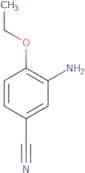
CAS:<p>Versatile small molecule scaffold</p>Fórmula:C12H20Cl2N2Pureza:Min. 95%Peso molecular:263.2 g/mol3-Amino-4-ethoxybenzonitrile
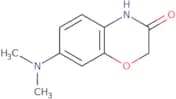
CAS:<p>Versatile small molecule scaffold</p>Fórmula:C9H10N2OPureza:Min. 95%Peso molecular:162.19 g/mol7-(Dimethylamino)-3,4-dihydro-2H-1,4-benzoxazin-3-one
CAS:<p>Versatile small molecule scaffold</p>Fórmula:C10H12N2O2Pureza:Min. 95%Peso molecular:192.21 g/mol3-(Trifluoromethyl)-1,4,5,7-tetrahydropyrano[3,4-c]pyrazole
CAS:<p>Versatile small molecule scaffold</p>Fórmula:C7H7F3N2OPureza:Min. 95%Peso molecular:192.14 g/mol3-Bromo-5-tert-butylphenol
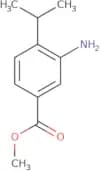
CAS:<p>Versatile small molecule scaffold</p>Fórmula:C10H13BrOPureza:Min. 95%Peso molecular:229.11 g/molMethyl 3-amino-4-(propan-2-yl)benzoate
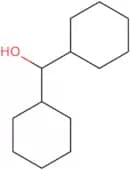
CAS:<p>Versatile small molecule scaffold</p>Fórmula:C11H15NO2Pureza:Min. 95%Peso molecular:193.24 g/molDicyclohexylmethanol
CAS:<p>Dicyclohexylmethanol is a trifunctional compound that contains a hydroxyl group, and can be used as a hydrogen bond donor or acceptor. The chemical structure of dicyclohexylmethanol can be seen in the figure below. Dicyclohexylmethanol has been used for sample preparation for hydrogen chloride gas. It has also been used to determine the concentration of blood ethanol levels and to measure blood pH in humans. Dicyclohexylmethanol is an important reactant in asymmetric synthesis reactions due to its ability to form hydrogen bonds with both reactants.</p>Fórmula:C13H24OPureza:Min. 95%Peso molecular:196.33 g/mol2-Cyanobiphenyl
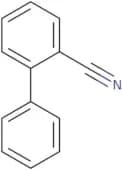
CAS:<p>2-Cyanobiphenyl is a versatile research chemical that has various applications in the field of chemistry. It is a biphenyl compound that is commonly used as a fluorescent probe in scientific experiments. The chemical structure of 2-Cyanobiphenyl makes it an ideal candidate for studying phase transitions and solid-state NMR (Nuclear Magnetic Resonance). Researchers often use this compound to investigate the phase transition temperature and properties of different materials, such as nematic liquid crystals.</p>Fórmula:C13H9NPureza:Min. 95%Peso molecular:179.22 g/moltert-Butyl 2,2-dimethyl-3-oxo-4-propylpiperazine-1-carboxylate
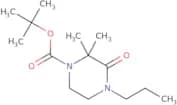
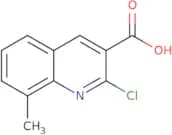
CAS:<p>Versatile small molecule scaffold</p>Fórmula:C14H26N2O3Pureza:Min. 95%Peso molecular:270.37 g/mol2-Chloro-8-methylquinoline-3-carboxylic acid
CAS:<p>Versatile small molecule scaffold</p>Fórmula:C11H8ClNO2Pureza:Min. 95%Peso molecular:221.64 g/mol
![(2E)-3-[2-(Allyloxy)phenyl]acrylic acid](/_next/image/?url=https%3A%2Fstatic.cymitquimica.com%2Fproducts%2F3D%2Fthumb-webp%2FPWB51701.webp&w=3840&q=75)

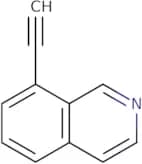
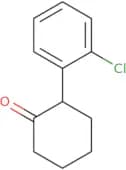
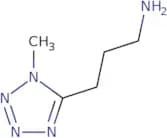
![3,4-Dimethyl-6H,7H-[1,2]oxazolo[5,4-b]pyridin-6-one](/_next/image/?url=https%3A%2Fstatic.cymitquimica.com%2Fproducts%2F3D%2Fthumb-webp%2FUAA38556.webp&w=3840&q=75)
![Bicyclo[3.3.1]nonan-3-amine hydrochloride](/_next/image/?url=https%3A%2Fstatic.cymitquimica.com%2Fproducts%2F3D%2Fthumb-webp%2FUAA38864.webp&w=3840&q=75)


![3-(Trifluoromethyl)-1,4,5,7-tetrahydropyrano[3,4-c]pyrazole](/_next/image/?url=https%3A%2Fstatic.cymitquimica.com%2Fproducts%2F3D%2Fthumb-webp%2FXQB93148.webp&w=3840&q=75)