Building Blocks
Subcategorías de "Building Blocks"
- Ácidos borónicos y derivados del ácido borónico(5.784 productos)
- Building Blocks quirales(1.244 productos)
- Building Blocks de hidrocarburos(6.105 productos)
- Building Blocks orgánicos(61.076 productos)
Se han encontrado 205454 productos de "Building Blocks"
(1S,4S)-5-[(tert-Butoxy)carbonyl]-2-oxa-5-azabicyclo[2.2.1]heptane-1-carboxylic acid
CAS:Please enquire for more information about (1S,4S)-5-[(tert-Butoxy)carbonyl]-2-oxa-5-azabicyclo[2.2.1]heptane-1-carboxylic acid including the price, delivery time and more detailed product information at the technical inquiry form on this page
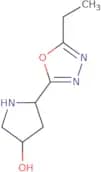
Fórmula:C11H17NO5Pureza:Min. 95%Peso molecular:243.26 g/mol(3R,5R)-5-(5-Ethyl-1,3,4-oxadiazol-2-yl)pyrrolidin-3-ol
CAS:Versatile small molecule scaffold
Fórmula:C8H13N3O2Pureza:Min. 95%Peso molecular:183.21 g/molRef: 3D-HCD11441
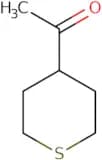
Producto descatalogado1-(Thian-4-yl)ethan-1-one
CAS:Versatile small molecule scaffold
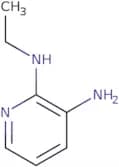
Fórmula:C7H12OSPureza:Min. 95%Peso molecular:144.24 g/mol2-N-Ethylpyridine-2,3-diamine
CAS:2-N-Ethylpyridine-2,3-diamine is a small molecule inhibitor that binds to the ATP binding site of HIV reverse transcriptase and inhibits its activity. It has been shown to inhibit the proliferation of human tumor cells in culture. This compound also prevents the formation of new virus particles and leads to a decrease in viral load. 2-N-Ethylpyridine-2,3-diamine does not bind to the same site as nevirapine, but instead binds to a different amino acid residue on the reverse transcriptase enzyme called Y181C. Residues at this location are found in all HIV strains resistant to nevirapine.
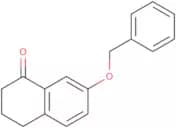
Fórmula:C7H11N3Pureza:Min. 95%Peso molecular:137.18 g/mol7-(Benzyloxy)-3,4-dihydronaphthalen-1(2H)-one
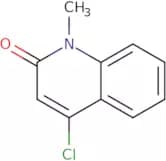
CAS:7-(Benzyloxy)-3,4-dihydronaphthalen-1(2H)-one is a tricyclic carboxamide that belongs to the carboxylic acid group. It has a constant boiling point and an acidic pH. 7-(Benzyloxy)-3,4-dihydronaphthalen-1(2H)-one is soluble in water and dilute acids. It has been shown that the melting point of 7-(Benzyloxy)-3,4-dihydronaphthalen-1(2H)-one is not affected by dilution or experiments. The chemical compounds are made up of benzoic acid and carboxylic acid groups that form a six-membered ring with two heterocycles on either side of the molecule.Fórmula:C17H16O2Pureza:Min. 95%Peso molecular:252.31 g/mol4-Chloro-1-methylquinolin-2(1H)-one
CAS:4-Chloro-1-methylquinolin-2(1H)-one is a molecule with analgesic activity. It has been shown to produce analgesia in the rat tail flick and hot plate tests, as well as anti-nociceptive effects in the mouse formalin test. The analgesic effect of 4-chloro-1-methylquinolin-2(1H)-one is thought to be due to its ability to inhibit the release of excitatory neurotransmitters from peripheral sensory neurons. This molecule has also been shown to have anti-inflammatory properties and is an intermediate for the synthesis of other drugs, such as diclofenac sodium.
Fórmula:C10H8ClNOPureza:Min. 95%Peso molecular:193.63 g/mol6-Chloro-2,3,4,9-tetrahydro-1H-carbazol-3-ol
CAS:Versatile small molecule scaffold
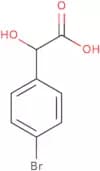
Fórmula:C12H12ClNOPureza:Min. 95%Peso molecular:221.68 g/mol(R)-4-Bromomandelic acid
CAS:Versatile small molecule scaffold
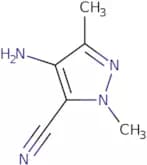
Fórmula:C8H7BrO3Pureza:Min. 95%Peso molecular:231.04 g/mol4-Amino-1,3-dimethyl-1H-pyrazole-5-carbonitrile
CAS:Versatile small molecule scaffold
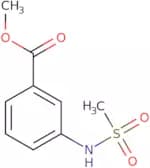
Fórmula:C6H8N4Pureza:Min. 95%Peso molecular:136.15 g/molMethyl 3-methanesulfonamidobenzoate
CAS:Methyl 3-methanesulfonamidobenzoate is an organic compound that is used as a reagent in organic synthesis. It has the chemical formula CH3O2C(CH2)2SO2CH=NOH. Methyl 3-methanesulfonamidobenzoate is a methyl ester of benzoic acid, which is also known as methyl benzoate. This compound has been shown to react with DNA, forming adducts with guanine and cytosine bases.
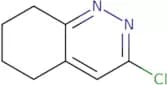
Fórmula:C9H11NO4SPureza:Min. 95%Peso molecular:229.26 g/mol3-Chloro-5,6,7,8-tetrahydrocinnoline
CAS:Versatile small molecule scaffold
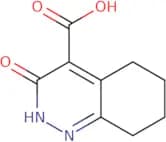
Fórmula:C8H9ClN2Pureza:Min. 95%Peso molecular:168.62 g/mol3-Oxo-2,3,5,6,7,8-hexahydrocinnoline-4-carboxylic acid
CAS:Versatile small molecule scaffold
Fórmula:C9H10N2O3Pureza:Min. 95%Peso molecular:194.2 g/mol2-Methyl-6-[(1,1,1-trifluoropropan-2-yl)oxy]pyridine-3-carbonitrile
CAS:Versatile small molecule scaffold
Fórmula:C10H9F3N2OPureza:Min. 95%Peso molecular:230.19 g/molRef: 3D-HAD75990
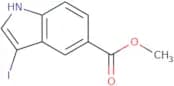
Producto descatalogadoMethyl 3-iodo-1H-indole-5-carboxylate
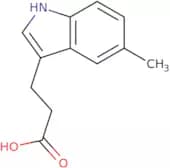
CAS:Versatile small molecule scaffoldFórmula:C10H8INO2Pureza:Min. 95%Peso molecular:301.08 g/mol3-(5-methyl-1H-indol-3-yl)propanoic acid
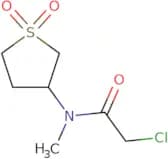
CAS:Versatile small molecule scaffoldFórmula:C12H13NO2Pureza:Min. 95%Peso molecular:203.24 g/mol2-Chloro-N-(1,1-dioxo-tetrahydro-1lambda(6)-thiophen-3-yl)-N-methyl-acetamide
CAS:Versatile small molecule scaffold
Fórmula:C7H12ClNO3SPureza:Min. 95%Peso molecular:225.69 g/mol2-Bromophenyl Methyl Sulfoxide
CAS:2-Bromophenyl Methyl Sulfoxide is a chiral molecule that has been studied for its light emission properties. It has potentials as an electrochemical oxidant, which can be used to oxidize organic compounds and hydrogen peroxide. 2-Bromophenyl Methyl Sulfoxide is soluble in solvents such as triflic acid, sulfur dioxide, and carbon tetrachloride. The oxidation of the sulfoxides with 2-bromophenyl methyl sulfoxide yields the corresponding sulfones. This compound has also been studied for its optical properties.
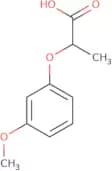
Fórmula:C7H7BrOSPureza:Min. 95%Peso molecular:219.1 g/mol2-(3-Methoxy-phenoxy)-propionic acid
CAS:2-(3-Methoxy-phenoxy)-propionic acid is a chiral compound that is used in organic synthesis. The racemic form of this molecule can be crystallized with the help of other molecules such as cocrystallization, heterodimers, underscores and enantiomers. It crystallizes in two different forms: the α-form and the β-form. The α-form has a melting point of 120 °C, whereas the β-form melts at 138 °C. The polymorphic nature of 2-(3-methoxy-phenoxy)-propionic acid is due to its structural differences in the crystal lattice. These differences are made possible by supramolecular interactions between neighboring molecules.
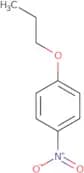
Fórmula:C10H12O4Pureza:Min. 95%Peso molecular:196.2 g/mol1-Nitro-4-propoxybenzene
CAS:1-Nitro-4-propoxybenzene is a covalent inhibitor of aspartic acid proteases. It is an aspartic acid analog that competes with the natural substrate for the active site and inhibits the transpeptidation reaction. This compound has been shown to be highly selective against renin, which is a key enzyme in the blood coagulation cascade. The 1-nitro group can be replaced by other groups to modulate potency or selectivity. These modifications may also improve water solubility, stability, or bioavailability.
Fórmula:C9H11NO3Pureza:Min. 95%Peso molecular:181.19 g/mol(S)-1-(4-(Methylthio)phenyl)ethanamine Hydrochloride
CAS:Versatile small molecule scaffoldFórmula:C9H13NS·HClPureza:Min. 95%Peso molecular:203.73 g/mol
![(1S,4S)-5-[(tert-Butoxy)carbonyl]-2-oxa-5-azabicyclo[2.2.1]heptane-1-carboxylic acid](/_next/image/?url=https%3A%2Fstatic.cymitquimica.com%2Fproducts%2F3D%2Fthumb-webp%2FHCD59921.webp&w=3840&q=75)


![2-Methyl-6-[(1,1,1-trifluoropropan-2-yl)oxy]pyridine-3-carbonitrile](/_next/image/?url=https%3A%2Fstatic.cymitquimica.com%2Fproducts%2F3D%2Fthumb-webp%2FHAD75990.webp&w=3840&q=75)