


Building Blocks
Subcategorías de "Building Blocks"
- Ácidos borónicos y derivados del ácido borónico(5.780 productos)
- Building Blocks quirales(1.239 productos)
- Building Blocks de hidrocarburos(6.100 productos)
- Building Blocks orgánicos(61.005 productos)
Se han encontrado 205234 productos de "Building Blocks"
rac-3-[(2R,3S)-3-Methyloxolan-2-yl]-4-(propan-2-yl)-4,5-dihydro-1H-1,2,4-triazol-5-one
CAS:Versatile small molecule scaffoldFórmula:C10H17N3O2Pureza:Min. 95%Peso molecular:211.26 g/molRef: 3D-JHD91082
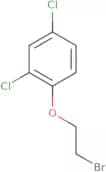
Producto descatalogado1-(2-Bromoethoxy)-2,4-dichlorobenzene
CAS:Versatile small molecule scaffold
Fórmula:C8H7BrCl2OPureza:Min. 95%Peso molecular:269.96 g/mol(3,4-Dihydro-2H-chromen-6-ylmethyl)ae hydrochloride
CAS:Versatile small molecule scaffold
Fórmula:C10H14ClNOPureza:Min. 95%Peso molecular:199.68 g/mol1-Propylcyclopropan-1-amine hydrochloride
CAS:Versatile small molecule scaffoldFórmula:C6H14ClNPureza:Min. 95%Peso molecular:135.63 g/molN-Methyl-1-(1-phenyl-1H-pyrazol-4-yl)methanamine hydrochloride
CAS:Versatile small molecule scaffold
Fórmula:C11H14ClN3Pureza:Min. 95%Peso molecular:223.7 g/mol2-(4-Bromo-2-methylphenoxy)acetic acid
CAS:2-(4-Bromo-2-methylphenoxy)acetic acid is a sulfonated phenolic compound that is synthesized by the sulfurylation of 2-methylphenoxyacetic acid with sulfuryl chloride. It has been used as a chemical intermediate in the synthesis of various drugs, such as triethanolamine. 2-(4-Bromo-2-methylphenoxy)acetic acid can also be used to produce fluorinated compounds, such as pentafluoropropionic and hexafluoroacetic acids. The chlorination reaction is an efficient method for the production of this compound.
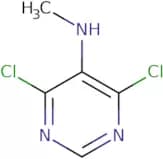
Fórmula:C9H9BrO3Pureza:Min. 95%Peso molecular:245.08 g/mol4,6-dichloro-N-methylpyrimidin-5-amine
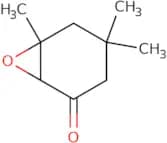
CAS:Versatile small molecule scaffoldFórmula:C5H5Cl2N3Pureza:Min. 95%Peso molecular:178 g/molIsophorone Oxide
CAS:Isophorone Oxide is a molecule that contains a carbonyl group. It is unreactive and does not form hydrogen bonds or react with hydroxy groups. Isophorone oxide has two reactive groups, the hydroxyl group and amido group, which are responsible for its chemical properties. The electron reduction of the carbonyl group can be achieved by using deionized water as a reducing agent. In solution form, Isophorone Oxide is colorless to light yellow liquid with a molecular weight of 144.16 g/mol.
Fórmula:C9H14O2Pureza:Min. 95%Peso molecular:154.21 g/mol1-Benzyl-N'-hydroxy-1H-1,2,3-triazole-4-carboximidamide
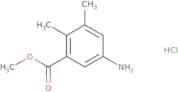
CAS:Versatile small molecule scaffoldFórmula:C10H11N5OPureza:Min. 95%Peso molecular:217.23 g/molMethyl 5-amino-2,3-dimethylbenzoate hydrochloride
CAS:Versatile small molecule scaffoldFórmula:C10H14ClNO2Pureza:Min. 95%Peso molecular:215.67 g/mol6'-Bromo-2',3'-dihydrospiro[imidazolidine-4,1'-indene]-2,5-dione
CAS:Versatile small molecule scaffold
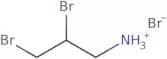
Fórmula:C11H9BrN2O2Pureza:Min. 95%Peso molecular:281.1 g/mol2,3-Dibromo-propylamine, hydrobromide
CAS:2,3-Dibromo-propylamine, hydrobromide is an organolithium compound that is postulated to exist. It has been synthesized in the laboratory but its structure and properties have not yet been fully characterized. In addition to allylamine and azetidine, it has also been shown to react with benzoyl peroxide to form a peroxide. The magnesium ion coordinates the bromine atom of 2,3-dibromo-propylamine, hydrobromide. This mechanism is similar to that of other organolithium compounds.
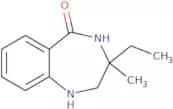
Fórmula:C3H8Br3NPureza:Min. 95%Peso molecular:297.81 g/mol3-Ethyl-3-methyl-2,3,4,5-tetrahydro-1H-1,4-benzodiazepin-5-one
CAS:Versatile small molecule scaffoldFórmula:C12H16N2OPureza:Min. 95%Peso molecular:204.27 g/molRef: 3D-DXC57172
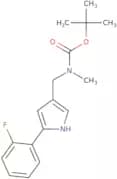
Producto descatalogadotert-Butyl ((5-(2-fluorophenyl)-1H-pyrrol-3-yl)methyl)(methyl)carbamate
CAS:Versatile small molecule scaffold
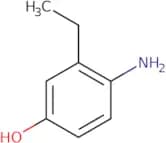
Fórmula:C17H21FN2O2Pureza:Min. 95%Peso molecular:304.36 g/mol4-Amino-3-ethylphenol
CAS:Versatile small molecule scaffold
Fórmula:C8H11NOPureza:Min. 95%Peso molecular:137.18 g/molRef: 3D-LCA63800
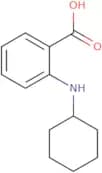
Producto descatalogado2-(Cyclohexylamino)benzoic acid
CAS:2-(Cyclohexylamino)benzoic acid is a chemical compound that reacts with aryl halides to form cyclic amines. The reaction proceeds by the formation of an intermediate, which is then hydrolyzed and decarboxylated to form the product. This reaction can be used for the synthesis of amines from either aromatic or aliphatic aryl chlorides. This process is often used in screening experiments because it has been shown to be selective for aryl halides and yields high yields. The addition of cross-coupling reactions can also yield high yields and produce desired products with good chemo- and regioselectivity. 2-(Cyclohexylamino)benzoic acid is also useful for the synthesis of hyperpolarized molecules for imaging studies, as well as in ultrafast experiments where transfer rates are important.
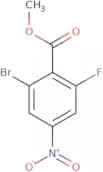
Fórmula:C13H17NO2Pureza:Min. 95%Peso molecular:219.28 g/molMethyl 2-bromo-6-fluoro-4-nitrobenzoate
CAS:Versatile small molecule scaffold
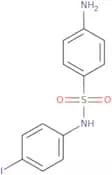
Fórmula:C8H5BrFNO4Pureza:Min. 95%Peso molecular:278.03 g/mol4-Amino-N-(4-iodophenyl)benzene-1-sulfonamide
CAS:Versatile small molecule scaffold
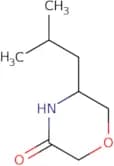
Fórmula:C12H11IN2O2SPureza:Min. 95%Peso molecular:374.2 g/mol(5S)-5-(2-Methylpropyl)morpholin-3-one
CAS:Versatile small molecule scaffold
Fórmula:C8H15NO2Pureza:Min. 95%Peso molecular:157.21 g/mol2-Phenyl-5H,6H,7H,8H-imidazo[1,2-a]pyrimidine hydrochloride
CAS:Versatile small molecule scaffold
Fórmula:C12H14ClN3Pureza:Min. 95%Peso molecular:235.71 g/mol
![rac-3-[(2R,3S)-3-Methyloxolan-2-yl]-4-(propan-2-yl)-4,5-dihydro-1H-1,2,4-triazol-5-one](/_next/image/?url=https%3A%2Fstatic.cymitquimica.com%2Fproducts%2F3D%2Fthumb-webp%2FJHD91082.webp&w=3840&q=75)




![6'-Bromo-2',3'-dihydrospiro[imidazolidine-4,1'-indene]-2,5-dione](/_next/image/?url=https%3A%2Fstatic.cymitquimica.com%2Fproducts%2F3D%2Fthumb-webp%2FFAD20567.webp&w=3840&q=75)
![2-Phenyl-5H,6H,7H,8H-imidazo[1,2-a]pyrimidine hydrochloride](/_next/image/?url=https%3A%2Fstatic.cymitquimica.com%2Fproducts%2F3D%2Fthumb-webp%2FDXC57196.webp&w=3840&q=75)