Aminas
Las aminas son un conjunto de moléculas que contienen un grupo funcional amino (derivado del amoníaco). Esta categoría incluye aminas en cualquier nivel de sustitución: primarias, secundarias, terciarias y sales de amonio. Las aminas son fundamentales en la síntesis orgánica y se utilizan ampliamente en productos farmacéuticos, agroquímicos y ciencias de los materiales. En CymitQuimica, ofrecemos una selección completa de aminas para satisfacer sus necesidades de investigación e industriales. Nuestra gama asegura el acceso a diversas aminas para diferentes procesos químicos e investigaciones innovadoras.
Subcategorías de "Aminas"
- Nitrosaminas(2.668 productos)
- Aminas primarias(30.948 productos)
- Cationes y sales de amonio cuaternario(1.099 productos)
- Aminas secundarias(20.886 productos)
- Aminas terciarias(17.195 productos)
Se han encontrado 8788 productos de "Aminas"
Ordenar por
Pureza (%)
0
100
|
0
|
50
|
90
|
95
|
100
4-(2-Aminoethyl)benzene sulfonamide
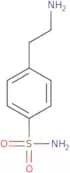
CAS:4-(2-Aminoethyl)benzene sulfonamide is a small-molecule drug that inhibits the activity of proteases, including serine and cysteine proteases. It has been shown to inhibit the growth of human renal cell cancer cells, as well as subcutaneous tumors in mice. 4-(2-Aminoethyl)benzene sulfonamide also inhibits the proliferation of Hl-60 cells and shows antitumor activity in a mouse model system. This drug is an inhibitor of prostaglandin endoperoxide synthase (PGHS), which is involved in tumorigenesis by causing inflammation and oxidative stress. 4-(2-Aminoethyl)benzene sulfonamide has been shown to be effective for treating colorectal adenocarcinoma, with no significant side effects on other organs.Fórmula:C8H12N2O2SPureza:Min. 95%Peso molecular:200.26 g/mol5-Amino-2-(trifluoromethyl)isonicotinic acid
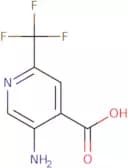
CAS:Please enquire for more information about 5-Amino-2-(trifluoromethyl)isonicotinic acid including the price, delivery time and more detailed product information at the technical inquiry form on this pageFórmula:C7H5F3N2O2Pureza:Min. 95%Peso molecular:206.12 g/mol3-Fluorophenethylamine
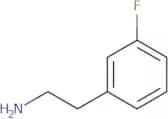
CAS:Producto controlado3-Fluorophenethylamine is a fluorinated analog of phenethylamine that binds to the same receptors and has a similar effect on neurotransmitters as the parent compound. 3-Fluorophenethylamine inhibits the production of tumor necrosis factor-α (TNF-α) in vitro, which may be due to its ability to inhibit prostaglandin synthesis by binding to cyclooxygenase. This drug has also been shown to have anti-inflammatory effects that are mediated by inhibition of TNF-α production and activation of nuclear factor kappa B (NFκB) pathways in hippocampal neurons.Fórmula:C8H10FNPureza:Min. 95%Peso molecular:139.17 g/mol4-Chloro-1h-pyrazol-3-amine
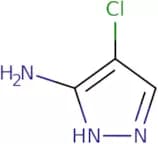
CAS:Please enquire for more information about 4-Chloro-1h-pyrazol-3-amine including the price, delivery time and more detailed product information at the technical inquiry form on this pageFórmula:C3H4ClN3Pureza:Min. 95%Peso molecular:117.54 g/mol2-Amino-3,4-dihydro-7-methoxy-2H-1-naphthalenone, hydrochloride
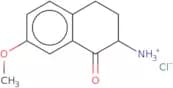
CAS:Producto controladoPlease enquire for more information about 2-Amino-3,4-dihydro-7-methoxy-2H-1-naphthalenone, hydrochloride including the price, delivery time and more detailed product information at the technical inquiry form on this pageFórmula:C11H14ClNO2Pureza:Min. 95%Peso molecular:227.69 g/mol6-Amino-1,3,5-triazine-2,4-diol
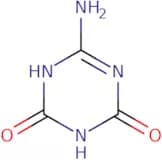
CAS:6-Amino-1,3,5-triazine-2,4-diol is a chemical that is soluble in water and has been shown to be an effective inhibitor of cyanuric acid degradation. It has been used in wastewater treatment and as a model system for the study of melamine and cyanuric acid interactions. 6-Amino-1,3,5-triazine-2,4-diol binds to cyanuric acid by forming a complex with it. This prevents the formation of reactive intermediates that lead to the degradation of cyanuric acid. 6-Amino-1,3,5-triazine-2,4-diol also inhibits the oxidation catalyst activity of sodium carbonate at pH 8.5. The toxicity of this chemical has been studied in rats and was found to be low.Fórmula:C3H4N4O2Pureza:Min. 95%Peso molecular:128.09 g/mol7-Amino nitrazepam
CAS:Producto controlado7-Amino nitrazepam is a metabolite of the benzodiazepine drug flunitrazepam. It is formed in the liver by cytochrome P450 and excreted in the urine. 7-Amino nitrazepam has been shown to have inhibitory effects on human liver and human serum. The inhibitory activity was found to be more potent than that of flunitrazepam, but less potent than that of alprazolam. 7-Amino nitrazepam was also found to inhibit rat liver microsomes, which could lead to a higher potency in vivo. This study also showed that 7-Amino nitrazepam is absorbed from the gastrointestinal tract and distributed into all tissues, including the brain, and can be detected in blood serum and urine samples.
Fórmula:C15H13N3OPureza:Min. 95%Peso molecular:251.28 g/mol3-Morpholinopropylamine
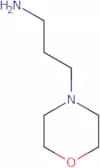
CAS:3-Morpholinopropylamine is a nitrogen-containing heterocyclic organic amine. It has been shown to bind to receptor cells and inhibit the uptake of chloride ions by liver cells, which may be due to its ability to form hydrogen bonds with chloride ions. The binding constants for this drug have also been determined using X-ray crystallography and nuclear magnetic resonance spectroscopy. 3-Morpholinopropylamine has been shown to have anticancer properties and is able to bind with DNA in a manner that inhibits DNA synthesis. This drug also inhibits the production of hydrochloric acid in the stomach, which may be due to its ability to interact electrochemically with amines.Fórmula:C7H16N2OPureza:Min. 95%Peso molecular:144.21 g/mol3-[(Dimethylamino)methyl]benzoic acid hydrochloride
CAS:Please enquire for more information about 3-[(Dimethylamino)methyl]benzoic acid hydrochloride including the price, delivery time and more detailed product information at the technical inquiry form on this pageFórmula:C10H13NO2Pureza:Min. 95%Peso molecular:179.22 g/molMethyl aminomethanimidothioate hydroiodide
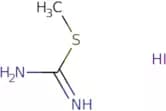
CAS:Methyl aminomethanimidothioate hydroiodide (MAI) is a nitro-substituted methylated analogue of the natural amino acid methionine. It has been shown to inhibit creatine kinase, which is an enzyme that regulates the conversion of energy from ATP to creatinine. MAI also inhibits adenosine receptors and can be used as an anti-inflammatory agent. It has been shown to suppress inflammatory diseases, such as arthritis and cancer, by inhibiting the production of inflammatory cytokines. MAI has been shown to be effective against viruses such as HIV and herpes simplex virus type 1 (HSV-1).Fórmula:C2H6N2S·HIPureza:Min. 95%Forma y color:PowderPeso molecular:218.06 g/molDesmethyl chlorpheniramine maleate salt
CAS:Please enquire for more information about Desmethyl chlorpheniramine maleate salt including the price, delivery time and more detailed product information at the technical inquiry form on this pageFórmula:C19H21ClN2O4Pureza:Min. 95%Peso molecular:376.83 g/mol3-(4'-Methoxy-3'-sulfonamidophenyl)-2-propylamine, hydrochloride
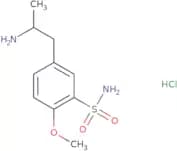
CAS:Producto controladoPlease enquire for more information about 3-(4'-Methoxy-3'-sulfonamidophenyl)-2-propylamine, hydrochloride including the price, delivery time and more detailed product information at the technical inquiry form on this pageFórmula:C10H16N2O3S•HClPureza:Min. 95%Forma y color:PowderPeso molecular:280.77 g/molN-Acetylethylenediamine
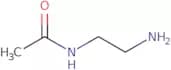
CAS:N-Acetylethylenediamine is a chemical compound that belongs to the class of quinoline derivatives. It has been shown to have detergent properties and can be used in the production of protein data, with ft-ir spectroscopy being used as a diagnostic tool for autoimmune diseases and cancer. N-acetylethylenediamine also has an anti-inflammatory effect due to its ability to inhibit the release of reactive oxygen species (ROS). This chemical is also used as a reagent in the synthesis of other compounds, such as hydrochloric acid.Fórmula:C4H10N2OPureza:Min. 95%Forma y color:PowderPeso molecular:102.14 g/mol2-Dicyclohexylphosphino-2'-(N,N-dimethylamino)biphenyl
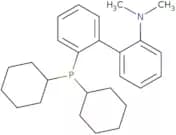
CAS:Ligand used in a Pd-catalyzed Suzuki aryl-aryl couplingFórmula:C26H36NPPureza:Min. 95%Forma y color:White To Yellow SolidPeso molecular:393.54 g/mol1-(Fmoc-amino)-4,9-dioxa-12-dodecanamine·HCl
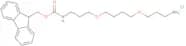
CAS:Producto controladoPlease enquire for more information about 1-(Fmoc-amino)-4,9-dioxa-12-dodecanamine·HCl including the price, delivery time and more detailed product information at the technical inquiry form on this pageFórmula:C25H34N2O4·HClPureza:Min. 95%Peso molecular:463.01 g/mol4-(Dimethylamino)-4-phenylcyclohexan-1-one
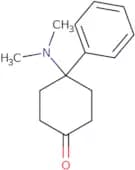
CAS:Producto controladoDimethylphencyclidine is a potent analgesic with high affinity for opioid receptors. It is an agonist at the μ-opioid receptor and κ-opioid receptor. Dimethylphencyclidine may also act as a nociceptive agent and has been shown to modulate pain in animals. This drug has also been shown to be neuropathic, as it inhibits the development of chronic constriction injury (CCI) in rats by reducing the formation of reactive oxygen species and increasing the expression of brain-derived neurotrophic factor (BDNF). Dimethylphencyclidine has undergone clinical trials for the treatment of neuropathic pain and is currently in phase II clinical development. The pharmacological properties of dimethylphencyclidine are due to its ability to act on opioid receptors and other neurotransmitter systems, including serotonin, dopamine, acetylcholine, glutamate, and glycine. The chemical name for this drug is 4-(Dimethylamino)-4-phenFórmula:C14H19NOPureza:Min. 95%Peso molecular:217.31 g/moltert-Butyl 6-(aminomethyl)-1,4-oxazepane-4-carboxylate
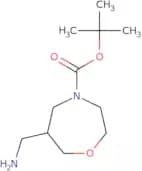
CAS:Please enquire for more information about tert-Butyl 6-(aminomethyl)-1,4-oxazepane-4-carboxylate including the price, delivery time and more detailed product information at the technical inquiry form on this pageFórmula:C11H22N2O3Pureza:Min. 95%Peso molecular:230.3 g/molAmmonium chloride
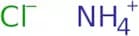
CAS:Ammonium chloride is a salt of ammonium and chloride. It is used in wastewater treatment as a coagulant, to remove suspended solids from the water. In addition, ammonium chloride has been shown to have potent antitumor activity and is used in chemotherapy treatments. Ammonium chloride can be toxic if ingested or inhaled and should not be handled without proper safety precautions. Ammonium chloride also has an effect on the bowel disease, slowing down the rate at which it progresses. It is produced when trimethyl reacts with blood or water vapor. The surface methodology was used to obtain thermodynamic data for ammonium chloride. This method can be applied to other compounds that are difficult to analyze by other methods.Fórmula:NH4ClPureza:Min. 95%Forma y color:PowderPeso molecular:53.49 g/molFmoc-TOAC-OH
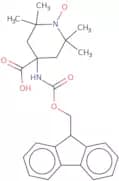
CAS:Fmoc-2,2,6,6-tetramethylpiperidine-N-oxyl-4-amino-4-carboxylic acid (FMOC) is a highly reactive nitroxide that reacts with oxygen to form superoxide radicals. FMOC has been used to study the effects of radiation on proteins and peptides. It can be synthesized by reacting an amino acid with the reagent N-(3-(dimethylamino)propyl)-N'-methylcarbodiimide hydrochloride (EDC). The product then reacts with 4-(2,2,6,6,-tetramethylpyridinium) perchlorate in acetonitrile to create a fluorescent compound. When FMOC is labeled with a heavy metal such as gadolinium or manganese it becomes paramagnetic and can be detected using magnetic resonance imaging (MRI). FMOC also binds to the sarcoplasmic reticulumFórmula:C25H29N2O5Pureza:Min. 95%Peso molecular:437.51 g/mol(S)-(-)-1-Boc-3-aminopyrrolidine
CAS:(S)-(-)-1-Boc-3-aminopyrrolidine is an inhibitor that inhibits the activity of phosphoinositide 3-kinase (PI3K) by binding to the ATP binding site and inhibiting PI3K. It has been shown to inhibit the activation of PI3Kδ, which plays a key role in tumorigenesis and metastasis. The drug also has metabolic stability and selectivity for PI3Kδ over other kinases, as well as high affinity for this enzyme. The drug was found to have low toxicity in vitro, but its effects on humans are unknown.Fórmula:C9H18N2O2Pureza:Min. 95%Forma y color:Clear LiquidPeso molecular:186.25 g/mol

![3-[(Dimethylamino)methyl]benzoic acid hydrochloride](/_next/image/?url=https%3A%2Fstatic.cymitquimica.com%2Fproducts%2F3D%2Fthumb-webp%2FFD124093.webp&w=3840&q=75)