Organoboranos
Los organoboranos son compuestos orgánicos caracterizados por la presencia de átomos de boro unidos al carbono. Estos compuestos son derivados de la molécula BH3 y desempeñan un papel importante en diversas reacciones químicas, incluyendo como intermediarios en la síntesis orgánica. En CymitQuimica, ofrecemos una amplia gama de organoboranos para apoyar sus necesidades de investigación e industriales. Nuestros productos están diseñados para ofrecer un alto rendimiento y fiabilidad en sus procesos sintéticos.
Se han encontrado 6123 productos de "Organoboranos"
Ordenar por
Pureza (%)
0
100
|
0
|
50
|
90
|
95
|
100
1,2-Bis(hydroxymethyl)-O-carborane
CAS:Producto controlado<p>1,2-Bis(hydroxymethyl)-O-carborane is a cyclic molecule that can be used in the synthesis of organic compounds. It can be prepared by reacting anhydrous sodium chloride with propiolic acid. It has been shown to produce decaborane and anion when reacted with chlorine. The chlorides are catalytic for the formation of methyl alcohol and methacrylates. 1,2-Bis(hydroxymethyl)-O-carborane has been used as a starting material for the synthesis of triflates and methyl alcohols. This compound has also been found to produce diffraction patterns that can be used for structural analysis.</p>Fórmula:C4H16B10O2Pureza:Min. 95%Peso molecular:204.28 g/molIron(II) tetrafluoroborate - 40-45% aqueous solution
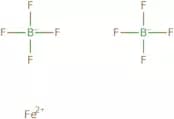
CAS:<p>Iron(II) tetrafluoroborate is a green-yellow crystalline solid that is soluble in water. It has been shown to have structural and optical properties that are similar to those of ferric chloride, but with the advantage of being less toxic. Iron(II) tetrafluoroborate is used as a homogeneous catalyst for organic reactions such as the hydrogenation of nitroarenes and the reduction of ketones. The catalytic activity of Iron(II) tetrafluoroborate arises from its ability to form hydrogen bonding interactions with other molecules and ions in solution.<br>Iron(II) tetrafluoroborate undergoes a number of reactions with other compounds, including cleavage products such as hydrogen sulfate and nitrogen atoms, which may be due to its chelate ligand. In coordination chemistry, Iron(II) tetrafluoroborate can form coordination complexes by reacting with potassium dichromate or calcium carbonate. These complexes are</p>Fórmula:B2F8FePureza:About 45%Forma y color:Slightly Green Clear LiquidPeso molecular:229.45 g/molRef: 3D-FI105721
Producto descatalogado(3,4,5-Trifluorophenyl)boronic acid
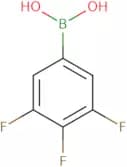
CAS:<p>The trifluorophenylboronic acid is a boronic acid that has been used in the synthesis of vitamin B12. This compound is often used as a catalyst for the Suzuki coupling reaction. It can also be used to synthesize amides and synthons. The trifluorophenylboronic acid is soluble in water, ethanol, and acetone. The pH of the solution depends on the type of base added. For example, when an amine is added to the solution, it increases to approximately 8-9. When a p-hydroxybenzoic acid is added to the solution, it decreases to approximately 2-3.</p>Fórmula:C6H4BF3O2Pureza:Min. 95%Forma y color:PowderPeso molecular:175.9 g/molRef: 3D-FT70125
Producto descatalogado