Aldehídos
Los aldehídos son compuestos orgánicos que contienen un grupo carbonilo (C=O) unido al menos a un átomo de hidrógeno. Estos compuestos versátiles son fundamentales en diversas reacciones químicas, incluyendo oxidación, reducción y adición nucleofílica. Los aldehídos son building blocks esenciales en la síntesis de productos farmacéuticos, fragancias y polímeros. En CymitQuimica, ofrecemos una amplia selección de aldehídos de alta calidad para apoyar sus aplicaciones de investigación e industriales.
Se han encontrado 8573 productos de "Aldehídos"
Ordenar por
Pureza (%)
0
100
|
0
|
50
|
90
|
95
|
100
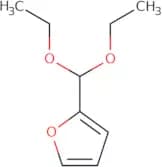
2-Furaldehyde diethylacetal
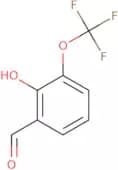
CAS:2-Furaldehyde diethylacetal is a synthetic compound that has been used in the synthesis of calcium carbonate. It is also a potent inhibitor of p. aeruginosa and other bacteria, as well as organic acids and halogen compounds. It reacts with hydroxy groups to form aldehydes, which are then oxidized to form carboxylic acid derivatives. The reaction mechanism for this compound is not well understood, but it is thought that the activation energy for the reaction may be low due to the presence of a furfural functional group.Fórmula:C9H14O3Pureza:Min. 95%Peso molecular:170.21 g/mol2-Hydroxy-3-(Trifluoromethoxy)Benzaldehyde
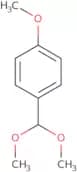
CAS:<p>2-Hydroxy-3-(trifluoromethoxy)benzaldehyde is a coordination compound that is used as a ligand. It has two-dimensional and crystal structures. The ligated molecule is usually coordinated to the metal ion, forming a dimer.</p>Fórmula:C8H5F3O3Pureza:Min. 95%Peso molecular:206.12 g/molp-Anisaldehyde dimethyl acetal
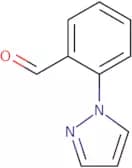
CAS:<p>p-Anisaldehyde dimethyl acetal is a broad-spectrum antimicrobial that can be synthesized from anisaldehyde and dimethoxyacetal. It has been shown to have anticancer properties in vitro. p-Anisaldehyde dimethyl acetal has also been shown to inhibit the growth of HL60 cells, which are specialized white blood cells. This compound was found to increase neuronal death and induce cachexia in mice. The molecular weight of p-Anisaldehyde dimethyl acetal is 244.24 g/mol, with a melting point of -14 °C and a boiling point of 156 °C. The molecule contains one asymmetric center, one hydrogen bond, one non-bonding electron pair, and no double bonds. This compound has acidic properties and it reacts with vitamin D3 in a cationic polymerization process at alkaline pH levels.</p>Fórmula:C10H14O3Pureza:Min. 95%Forma y color:Colourless To Pale Yellow Clear LiquidPeso molecular:182.22 g/mol2-(1H-Pyrazol-1-yl)benzaldehyde
CAS:<p>2-(1H-Pyrazol-1-yl)benzaldehyde is a synthetic chemical compound that is used in the preparation of coupling reactions. It has been shown to be an efficient reagent for the synthesis of 2-bromobenzaldehyde and pyrazole. The molecule has a hydrazone attack, which can be coupled with 2-bromobenzaldehyde, with or without the use of an additional base such as sodium methoxide. This reaction can be carried out at room temperature and does not require any harsh conditions. 2-(1H-Pyrazol-1-yl)benzaldehyde also belongs to the family of aldehydes, which are molecules containing a carbon group that is connected to two hydrogen groups (i.e., RCH=O). Hydrogenation of this type of molecule gives rise to alcohols (RCHOH).</p>Fórmula:C10H8N2OPureza:Min. 95%Peso molecular:172.18 g/molTacrolimus methyl acryl aldehyde
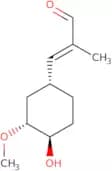
CAS:Please enquire for more information about Tacrolimus methyl acryl aldehyde including the price, delivery time and more detailed product information at the technical inquiry form on this pageFórmula:C11H18O3Pureza:Min. 95%Peso molecular:198.26 g/mol4-tert-Butylbenzaldehyde
CAS:<p>4-tert-Butylbenzaldehyde is an organic compound with the molecular formula CH3COCH2C6H5. It is a viscous liquid that is insoluble in water and has a boiling point of 146 °C. 4-tert-Butylbenzaldehyde reacts with cationic surfactants to form polymeric micelles, which are spherical structures composed of many small spherical subunits. These polymeric micelles are used as model systems for studying the properties of surfactant aggregates in solution. The reaction mechanism for this polymerization process involves the oxidation of 4-tert-butylbenzaldehyde by hydrogen peroxide and the subsequent condensation of 4-tert-butylbenzoic acid with malonic acid or other cinnamic acid derivatives to form the corresponding esters. The oxidized product, 4-tert-butylbenzoic acid, can be regenerated by boiling a mixture containing it</p>Fórmula:C11H14OPureza:Min. 96.5%Forma y color:Colorless Clear LiquidPeso molecular:162.23 g/mol1-Methyl-2-imidazolecarboxaldehyde
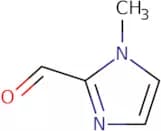
CAS:1-Methyl-2-imidazolecarboxaldehyde is a compound that has been studied for its redox potential, which is the measure of the tendency of a molecule to gain or lose electrons. 1-Methyl-2-imidazolecarboxaldehyde has shown to be an excellent candidate as an electrochemical probe. The molecule has also been shown to bind chloride ions in water, forming a tetradentate chelate ring. This type of chelate ring is formed between two nitrogen atoms and four oxygen atoms from the water molecule. The compound forms hydrogen bonds with other molecules in its vicinity, including hepg2 cells and chloride ions.Fórmula:C5H6N2OPureza:Min. 95%Forma y color:White To Yellow To Orange Solid Or Liquid (May Vary)Peso molecular:110.11 g/molFormaldehyde-d2 solution, 20 wt. % in D2O
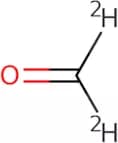
CAS:Producto controlado<p>Formaldehyde-d2 solution is a formaldehyde solution that contains deuterium, which has the same chemical properties as hydrogen but has an additional neutron in its nucleus. Formaldehyde-d2 solution is used to prepare samples for NMR and ESI-MS experiments. The reaction mechanism of formaldehyde is believed to be an acid-catalyzed hydrolysis of the hydrogen bond between formaldehyde and methanol. Deuterium isotopes are generally considered to be non-radioactive and have little or no effect on biological systems. Formaldehyde-d2 solution can inhibit fatty acids from binding to the surface of potatoes, which may make it useful in treating autoimmune diseases.</p>Fórmula:CD2OPureza:Min. 95%Forma y color:Clear LiquidPeso molecular:32.04 g/mol5-(4-Methoxyphenyl)isoxazole-3-carboxaldehyde
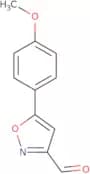
CAS:<p>5-(4-Methoxyphenyl)isoxazole-3-carboxaldehyde (5MI) is a broad-spectrum antimicrobial agent that exhibits activity against bacteria and fungi. It has been shown to be active against gram-positive bacteria, including Staphylococcus aureus, as well as Candida albicans and other pathogenic fungi. 5MI is active in the presence of ethanol, but not in the absence of alcohol. In vitro studies show that 5MI inhibits the growth of gram-negative bacteria such as Escherichia coli and Salmonella enterica serovar Typhimurium. 5MI also exhibits antifungal activity against Aspergillus niger and Saccharomyces cerevisiae.</p>Fórmula:C11H9NO3Pureza:Min. 95%Peso molecular:203.19 g/mol1-(3-Methoxybenzyl)-1H-indole-3-carbaldehyde
CAS:Producto controladoPlease enquire for more information about 1-(3-Methoxybenzyl)-1H-indole-3-carbaldehyde including the price, delivery time and more detailed product information at the technical inquiry form on this pageFórmula:C17H15NO2Pureza:Min. 95%Peso molecular:265.31 g/molPyridine-3-carboxaldehyde
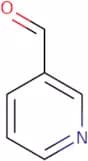
CAS:<p>Pyridine-3-carboxaldehyde is a heterocyclic compound that is structurally related to nicotinic acid and picolinic acid. It has been shown to have anti-tumor activity, with hl-60 cells as the model system. Pyridine-3-carboxaldehyde has also been shown to be toxic to bacteria in biological studies. The chemical stability of this compound was studied by Langmuir adsorption isotherm and electrochemical impedance spectroscopy. It was found that pyridine-3-carboxaldehyde is stable at a pH range of 7 to 8 and at temperatures up to 60 degrees Celsius.</p>Fórmula:C6H5NOPureza:Min. 95%Forma y color:Clear LiquidPeso molecular:107.11 g/mol4-Bromofuran-2-carbaldehyde
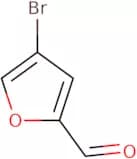
CAS:<p>4-Bromofuran-2-carbaldehyde is a synthetic compound that has been shown to have antioxidant properties. It contains an electron-donating carbonyl group and an electron-withdrawing bromine atom. 4-Bromofuran-2-carbaldehyde is useful in the treatment of endophytic fungi infections, as it inhibits the synthesis of ergosterol, which is an important component of the fungal cell membrane. The molecule's conformational properties are also important for its biological activity, as they enable it to act as a chiral ligand by binding to proteins in a way that will inhibit their function. In addition, 4-bromofuran-2-carbaldehyde has been shown to be effective against cancer cells in vitro, particularly against MMCF7 cells. This may be due to its ability to bind to DNA and prevent transcription or replication of DNA strands.</p>Fórmula:C5H3BrO2Pureza:Min. 95%Peso molecular:174.98 g/molTrans-2-nonenal
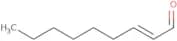
CAS:<p>Trans-2-nonenal is a monoclonal antibody that recognizes the physiological function of cardiac and rat liver microsomes. It has been shown to inhibit enzyme activities in both cell lines. Trans-2-nonenal has also been shown to protect against ischemia/reperfusion injury in rats by reducing the release of intracellular Ca2+ and ATP levels. Trans-2-nonenal is genotoxic and induces oxidative injury, which may be due to its ability to react with caproic acid to form reactive oxygen species.</p>Fórmula:C9H16OPureza:Min. 95%Peso molecular:140.22 g/mol4(5)-Methyl-1H-imidazole-2-carbaldehyde
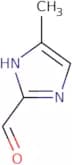
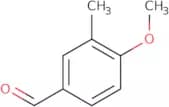
CAS:Please enquire for more information about 4(5)-Methyl-1H-imidazole-2-carbaldehyde including the price, delivery time and more detailed product information at the technical inquiry form on this pageFórmula:C5H6N2OPureza:95%NmrPeso molecular:110.11 g/mol3-Methyl-p-anizaldehyde
CAS:<p>3-Methyl-p-anizaldehyde is a vanillyl alcohol, which is a natural compound that can be found in vanilla beans. It has been used in the synthesis of vanillic acid and lactams. 3-Methyl-p-anizaldehyde has been shown to react with alkyl halides to form alkylated products. These reactions are catalyzed by an enzyme called alcohol dehydrogenase. This enzyme binds to the hydroxyl group on the 3 position of the vanillin molecule, which is then oxidized to form a functional group called an acetate ester. The reaction occurs at low temperatures and can result in optical activity if it produces a chiral product. 3-Methyl-p-anizaldehyde also reacts with ecteinascidins, which are marine natural products that have potent cytotoxic properties against cancer cells.</p>Fórmula:C9H10O2Pureza:Min. 95%Peso molecular:150.17 g/mol1,2,4,5-Tetramethyl-1H-pyrrole-3-carbaldehyde
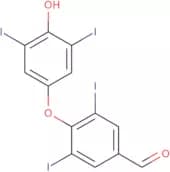
CAS:<p>Please enquire for more information about 1,2,4,5-Tetramethyl-1H-pyrrole-3-carbaldehyde including the price, delivery time and more detailed product information at the technical inquiry form on this page</p>Fórmula:C9H13NOPureza:Min. 95%Peso molecular:151.21 g/mol3,5,3',5'-Tetraiodo thyroaldehyde
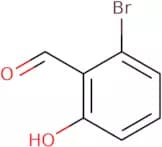
CAS:<p>Please enquire for more information about 3,5,3',5'-Tetraiodo thyroaldehyde including the price, delivery time and more detailed product information at the technical inquiry form on this page</p>Fórmula:C13H6I4O3Pureza:Min. 95%Forma y color:PowderPeso molecular:717.8 g/mol2-Bromo-6-hydroxybenzaldehyde
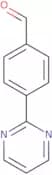
CAS:<p>2-Bromo-6-hydroxybenzaldehyde is a synthetic chemical that consists of a furan ring with an acetonitrile group. It has been shown to be a constant in cyclic electroreduction and is used as a biomolecular surfactant. 2-Bromo-6-hydroxybenzaldehyde has also been shown to react intramolecularly with the hydroxyl group on the benzene ring, which results in the formation of a dimer. This chemical can be produced by solvolysis or electroreduction.</p>Fórmula:C7H5BrO2Pureza:Min. 95%Forma y color:PowderPeso molecular:201.02 g/mol4-(Pyrimidin-2-yl)benzaldehyde
CAS:<p>Please enquire for more information about 4-(Pyrimidin-2-yl)benzaldehyde including the price, delivery time and more detailed product information at the technical inquiry form on this page</p>Fórmula:C11H8N2OPureza:Min. 95%Forma y color:PowderPeso molecular:184.19 g/mol4,4-difluorocyclohexane-1-carbaldehyde
CAS:<p>Please enquire for more information about 4,4-difluorocyclohexane-1-carbaldehyde including the price, delivery time and more detailed product information at the technical inquiry form on this page</p>Fórmula:C7H10F2OPureza:Min. 95%Forma y color:Colorless PowderPeso molecular:148.15 g/mol