Glycoscience
Subcategorías de "Glycoscience"
- Aminoazúcares(108 productos)
- Anticuerpos relacionados con azúcares(283 productos)
- Glicolípidos(46 productos)
- Glicosaminoglicanos (GAGs)(55 productos)
- Glucósidos(419 productos)
- Monosacáridos(6.618 productos)
- Oligosacáridos(3.714 productos)
- Polisacáridos(505 productos)
Se han encontrado 11025 productos de "Glycoscience"
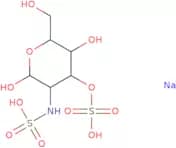
D-Glucosamine-2-N,3-O-disulphate disodium salt
CAS:D-Glucosamine-2-N,3-O-disulphate disodium salt is a carbohydrate that is a modification of the saccharide D-glucosamine. It can be synthesized by modification and fluorination of the saccharide. The complex carbohydrate is a methylated glycosylated oligosaccharide that is custom synthesized and has high purity. This product contains no detectable impurities, such as other sugars or amino acids. This carbohydrate also undergoes methylation and glycosylation to provide stability to the molecule in the presence of water or heat.Fórmula:C6H11NO11S2Na2Pureza:Min. 95%Forma y color:White PowderPeso molecular:383.25 g/mol3-O-(b-D-Galactopyranosyl)-D-arabinose
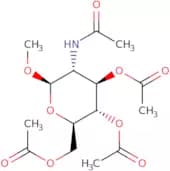
CAS:3-O-(b-D-Galactopyranosyl)-D-arabinose is a disaccharide sugar that is found in mammalian tissue and many other biological systems. It binds to fatty acids, which are important for the structure of cell membranes. 3-O-(b-D-Galactopyranosyl)-D-arabinose is also an important component of oligosaccharides and glycolipids. The binding constants for this sugar have been determined by both titration calorimetry and microcalorimetry. 3-O-(b-D-Galactopyranosyl)-D arabinose has been used as an antiviral agent against Leishmania spp., which is a parasitic protozoa that causes leishmaniasis, the third most common human parasitic disease. This compound has also been shown to inhibit the growth of microalgae, such as Chlorella sorokiniana.Fórmula:C11H20O10Pureza:Min. 95%Forma y color:PowderPeso molecular:312.27 g/molMethyl 2-acetamido-3,4,6-tri-O-acetyl-2-deoxy-β-D-glucopyranoside
CAS:Methyl 2-acetamido-3,4,6-tri-O-acetyl-2-deoxy-β-D-glucopyranoside is an Oligosaccharide that is used in the preparation of complex carbohydrates. It has a CAS number of 2771-48-4 and can be synthesized using a custom synthesis. This product is available in high purity and monosaccharide form. It has been glycosylated and methylated as well as fluorinated and saccharified.Fórmula:C15H23NO9Pureza:Min. 95%Forma y color:White Off-White PowderPeso molecular:361.34 g/mol5-Azido-6-benzylamino-N-fluorenylmethoxycarbonyl-5,6-dideoxy-1,2-O-isopropylidene-L-idofuranose
5-Azido-6-benzylamino-N-fluorenylmethoxycarbonyl-5,6-dideoxy-1,2-O-isopropylidene-L-idofuranose is a custom synthesis that is used in the methylation of saccharides. It is also used for Click and azide modifications as well as fluorination. 5ABAFM is soluble in methanol and DMSO and has a CAS number of 2591402.Pureza:Min. 95%5,6-O-Isopropylidene-L-gulono-1,4-lactone
CAS:5,6-O-Isopropylidene-L-gulono-1,4-lactone is a glycerol derivative that has potent cytotoxic activity. It is able to inhibit the growth of cancer cells and induce apoptosis in human cell lines. 5,6-O-Isopropylidene-L-gulono-1,4-lactone can be used as an anti-cancer drug for the treatment of various types of cancers. The drug also has an ability to inhibit polyurethane synthesis and introduce new functional groups into polyurethanes. 5,6-O-Isopropylidene L gulono 1,4 lactone is not toxic to healthy cells because it does not bind to DNA or RNA; however it binds to polymers such as proteins and polyurethane chains. This compound has been shown to have a skeleton consisting of triterpenoid structures.Fórmula:C9H14O6Peso molecular:218.20 g/molRef: 3D-I-7971
5gA consultar10gA consultar25gA consultar50gA consultar100gA consultar-Unit-ggA consultar1-O-Acetyl-3,5-bis(4-chlorobenzoyl)-2-deoxy-D-ribose
CAS:1-O-Acetyl-3,5-bis(4-chlorobenzoyl)-2-deoxy-D-ribose is a methylated saccharide that can be synthesized from D-ribose and 4-(chloromethyl)benzaldehyde. It has been used for the modification of polysaccharides with click chemistry to produce oligosaccharides. This compound has also been used in the synthesis of glycosyls such as N,N'-diacetylchitobiose and N,N'-diacetylchitotriose. 1-O-Acetyl 3,5 bis (4 chlorobenzoyl)-2 deoxy D ribose is an Oligosaccharide that is soluble in water and is stable at high temperatures. The purity of this compound exceeds 99% and it's CAS number is 1207459-15-1.Fórmula:C21H18Cl2O7Pureza:(%) Min. 95%Forma y color:White PowderPeso molecular:453.27 g/mol1,2-Dideoxy-3,5-di-O-toluoyl-D-ribose
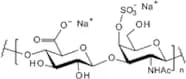
CAS:1,2-Dideoxy-3,5-di-O-toluoyl-D-ribose is a synthetic sugar that can be used in the synthesis of complex carbohydrates. It has been modified with fluorine, methylation, and click chemistry. It is also available as a high purity product. 1,2-Dideoxy-3,5-di-O-toluoyl-D-ribose is an oligosaccharide that is used in glycosylation reactions to form polysaccharides or saccharides. Click chemistry allows for the modification of this sugar with other molecules such as amino acids or peptides. This modification may be useful for studying protein interactions or for drug development.Fórmula:C21H22O5Pureza:Min. 95%Peso molecular:354.4 g/molHyaluronic acid sodium salt - Low molecular weight 10,000 - 50,000
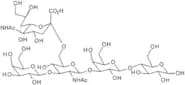
CAS:Gycosaminoglycan in many organs; joint lubricant and shock absorberFórmula:(C14H20NO11Na)nPureza:Min. 95.0%Forma y color:Powder4-O-(6-O-[2-Acetamido-2-deoxy-b-D-glucopyranosyl]-b-D-galactopyranosyl)-D-glucopyranose
CAS:Lacto-N-neotetraose is a trisaccharide composed of two galactose units and one glucose unit. It has been found to be an effective carbohydrate for the treatment of colostrum depletion in newborns. Lacto-N-neotetraose can be obtained through methanolysis, which is the hydrolysis of lactose by the addition of methanol to produce a mixture of sugars. This process is activated by ion exchange chromatography, and then hydrolyzed to produce oligosaccharides. Lacto-N-neotetraose can also be obtained from human or horse milk as 13C NMR spectroscopy shows that it is present in both species.Fórmula:C20H35NO16Pureza:Min. 98 Area-%Forma y color:PowderPeso molecular:545.49 g/mol1,3,4,6-Tetra-O-acetyl-2-deoxy-2-fluoro-D-galactopyranose
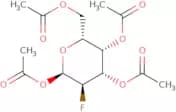
CAS:1,3,4,6-Tetra-O-acetyl-2-deoxy-2-fluoro-D-galactopyranose is a fluorinated sugar that is used in the synthesis of glycosides. It is a synthetic compound that is prepared by reacting 1,3,4,6-tetraacetyl galactose with potassium bifluoride and diethyl oxalate in presence of anhydrous sodium sulfate. The product obtained has the following structural formula: The chemical name for this compound is 1,3,4,6-Tetraacetyl -2-[(1R)-1-(ethoxycarbonyl)propyl]-2-(fluorooxymethyl) -D-galactopyranose. The CAS number for this compound is 83697–45–4.Fórmula:C14H19FO9Pureza:(As Sum Of Anomers) Min. 98 Area-%Forma y color:White PowderPeso molecular:350.3 g/molChondroitin sulfate A sodium salt - Average MW 20,000 - 30,000
CAS:The disaccharide repeating unit of chondroitin sulphate consists of N-acetyl galactosamine sulphate linked β1,4 to glucuronic acid. Each monosaccharide may be left unsulphated, sulphated once, or sulphated twice. The most common pattern is that the hydroxyl groups of the 4 and 6 positions of the N-acetyl-galactosamine are sulphated, with some chains having the position 2 of the glucuronic acid sulphated.Pureza:Min. 90 Area-%Forma y color:White PowderChitosan - Molecular weight 190,000-310,000
CAS:Chitosan is the deacetylated form of chitin. The polysaccharide is deacetylated in order to render it soluble, which is then possible at pH values of less than 7 (normally in dilute acid). This then allows the material to be used in a number of industrial applications as a binder and film former.
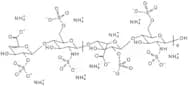
Forma y color:Off-White PowderHeparin derived dp18 saccharide ammonium salt
Heparin derived dp18 saccharide ammonium salt is a complex carbohydrate that has been modified with methylation, custom synthesis, click modification, and fluorination. It is used as an anticoagulant to prevent the formation of blood clots. Modification of the sugar chain on the heparin molecule can be achieved through either monosaccharide or polysaccharide substitution. The monosaccharides most commonly found in heparin are glucosamine and N-acetylglucosamine. The polysaccharides that can be found in heparin include chondroitin sulfate, dermatan sulfate, keratan sulfate, and heparan sulfate. Heparin derived dp18 saccharide ammonium salt is a high purity product that has been modified to have a higher degree of efficacy for use in clinical applications. This product is available for purchase at a cost-effective price point.Pureza:Min. 95%Forma y color:PowderPeso molecular:~ 5200 (average)Isoprimeverose
CAS:Isoprimeverose is a covalently linked polysaccharide with a molecular weight of about 5,000. It has been shown to have an optimum pH at around 7.5 and is soluble in water. Isoprimeverose was found to be highly immunogenic in rats and mice, producing high levels of polyclonal antibodies against the protein target. The carbohydrate moiety of isoprimeverose contains galacturonic acid, which may play a role in its uptake by mammalian cells. The hydroxyl group on the sugar molecule may also play a role in this process. Isoprimeverose can be used as an artificial sweetener because it does not contain any sugars or carbohydrates that can cause tooth decay or other dental problems.
Fórmula:C11H20O10Pureza:Min. 95%Forma y color:White PowderPeso molecular:312.27 g/molLS-tetrasaccharide b
CAS:Sialylated tetrasaccharide found in human milk, possible health benefits for the neonate by supporting resistance to pathogens, gut maturation, immune function, and cognitive development.Fórmula:C37H61N2O29•NH4Pureza:Min. 95 Area-%Forma y color:White PowderPeso molecular:1,015.92 g/molL-Rhamnose monohydrate
CAS:L-rhamnose (Rha, 6-deoxy-L-mannose) (Collins, 2006) is normally bound to other sugars as a glycoside in many plant oligosaccharides and in polysaccharides. Rhamnose is also a component of the cell wall of Mycobacterium. In plants, rhamnose is found in the polysaccharide rhamnogalacturonan I, a branched pectic polysaccharide that accounts for 7â14% of the primary wall (Oomen, 2002). Rhamnose is also found in rhamnogalacturonan II, a complex polysaccharide that accounts for âŒ4% of the wall in dicots (Vidal, 2000). Rhamnose is also found in chacotriose and solatriose, the glycan components of solamargine and solasonine, two glycoalkaloids with anticancer properties (Al Sinani, 2017). An understanding of the rhamnose-containing polysaccharides of the gram positive cell wall has identified the biosynthetic pathway as an attractive therapeutic target for antimicrobial drug development (Mistou, 2016).Fórmula:C6H12O5•H2OPureza:Min. 98 Area-%Forma y color:Off-White PowderPeso molecular:182.17 g/mol(5R, 8R, 9S) -8- [(4R) - 2, 2-Dimethyl- 1, 3- dioxolan- 4- yl] - 9- hydroxy- 2, 2- dimethyl- 1, 3, 7- trioxaspiro[4.4] nonan- 6- one
5,8-Dihydroxy-6-fluoro-2,2-dimethyl-1,3,7-trioxaspiro[4.4]nonane - 8-[(4R)-2,2-dimethyl-1,3-dioxolan-4-yl]-9-(hydroxymethyl) - 2,2-dimethyl - 1,3,7 - trioxaspiro[4.4]nonane is a synthetic glycosylated fluorinated octahydropyrrole (5R)-8-(hydroxymethyl)-9-(hydroxymethyl)-6-[(methyloxy)methyl]-2,2,- dimethylpiperidine that is used as an intermediate in the synthesis of oligosaccharides and polysaccharides. It is also used to modify complex carbohydrates for click chemistry applications. This product has a CAS number of 9248411–67–0 and a purity of >Pureza:Min. 95%Ganglioside GM1
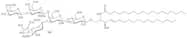
CAS:Ganglioside GM1 has a core tetrasaccharide structure (Galβ1,3GalNAcβ1,4Galβ1,4Glc) with sialic acid linked α2,3 to the inner galactose residue, ceramide linked β to position 1 on the reducing terminal glucose residue (Ledeen, 2009), and is abundant in all mammalian brains, where it covers 10%-20% of the total ganglioside mixture. Ganglioside GM1 is found in epithelial membranes and is a key element for the detection of bacterial toxicity and viral infection. It is the intestinal receptor for cholera toxin, the B-subunits of heat-labile toxin (LTB) from E.coli, for rotavirus, and simian virus 40. GM1 functions as a neurotrophic and neuroprotective compound and has been used therapeutically for diabetic and peripheral neuropathies. It also has the ability to bind amyloid-β proteins and is involved in Alzheimer’s pathogenesis (Chiricozzi, 2020).Fórmula:C73H131N3O31·xNaPureza:Min. 95 Area-%Forma y color:White PowderPeso molecular:1,546.82 g/mol1-O-Methyl-β-D-xylopyranoside
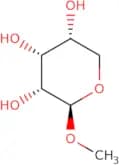
CAS:1-O-Methyl-beta-D-xylopyranoside is a glycoside that consists of a glucose molecule linked to the hydroxyl group of p-hydroxybenzoic acid through an alpha glycosidic bond. It is found in many plants, such as in the leaves of the common bay tree (Laurus nobilis) and in the bark of the cinnamon tree (Cinnamomum verum). 1-O-Methyl-beta-D-xylopyranoside is used as a sweetener and flavoring agent. It is also used in some pharmaceutical drugs, including antiulcer agents and antidiarrheal agents. This compound has been shown to have an effective dose of 5 mg/kg when given orally to humans.Fórmula:C6H12O5Pureza:Min. 98.0 Area-%Peso molecular:164.16 g/molMethyl 3,4-di-O-benzyl-2-deoxy-a-D-glucopyranoside
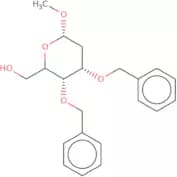
Methyl 3,4-di-O-benzyl-2-deoxy-a-D-glucopyranoside (MBG) is a synthetic compound that is modified at the C3 position with a benzyl group. MBG is an oligosaccharide and polysaccharide that has been shown to have potential as a drug for the treatment of cancer. It has been shown to inhibit tumor growth in animals and human cells by inhibiting DNA synthesis and protein synthesis. Additionally, it can be used for the prevention of postoperative adhesions by inhibiting collagen formation.Fórmula:C21H26O5Pureza:Min. 95%Peso molecular:358.43 g/mol





![4-O-(6-O-[2-Acetamido-2-deoxy-b-D-glucopyranosyl]-b-D-galactopyranosyl)-D-glucopyranose](/_next/image/?url=https%3A%2Fstatic.cymitquimica.com%2Fproducts%2F3D%2Fthumb-webp%2FOA05021.webp&w=3840&q=75)



![(5R, 8R, 9S) -8- [(4R) - 2, 2-Dimethyl- 1, 3- dioxolan- 4- yl] - 9- hydroxy- 2, 2- dimethyl- 1, 3,…](/_next/image/?url=https%3A%2Fstatic.cymitquimica.com%2Fproducts%2F3D%2Fthumb-webp%2FMD170665.webp&w=3840&q=75)