Glycoscience
Subcategorías de "Glycoscience"
- Aminoazúcares(108 productos)
- Anticuerpos relacionados con azúcares(283 productos)
- Glicolípidos(46 productos)
- Glicosaminoglicanos (GAGs)(55 productos)
- Glucósidos(419 productos)
- Monosacáridos(6.617 productos)
- Oligosacáridos(3.718 productos)
- Polisacáridos(505 productos)
Se han encontrado 11021 productos de "Glycoscience"
Ethyl 2,3-O-isopropylidene-a-L-thiorhamnopyranoside
CAS:Ethyl 2,3-O-isopropylidene-a-L-thiorhamnopyranoside (Ip) is a glycosylation inhibitor that inhibits the formation of an alpha-(1,2)-link between glucose and mannose in the glycosylation of the pentasaccharide. The maximum tolerated dosages of Ip have been determined in HL-60 cells. Trichloroacetimidate is used as a substitute for Ip in these experiments because it can be dissolved in water and has a high therapeutic index. Convergent synthesis of Ip was achieved by reacting pentasaccharides with trichloroacetimidate to produce pentasaccharides with substituted mannose residues at position two and three.Fórmula:C11H20O4SPureza:Min. 95%Peso molecular:248.34 g/mol1,2,4,6-Tetra-O-acetyl-3-deoxy-D-galactose
1,2,4,6-Tetra-O-acetyl-3-deoxy-D-galactose (1,2,4,6TDA) is a custom synthesis that is a complex carbohydrate. It has been modified with methylation and glycosylation. 1,2,4,6TDA is an oligosaccharide with a molecular weight of 498.06 Da and a CAS number of 90193-74-8. This product is high purity and can be fluorinated. This product can also be synthesized using the click modification reaction.Fórmula:C14H20O9Pureza:Min. 95%Peso molecular:332.3 g/mol1,2,6-Tri-O-acetyl-3,4-di-O-benzyl-α-D-mannopyranose
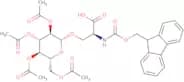
CAS:1,2,6-Tri-O-acetyl-3,4-di-O-benzyl-a-D-mannopyranose is a synthetic sugar that has been modified with three acetates and benzyl groups. It is used in the synthesis of glycosides and oligosaccharides. 1,2,6-Tri-O-acetyl-3,4-di-O-benzyl-a-D-mannopyranose is also an important building block for the synthesis of complex carbohydrates.Fórmula:C26H30O9Pureza:Min. 95%Peso molecular:486.51 g/mol2,3,4,6-Tetra-O-acetyl-β-D-glucopyranosyl-Fmoc serine
CAS:2,3,4,6-Tetra-O-acetyl-b-D-glucopyranosyl-Fmoc serine is a protein that belongs to the group of bifunctional glycosides. It is used in recombinant virus production as a component of the viral coat protein (VP). 2,3,4,6-Tetra-O-acetyl-b-D-glucopyranosyl-Fmoc serine binds to tyrosine kinase receptors and inhibits their activity. This inhibition prevents cell adhesion and migration and can cause tumor regression in some cancers. 2,3,4,6-Tetra-O-acetyl-b-D--glucopyranosyl--Fmoc serine also has antiviral activity due to its ability to inhibit the replication of viruses containing RNA genomes.
Fórmula:C32H35NO14Pureza:Min. 95%Forma y color:SolidPeso molecular:657.63 g/mol2-Methyl-(1,2-dideoxy-a-D-glucopyrano)-[2,1-d]-2-oxazoline
CAS:2-Methyl-(1,2-dideoxy-a-D-glucopyrano)-[2,1-d]-2-oxazoline is a high purity, custom synthesis carbohydrate. It has been fluorinated and methylated to increase its stability and resistance to proteases. This compound is used in the synthesis of oligosaccharides and polysaccharides. It can be glycosylated or click modified with thiol groups.Fórmula:C8H13NO5Pureza:Min. 95%Forma y color:PowderPeso molecular:203.19 g/mol2,6-Dideoxy-L- arabino- hexose
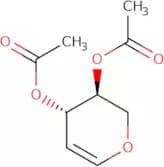
CAS:2,6-Dideoxy-L-arabino-hexose is a carbohydrate that can be custom synthesized. It has a high purity with a custom synthesis and can be methylated and glycosylated. This modification changes the chemical structure of the sugar, which may have important therapeutic effects on cancer cells.Fórmula:C6H12O4Pureza:Min. 95%Peso molecular:148.16 g/mol3,4-Di-O-acetyl-L-arabinal
CAS:3,4-Di-O-acetyl-L-arabinal is a synthetic compound that belongs to the class of monofluorides. It has been synthesized from l-arabinose by a stereoselective process, with triflic acid as the catalyst and propargylation as the key step. The synthetic pathway starts from an acid hydrolysis of L-arabinose to yield 3,4-di-O-acetyl-L-arabinonic acid. This acid is then converted to 3,4 diacetyl L arabinonic acid with acetic anhydride and acetic acid in the presence of triethylamine. The final product is then obtained by reacting this intermediate with 1 equivalent of sodium fluoride in tetrahydrofuran (THF) using catalytic reduction with sodium borohydride at 0 °C. The major advantage of this synthetic process is that it provides two stereoisomers: (
Fórmula:C9H12O5Pureza:Min. 95%Forma y color:Yellow Clear LiquidPeso molecular:200.19 g/mol(2R, 3S, 4S) -3-Fluoro- 4- (fluoromethyl])- 1- (phenylmethyl) -2- azetidinecarboxylic acid methyl ester
(2R, 3S, 4S) -3-Fluoro-4-(fluoromethyl)-1-(phenylmethyl)-2-azetidinecarboxylic acid methyl ester is a synthetic compound that is used in the preparation of modified saccharides and oligosaccharides. These compounds are used in the synthesis of complex carbohydrates. This product also has fluoroquinolone resistance and has been shown to be an inhibitor of RNA polymerase II transcription and DNA topoisomerase I.
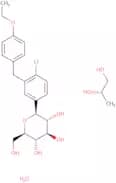
Pureza:Min. 95%Dapagliflozin propanediol monohydrate
CAS:Dapagliflozin is an oral antidiabetic drug that acts by inhibiting the SGLT2 enzyme. The SGLT2 enzyme is responsible for reabsorbing glucose from the kidney, so by inhibiting this enzyme, glucose will be excreted in the urine and blood glucose levels will decrease. Dapagliflozin also has a low bioavailability in vivo, which can be improved by administration with food. This drug has been shown to have a longer elimination half-life than canagliflozin and empagliflozin. Dapagliflozin has been shown to have a higher potency than metformin hydrochloride in vitro.Fórmula:C24H35ClO9Pureza:(Hplc) Min. 99.0%Forma y color:PowderPeso molecular:502.98 g/mol4-Methoxyphenyl 6-O-tert-butyldimethylsilyl-2-deoxy-2-(2,2,2-trichloroethoxyformamido)-b-D-glucopyranoside
4-Methoxyphenyl 6-O-tert-butyldimethylsilyl-2-deoxy-2-(2,2,2-trichloroethoxyformamido)-b-D-glucopyranoside is a synthetic oligosaccharide that is used as an intermediate in the synthesis of glycosylation products. This product can be custom synthesized and is provided with high purity. The CAS number for this product is 56874-06-1.Pureza:Min. 95%Hyaluronic acid sodium - Average MW 1.8 - 2.5 million Da
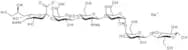
CAS:Gycosaminoglycan in many organs; joint lubricant and shock absorberFórmula:(C14H20NO11Na)nPureza:Min. 95%Forma y color:PowderSSEA-4 hexaose
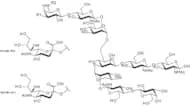
SSEA-4 hexaose is a virulence factor that belongs to the lectin family. It has been shown to be activated by binding to lectins, which are proteins that bind carbohydrates. SSEA-4 hexaose has also been shown to have cytotoxic effects on cells and induce apoptosis in some cancer cell lines. This glycan is expressed in many tissues, including brain, heart, liver, kidney, erythrocytes, lymphocytes and monocytes. In addition, it binds specifically to clostridium perfringens and mycobacterium tuberculosis with high affinity.
Fórmula:C43H71N2O34NaPureza:Min. 90 Area-%Forma y color:PowderPeso molecular:1,183.01 g/moln-Octyl-β-D-thiogalactopyranoside
CAS:n-Octyl-beta-D-thiogalactopyranoside is a modification of the sugar Galactose. It is a mono saccharide that can be found in the form of an oligosaccharide or polysaccharide. The modification of the sugar is done by methylation, glycosylation and fluorination. n-Octyl-beta-D-thiogalactopyranoside has CAS No. 42891-16-7 and can be found on PubChem CID: 5135624.
Fórmula:C14H28O5SPeso molecular:308.44 g/molRef: 3D-O-2700
5gA consultar10gA consultar25gA consultar50gA consultar100gA consultar-Unit-ggA consultarMethyl 6-deoxy-α-D-glucopyranoside
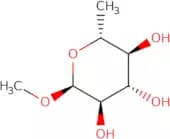
CAS:Methyl 6-deoxy-α-D-glucopyranoside is a synthetic monosaccharide. It is an important building block in the synthesis of glycosides, polysaccharides, and oligosaccharides. The product also has many applications in click chemistry, fluorination, and polysaccharide modification. Methyl 6-deoxy-α-D-glucopyranoside is available for custom synthesis to suit your specifications.Fórmula:C7H14O5Pureza:Min. 98 Area-%Forma y color:White PowderPeso molecular:178.18 g/molIsolinamarin
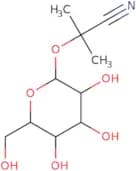
CAS:Isolinamarin is a natural product and chemical compound that has been found in leaves of the plant Passiflora edulis. Isolinamarin is synthesized by β-glucosidase from isolinol, an alicyclic alcohol. The synthetic route to isolinamarin starts with acetobromoglucose and proceeds through a series of steps that involve the formation of an acetal group, conversion to an aldehyde, oxidation to a carboxylic acid, and finally conversion to the desired product. Isolinamarin inhibits β-glucosidase by binding at the active site and preventing further substrate hydrolysis. It blocks glucose uptake into cells by inhibiting glucose transporters on cell membranes, as well as inhibiting glycolysis in humans.Pureza:Min. 95%Voglibose
CAS:Voglibose is a competitive inhibitor of α-glucosidase used for the control of blood sugar levels in patients with type 2 diabetes mellitus. The compound binds reversibly to intestinal carbohydrate-active digestive enzymes with α-glucosidase activity, inhibits breakdown of complex sugars and consequently delays the absorption of glucose into blood.Fórmula:C10H21NO7Forma y color:White PowderPeso molecular:267.28 g/mol(5R, 8R, 9S) -8- [(4R) - 2, 2- Dimethyl- 1, 3- dioxolan- 4- yl] - 9- hydroxy- 2, 2- dimethyl- 1, 3, 7- trioxaspiro[4.4] nonan- 6- on e
(5R, 8R, 9S) -8- [(4R) - 2, 2- Dimethyl- 1, 3- dioxolan- 4- yl] - 9- hydroxy- 2, 2- dimethyl- 1, 3, 7- trioxaspiro[4.4] nonan- 6- on e is a synthetic glycosylin containing a complex carbohydrate. It has been modified with methylation and Click chemistry to provide a fluorinated saccharide which can be used for the synthesis of oligosaccharides. This product is custom made and can be synthesized with high purity.Pureza:Min. 95%A1 Glycan, 2-AB labelled
A1 Glycan, 2-AB labelled is a custom synthesis of a complex carbohydrate. The carbohydrate is an oligosaccharide that has been modified with methylation and glycosylation. The carbohydrate has a CAS number and is a polysaccharide. It is modified with saccharide, methylation, and glycosylation. The carbohydrate has undergone click modification and fluorination and it is synthetic.
Pureza:Min. 95%2,6-di-O-n-pentyl-3-O-n-butyryl-γ-cyclodextrin
This gamma-cyclodextrin (γ-CD) derivative is a modified cyclic oligosaccharide composed of eight glucose units, featuring a larger cavity size than α- and β-cyclodextrins. This structural characteristic allows γ-CDs to form inclusion complexes with a wider range of guest molecules, making it particularly versatile in various industries. In the food sector, it is used as a carrier and stabilizer for flavors, fat-soluble vitamins, and polyunsaturated fatty acids, protecting volatile compounds from evaporation. In pharmaceuticals, it enhances the solubility and bioavailability of poorly water-soluble drugs and, thanks to its larger ring size, allows for the encapsulation of larger molecules or even entire drug molecules. γ-CDs and derivatives are also used for environmental remediation and, in analytical chemistry, for the extraction and concentration of target substances.Fórmula:C160H288O48Pureza:Min. 95%Peso molecular:2,979.97 g/mol1,2,3,4-Tetra-O-acetyl-D-lyxopyranose
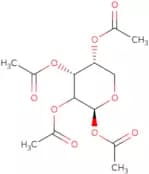
CAS:1,2,3,4-Tetra-O-acetyl-D-lyxopyranose (LXT) is a human lymphocyte growth factor that stimulates the proliferation of human lymphocytes. It also exhibits antiviral activity against murine leukemia and murine viruses in cell culture. LXT has been shown to inhibit the replication of the virus that causes human breast carcinoma. This compound also exhibits anti-inflammatory effects on murine leukemia cells and can stimulate the production of interferon from mouse spleen cells.
Fórmula:C13H18O9Pureza:Min. 95%Peso molecular:318.3 g/mol



![2-Methyl-(1,2-dideoxy-a-D-glucopyrano)-[2,1-d]-2-oxazoline](/_next/image/?url=https%3A%2Fstatic.cymitquimica.com%2Fproducts%2F3D%2Fthumb-webp%2FMM10955.webp&w=3840&q=75)
![(2R, 3S, 4S) -3-Fluoro- 4- (fluoromethyl])- 1- (phenylmethyl) -2- azetidinecarboxylic acid methyl …](/_next/image/?url=https%3A%2Fstatic.cymitquimica.com%2Fproducts%2F3D%2Fthumb-webp%2FMF163470.webp&w=3840&q=75)


![(5R, 8R, 9S) -8- [(4R) - 2, 2- Dimethyl- 1, 3- dioxolan- 4- yl] - 9- hydroxy- 2, 2- dimethyl- 1, 3…](/_next/image/?url=https%3A%2Fstatic.cymitquimica.com%2Fproducts%2F3D%2Fthumb-webp%2FMD170668.webp&w=3840&q=75)