Glycoscience
Subcategorías de "Glycoscience"
- Aminoazúcares(108 productos)
- Anticuerpos relacionados con azúcares(282 productos)
- Glicolípidos(46 productos)
- Glicosaminoglicanos (GAGs)(55 productos)
- Glucósidos(419 productos)
- Monosacáridos(6.624 productos)
- Oligosacáridos(3.682 productos)
- Polisacáridos(504 productos)
Se han encontrado 11047 productos de "Glycoscience"
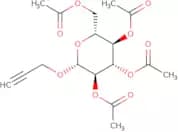
2-Propynyl-2,3,4,6-tetra-O-acetyl-b-D-glucopyranoside
CAS:2-Propynyl-2,3,4,6-tetra-O-acetyl-b-D-glucopyranoside is a carbohydrate. It is an oligosaccharide that contains a glucose molecule with four acetyl groups at the 2 position. This type of modification can be used to create high purity compounds for research purposes. 2-Propynyl-2,3,4,6-tetra-O-acetyl-b-D-glucopyranoside also has methylation and glycosylation sites available for custom synthesis.Fórmula:C17H22O10Pureza:Min. 95%Forma y color:White PowderPeso molecular:386.35 g/molMethyl 2,3,4-tri-O-acetyl-6-O-tert-butyldiphenylsilyl-a-D-galactopyranoside
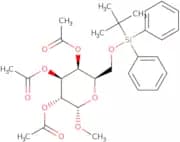
CAS:Methyl 2,3,4-tri-O-acetyl-6-O-tert-butyldiphenylsilyl a-D-galactopyranoside is an oligosaccharide that has been modified with methylation, glycosylation and fluorination. It is an important compound in carbohydrate chemistry. The oligosaccharide is synthesized by the condensation of 3 molecules of galactose with 1 molecule of mannose to form a disaccharide. This product is manufactured by custom synthesis and has been purified to high purity.Fórmula:C29H38O9SiPureza:Min. 95%Peso molecular:558.71 g/molAllyl 2-acetamido-2-deoxy-?-D-glucopyranoside
CAS:Allyl 2-acetamido-2-deoxy-a-D-glucopyranoside is a synthetic oligosaccharide that has the ability to bind to the O antigen of bacterial cells. It is used in vaccines as an adjuvant and has been shown to increase antibody production and provide protection against Shigella, a bacterial infection. This compound also shows chemoenzymatic activity, which allows for regiospecifically catalytic conversion of glycosides. Allyl 2-acetamido-2-deoxy-a-D-glucopyranoside binds to specific microbial enzymes that contain an acceptor site, with its catalytic function being activated by these enzymes.Fórmula:C11H19NO6Pureza:Min. 95%Forma y color:PowderPeso molecular:261.27 g/mol2,3,4,6-Tetra-O-acetyl-1-azido-1-deoxy-α-D-galactopyranosyl cyanide
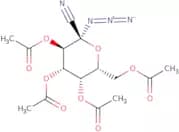
CAS:A solar thermal collector is a device that absorbs the sun's heat, or thermal energy, and converts it to useful heat energy. It consists of a dark-colored surface (usually metal) that absorbs sunlight and transfers the heat by radiation to a fluid such as water or oil, which then carries the heat away for use. The efficiency of this type of collector depends on the quantity of sunlight that reaches it, the temperature difference between the hot fluid and ambient air, and its design. A typical solar thermal collector has an efficiency of about 10%.Fórmula:C15H18N4O9Pureza:Min. 95%Forma y color:White/Off-White SolidPeso molecular:398.32 g/mol5,7-Dichloro-8-hydroxyquinoline b-D-glucuronide
CAS:Chromogenic substrate targeting beta-glucuronidaseFórmula:C15H13Cl2NO7Pureza:Min. 98 Area-%Forma y color:Yellow PowderPeso molecular:390.17 g/mol4-Toluoyl 2,3-di-O-benzoyl-4,6-O-benzylidene-b-D-thioglucopyranoside
4-Toluoyl 2,3-di-O-benzoyl-4,6-O-benzylidene-b-D-thioglucopyranoside is a custom synthesis of an oligosaccharide. It is available as a white solid and has a molecular formula of C14H14F6O8S2 and a molecular weight of 458.35. This compound is soluble in water and can be stored at room temperature.Pureza:Min. 95%1,6-Anhydro-3,4-dideoxy-b-D-erythro-hex-3-enopyranose
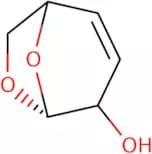
CAS:1,6-Anhydro-3,4-dideoxy-b-D-erythro-hex-3-enopyranose is a custom synthesis of a glycoconjugate that contains a sugar. It is a synthetic saccharide with an oligosaccharide and monosaccharides. The structure of this compound has been modified to include fluorination, methylation, and click chemistry. This product has high purity and can be used for glycosylation reactions in the laboratory.Fórmula:C6H8O3Pureza:Min. 95%Peso molecular:128.13 g/mol2-Azidoethyl 2-acetamido-2-deoxy-b-D-glucopyranoside
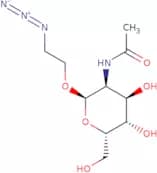
CAS:2-Azidoethyl 2-acetamido-2-deoxy-b-D-glucopyranoside is a toxic compound that inhibits protein synthesis by binding to the enzyme glucokinase. It has been shown to inhibit the release of fatty acids in hepatocytes and to inhibit triglyceride lipase activity in cell culture. This chemical also has a damaged sequence, which is a factor that may lead to toxicity. 2-Azidoethyl 2-acetamido-2-deoxy-b-D-glucopyranoside also has been shown to have physiological activities, such as inhibition of cardiac cells and symptoms such as inflammation. These effects are thought to be mediated by its ability to bind with DNA and RNA, altering their function.
Fórmula:C10H18N4O6Pureza:Min. 95%Forma y color:White PowderPeso molecular:290.27 g/mol1,2:3,4-Di-O-isopropylidene-a-D-galacturonide methyl ester
CAS:1,2:3,4-Di-O-isopropylidene-a-D-galacturonide methyl ester is a synthetic monosaccharide that is used in the synthesis of oligosaccharides and polysaccharides. This product has been synthesized by fluorination of galacturonic acid and methylation of the resulting alcohol with methanol. The desired product can be obtained through glycosylation using a variety of sugars or click modification using an azide building block. This product has been shown to have high purity, which is determined by HPLC analysis.Fórmula:C13H20O7Pureza:Min. 95%Peso molecular:288.29 g/mol(2R, 3R, 4R) -3-Benzyloxy- 1- benzyl-4- (hydroxymethyl) - 2- azetidinecarboxylic acid methyl ester
(2R, 3R, 4R) -3-Benzyloxy- 1- benzyl-4-(hydroxymethyl)- 2-azetidinecarboxylic acid methyl ester is an oligosaccharide. It is a modification of the Oligosaccharide which is a carbohydrate with multiple saccharides. This means that it contains two or more types of sugar monomers. The primary type of sugar in this compound is the Monosaccharide, which are single units of sugar that are joined together to form a sugar polymer. The other type of sugar in this compound is the Polysaccharide, which is made up of many different monomers. Carbohydrates are an important source of energy for living organisms and they can be found in many different forms such as sugars and starches. This compound has been modified by Methylation (addition of a methyl group), Glycosylation (addition of glycosidicPureza:Min. 95%Phosphoric acid mono-((2R,3R,4S,5R)-2,3,4,5,6,7-hexahydroxy-heptyl) ester barium salt
Phosphoric acid mono-((2R,3R,4S,5R)-2,3,4,5,6,7-hexahydroxy-heptyl) ester barium salt is a Glycosylation product. It is a complex carbohydrate with the molecular formula C6H14O6P. The glycosylation of this compound can be accomplished by methylation or by Click modification. This product also has an Oligosaccharide content and Polysaccharide properties. The CAS Number for this compound is 595-25-1.Fórmula:C7H15O10PBaPureza:Min. 95%Peso molecular:427.49 g/molD-Mannose-6-phosphate disodium salt hydrate
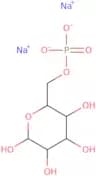
CAS:D-Mannose-6-phosphate disodium salt hydrate (DMDSP) is an endogenous pentose phosphate metabolite that is found in the human body. DMDSP is generated from the metabolism of mannose and glucose and functions as a regulator of metabolic intermediates. It has also been shown to inhibit bacterial growth and function as a competitive inhibitor of bacterial DNA gyrase, an enzyme that maintains the integrity of bacterial DNA. Genetic polymorphism in the DMDP gene may be associated with changes in response to DMDSP. The reductive amination reaction can be used to synthesize this compound from L-aspartic acid, malic enzyme, and nicotinamide adenine dinucleotide phosphate.Fórmula:C6H11O9PNa2·H2OPureza:Min. 95 Area-%Forma y color:White PowderPeso molecular:322.11 g/molN-Benzyl-3,5-dideoxy-3,5-imino-1,2-O-isopropylidene-L-lyxofuranose
N-Benzyl-3,5-dideoxy-3,5-imino-1,2-O-isopropylidene-L-lyxofuranose is a compound that belongs to the group of complex carbohydrates. It is a monosaccharide with a molecular weight of 538.32 g/mol and a CAS number of 1607741-34-8. This product has been custom synthesized for research purposes. The purity level is high and it can be used in glycosylation reactions.Pureza:Min. 95%(1R) -1- [(2S, 3R) - 3- Hydroxy- 1- butyl - 2- azetidinyl] -1, 2- ethanediol
(1R) -1- [(2S, 3R) - 3- Hydroxy- 1- butyl - 2- azetidinyl] -1, 2- ethanediol is a glycosylase that catalyzes the hydrolysis of terminal sialic acid residues from oligosaccharides and monosaccharides. It is used in the synthesis of complex carbohydrates. This glycosylase has been shown to be highly specific for terminal sialic acids and can also be used to produce oligosaccharides with desired linkages between the sugars. The enzyme is most active at low pH and high temperatures.
Pureza:Min. 95%a-D-Glucoheptonic acid magnesium salt
CAS:a-D-Glucoheptonic acid magnesium salt is a carbohydrate that belongs to the group of saccharides. It can be used as an anti-inflammatory agent, and has been shown to inhibit the production of nitric oxide in macrophages. It also has antiviral properties. This product is available for custom synthesis, with high purity and high purity.Fórmula:C13H23O8MgPureza:Min. 95%Forma y color:PowderPeso molecular:331.62 g/mol1,3,4,6-Tetra-O-benzoyl-α-D-fructofuranose
CAS:1,3,4,6-Tetra-O-benzoyl-a-D-fructofuranose is a fluorinated monosaccharide. It is an artificial sugar that has been modified with a benzoyl group at the 1 position and a tetra-O-benzoyl group at the 3 position. This compound has been synthesized using a custom synthesis. The compound is soluble in water and ethanol and can be used as a glycosylation or polysaccharide modification reagent. Click chemistry reactions have been performed on this compound to introduce methyl groups to the 4 and 6 positions of the sugar ring. The purity of this product is >99%.
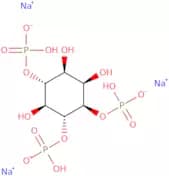
Fórmula:C34H28O10Pureza:Min. 95%Forma y color:White To Off-White SolidPeso molecular:596.58 g/molD-myo-Inositol 1,4,6-triphosphate sodium salt
CAS:D-myo-Inositol 1,4,6-triphosphate sodium salt (DMIPS) is an alkaline polymer. It is a high capacity, rechargeable electrode material that can be used in electrochemical cells. DMIPS has been shown to have the highest energy density and power density of any known polymer and can operate at low temperatures. This material has been shown to be effective in polymer electrolyte membrane fuel cells, as well as being used as a separator in lithium ion batteries.Fórmula:C6H12O15P3·xNaPureza:Min. 95%Peso molecular:417.07 g/mol(2R, 3S, 4R, 5S) -3,4-Dihydroxy-2, 5- pyrrolidinedimethano l
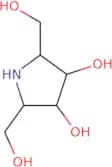
CAS:(2R, 3S, 4R, 5S) -3,4-Dihydroxy-2,5-pyrrolidinedimethanol is a methylated form of levoglucosan. It is a synthetic compound that can be produced by the modification of glucose or by the fluorination of glycerol. This white crystalline solid can be used in various applications such as the synthesis of oligosaccharides and polysaccharides or as a sugar for use in high purity experiments. This product is available for custom synthesis and has been shown to have an excellent quality.Pureza:Min. 95%(2S, 3S, 4S) -2- (Hydroxymethyl) - 1- methyl- 3, 4- pyrrolidinediol
CAS:Ketoconazole is an anti-infective agent that is used in the treatment of fungal and yeast infections. It has been shown to inhibit the transcriptional activation of many genes, including those encoding for α subunit of RNA polymerase and sequences involved in drug metabolism. Ketoconazole also inhibits the formation of benzimidazole compounds in bacteria, which are used by some bacteria to protect themselves against other antibiotics. The biological function of ketoconazole is not yet fully understood, but it has been shown to have a negative effect on pancreatic function in CD-1 mice.Pureza:Min. 95%Methyl 2,3,5-tri-O-(2,4-dichlorobenzyl)-b-D-ribofuranoside
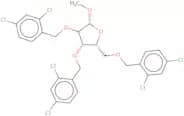
CAS:Methyl 2,3,5-tri-O-(2,4-dichlorobenzyl)-b-D-ribofuranoside is a glycosylation agent that is used as a monosaccharide or oligosaccharide modification. It can be utilized in the synthesis of saccharides and polysaccharides. Methyl 2,3,5-tri-O-(2,4-dichlorobenzyl)-b-D-ribofuranoside is a custom synthesis product with high purity and CAS No. 163759-40-8.Fórmula:C27H24Cl6O5Pureza:Min. 95%Peso molecular:641.21 g/mol








![(1R) -1- [(2S, 3R) - 3- Hydroxy- 1- butyl - 2- azetidinyl] -1, 2- ethanediol](/_next/image/?url=https%3A%2Fstatic.cymitquimica.com%2Fproducts%2F3D%2Fthumb-webp%2FMH163534.webp&w=3840&q=75)