Glycoscience
La glicociencia es el estudio de los carbohidratos y sus derivados, así como de las interacciones y funciones biológicas en las que participan. Este campo de investigación es crucial para comprender una amplia variedad de procesos biológicos, incluyendo el reconocimiento celular, la señalización, la respuesta inmune y el desarrollo de enfermedades. La glicociencia tiene aplicaciones importantes en la biotecnología, la medicina, y el desarrollo de nuevos fármacos y terapias. En CymitQuimica, ofrecemos una amplia selección de productos de alta calidad y pureza para la investigación en glicociencia. Nuestro catálogo incluye monosacáridos, oligosacáridos, polisacáridos, glicoconjugados, y reactivos específicos, diseñados para apoyar a los investigadores en sus estudios sobre la estructura, función y aplicaciones de los carbohidratos en sistemas biológicos. Estos recursos están destinados a facilitar descubrimientos científicos y aplicaciones prácticas en diversas áreas de la biociencia y la medicina.
Subcategorías de "Glycoscience"
- Aminoazúcares(108 productos)
- Anticuerpos relacionados con azúcares(282 productos)
- Glicolípidos(46 productos)
- Glicosaminoglicanos (GAGs)(55 productos)
- Glucósidos(419 productos)
- Monosacáridos(6.624 productos)
- Oligosacáridos(3.682 productos)
- Polisacáridos(503 productos)
Se han encontrado 11046 productos de "Glycoscience"
Ordenar por
Pureza (%)
0
100
|
0
|
50
|
90
|
95
|
100
(2S, 3R, 4S) -2- [(1S) - 1, 2-Dihydroxyethyl] - 1- methyl- 3, 4- pyrrolidinediol
<p>(2S, 3R, 4S) -2- [(1S) - 1, 2-Dihydroxyethyl] - 1- methyl- 3, 4- pyrrolidinediol is a glycosylate compound that is synthesized by the chemical modification of polysaccharides. It has many modifications like fluorination, saccharide and modification. This product can be custom synthesized to fit the requirements of the customer. The CAS number for this product is 1118-71-4. The molecular formula for this compound is C6H14O3 and it has a molecular weight of 192.19 g/mol. The purity level for this product is >99%.</p>Pureza:Min. 95%2C-Hydroxymethyl-2,3:5,6-di-O-isopropylidene-D-mannono-1,4-lactone
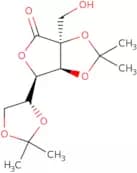
CAS:2C-Hydroxymethyl-2,3:5,6-di-O-isopropylidene-D-mannono-1,4-lactone is a synthetic monosaccharide with a CAS number of 70147-48-7. This compound has been modified to include the hydroxymethyl group and the 2C designation. It is used as an ingredient in the synthesis of complex carbohydrates.Fórmula:C13H20O7Pureza:Min. 95%Forma y color:PowderPeso molecular:288.29 g/molMethyl 2,3-di-O-methyl-α-D-xylofuranoside
CAS:A useful xylose building blockFórmula:C8H16O5Pureza:Min. 95%Forma y color:PowderPeso molecular:192.21 g/molGM1b-Oligosaccharide
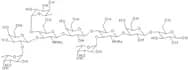
<p>GM1b pentasaccharide (sodium salt) has a core tetrasaccharide structure (Galβ1,3GalNAcβ1,4Galβ1,4Glc) with a single sialic acid residue linked α2,3 to the terminal galactose residue (Ledeen, 2009). GM1b oligosaccaharide is the carbohydrate moiety in GM1b ganglioside, which is a minor component of human brain monosialoganglioside fraction. GM1b ganglioside and especially anti-GM1b IgG antibodies are associated with axonal Guillain-Barré syndrome, which develops followingâ¯C. jejuniâ¯infection (Yuki, 1999).</p>Fórmula:C37H61N2O29NaPureza:Min. 90 Area-%Forma y color:PowderPeso molecular:1,020.87 g/mol1’,2’-Di-O-acetyl-5’-O-benzoyl-3’-deoxy-3’-fluoro-D-ribofuranose
<p>1’,2’-Di-O-acetyl-5’-O-benzoyl-3’-deoxy-3’-fluoro-D-ribofuranose is a glycosylated monosaccharide that is custom synthesized for use as a fluorinated probe in the detection of protein glycosylation. This compound has been shown to react with Methyl groups to form a complex carbohydrate. 1’,2’-Di-O-acetyl-5’-O-benzoyl-3’ -deoxy -3’ -fluoro D ribofuranose is soluble in water and organic solvents such as ethanol or methanol. The CAS number for this compound is 522611–41–0.</p>Pureza:Min. 95%(2R, 3S, 4S, 5R) - 2- (Hydroxymethyl) - 5- methyl-3, 4- pyrrolidinediol
CAS:(2R, 3S, 4S, 5R) - 2- (Hydroxymethyl) - 5- methyl-3, 4- pyrrolidinediol is a synthetic compound that can be used as a building block in the synthesis of complex carbohydrates. This product is custom synthesized to order. It has high purity and is available for bulk or small quantities. It can be modified with fluorination or methylation. The product contains an oligosaccharide or polysaccharide as a saccharide. This product is also known as Methylation, CAS No. 1932460-16-6, Custom synthesis, Click modification, Oligosaccharide, Polysaccharide, saccharide, Carbohydrate, Fluorination, complex carbohydrate, High purity, Modification, Monosaccharide, sugar.Pureza:Min. 95%(R)-1,4-Anhydro-2-O-(2,4-dimethoxybenzoyl)-3,5-O-(1,1,3,3- tetraisopropyldisiloxane-1,3-diyl)-4-sulfinyl-D-ribitol
CAS:(R)-1,4-Anhydro-2-O-(2,4-dimethoxybenzoyl)-3,5-O-(1,1,3,3- tetraisopropyldisiloxane-1,3-diyl)-4-sulfinyl-D-ribitol is a synthetic carbohydrate. It is a monosaccharide that has been modified with methylation and fluorination. The compound is used in the synthesis of oligosaccharides and polysaccharides. (R)-1,4-Anhydro-2-O-(2,4-dimethoxybenzoyl)-3,5--O-(1,1,3,3--tetraisopropyldisiloxane) -D ribitol has been found to be an active ingredient in pharmaceutical products.Pureza:Min. 95%N-Benzyl-6-fluoro-3,5,6-trideoxy-3,5-imino-L-idofuranose
N-Benzyl-6-fluoro-3,5,6-trideoxy-3,5-imino-L-idofuranose is an NMR spectroscopic heterocyclic compound. It has a molecular weight of 532.8 g/mol and a molecular formula of C12H14N2O8F3. This is a synthetic compound that belongs to the category of carbohydrates.Pureza:Min. 95%2,3:4,5-Di-O-isopropylidene-1-O-methacryloyl-b-D-fructopyranose - Stabilised with Mono Methyl Ether of Hydroquinone
CAS:2,3:4,5-Di-O-isopropylidene-1-O-methacryloyl-b-D-fructopyranose - Stabilised with Mono Methyl Ether of Hydroquinone is a custom synthesized carbohydrate with a complex structure. It has been modified using methylation and glycosylation reactions to produce different saccharide structures. This product is fluorinated at the 2,3,4,5 positions and is commercially available with high purity.Fórmula:C16H24O7Pureza:Min. 95%Forma y color:PowderPeso molecular:328.36 g/molTrifucosyl-p-lacto-N-hexaose
CAS:Trifucosyl-p-lacto-N-hexaose is a complex carbohydrate that has been modified by methylation and glycosylation. It is a synthesized sugar that may be used as a pharmaceutical agent or as an additive in food products. Trifucosyl-p-lacto-N-hexaose has been modified using Click chemistry and fluorination, which have been shown to increase the purity of this compound. This product has a high degree of purity, as it is synthesized from pure materials.Fórmula:C58H98N2O43Pureza:Min. 90 Area-%Forma y color:SolidPeso molecular:1,511.39 g/molD-Glucuronic acid, sodium salt monohydrate
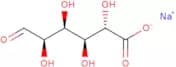
CAS:<p>Custom synthesis of D-glucuronic acid, sodium salt monohydrate.</p>Pureza:Min. 95%2-O-(a-D-Galactopyranosyl)-D-glucopyranose
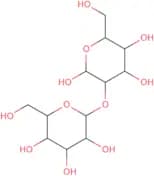
CAS:<p>2-O-(a-D-Galactopyranosyl)-D-glucopyranose is a disaccharide consisting of two monosaccharides, glucose and galactose. It also contains a hydroxy group on the second carbon atom in the molecule. 2-O-(a-D-Galactopyranosyl)-D-glucopyranose is found in some plants including sugarcane, sugar beet, and sweet potatoes. This disaccharide is broken down by enzymes called beta-galactosidases into its two monosaccharides. Beta-galactosidases are used as an enzyme therapy to treat certain genetic disorders that affect the breakdown of carbohydrates.</p>Fórmula:C12H22O11Pureza:Min. 95%Peso molecular:342.3 g/mol3-Hydroxydesloratadine b-D-glucuronide sodium salt
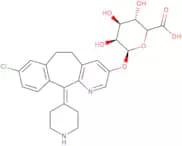
CAS:<p>3-Hydroxydesloratadine b-D-glucuronide sodium salt is a carbohydrate that is used as an intermediate in the synthesis of saccharides. It can be modified to make it more soluble in water by adding fluorine atoms, which increases its solubility and bioavailability. 3-Hydroxydesloratadine b-D-glucuronide sodium salt is synthesized using a custom synthesis method with high purity and high yield. It has glycosylation, methylation, and click modification done on it during the synthesis process.</p>Fórmula:C25H26ClN2O7·NaPureza:Min. 95%Forma y color:PowderPeso molecular:524.93 g/mol3,6-Dimethyl-a-cyclodextrin
<p>Alpha-cyclodextrin (α-CD) derivative with a hydrophilic exterior and lipophilic cavity (smaller than β-CDs and γ-CDs) to allocate certain guest molecules. This structural characteristic enables applications in molecular encapsulation, solubility enhancement, and stabilization across multiple industries. In pharmaceuticals, it serves as a drug delivery vehicle, enhancing the bioavailability and stability of active ingredients. The food industry utilizes it as a stabilizer for flavors, colors, and nutrients, as well as a functional ingredient for its effects on lipid metabolism. In cosmetics, it acts as a complex agent for fragrances and active components. Its applications extend to analytical chemistry for chiral separation and to materials science for developing smart materials and nanosystems.</p>Fórmula:C48H84O30Pureza:Min. 95%Peso molecular:1,141.16 g/molUDP-D-glucuronide trisodium salt
CAS:<p>Substrate for glucuronosyltransferases</p>Fórmula:C15H19N2Na3O18P2Pureza:Min. 98 Area-%Forma y color:White Off-White PowderPeso molecular:646.24 g/mol2-Acetamido-3,4,6-tri-O-acetyl-2-deoxy-β-D-glucopyranosyl amine
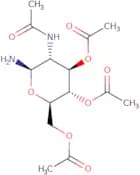
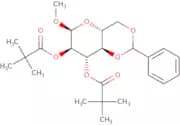
CAS:2-Acetamido-3,4,6-tri-O-acetyl-2-deoxy-b-D-glucopyranosyl amine is a high purity custom synthesis sugar. It can be modified with fluorination, glycosylation, and methylation. It has CAS No. 4515-24-6 and is a synthetic oligosaccharide monosaccharide saccharide carbohydrate complex carbohydrate.Fórmula:C14H22N2O8Pureza:Min. 95%Forma y color:PowderPeso molecular:346.33 g/molMethyl 4,6-O-benzylidene-2,3-di-O-pivaloyl-a-D-glucopyranoside
CAS:<p>Methyl 4,6-O-benzylidene-2,3-di-O-pivaloyl-a-D-glucopyranoside is a custom synthesis of a high purity and high quality. This product is an oligosaccharide with a complex carbohydrate structure. Methyl 4,6-O-benzylidene-2,3-di-O-pivaloyl-a-D-glucopyranoside has been shown to be highly stable in the presence of strong acids and bases. It can be modified using click chemistry reactions for further experimental research.</p>Fórmula:C24H34O8Pureza:Min. 95%Peso molecular:450.53 g/molMethy 2-deoxy-5-O-(4-phenylbenzoyl)-a-D-ribofuranoside
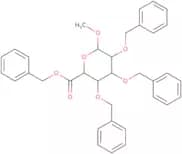
CAS:Methyl 2-deoxy-5-O-(4-phenylbenzoyl)-a-D-ribofuranoside is a custom synthesis of an Oligosaccharide, Polysaccharide, saccharide, Carbohydrate. It is a fluorinated modification of a high purity custom synthesis of Methy 2-deoxy-5-O-(3,4,6-trichlorobenzoyl)-a-D-ribofuranoside. The compound has been modified by Click chemistry to include a methyl group at the C2 position and it has been shown to be a complex carbohydrate. The compound has also been synthesized with great purity and high quality. This compound can be used in the study of monosaccharides, sugars and synthetic compounds.Fórmula:C19H20O5Pureza:Min. 95%Peso molecular:328.36 g/molMethyl 2,3,4-tri-O-benzyl-α-D-glucuronide benzyl ester
CAS:Methyl 2,3,4-tri-O-benzyl-α-D-glucuronide benzyl ester is a Carbohydrate. It is soluble in water and insoluble in alcohol. The molecular weight of Methyl 2,3,4-tri-O-benzyl-α-D-glucuronide benzyl ester is 584.1 g/mol. The CAS Registry Number for Methyl 2,3,4-tri-O-benzyl-α-D-glucuronide benzyl ester is 14279733.Fórmula:C35H36O7Pureza:Min. 95%Forma y color:Colorless Clear LiquidPeso molecular:568.66 g/molAllitol
CAS:<p>Allitol is a sugar alcohol that is used as a sweetener. It can be found naturally in some fruits and vegetables, but it can also be produced by hydrogenation of xylose. Allitol is metabolized by the liver and has been shown to inhibit fatty acid synthesis. It also has insulin-resistance effects, which may be due to its ability to inhibit the conversion of glucose into fatty acids. Allitol has been shown to decrease the levels of hydrochloric acid in the stomach, which may lead to an increase in gastric pH. Allitol will react with strong bases such as sodium hydroxide or potassium hydroxide to form d-talitol and polycarboxylic acid, respectively. Magnetic resonance spectroscopy (MRS) can be used to study the biochemical properties of allitol because it has a unique magnetic resonance spectrum (MRS).</p>Fórmula:C6H14O6Pureza:Min. 98 Area-%Forma y color:PowderPeso molecular:182.17 g/mol
![(2S, 3R, 4S) -2- [(1S) - 1, 2-Dihydroxyethyl] - 1- methyl- 3, 4- pyrrolidinediol](/_next/image/?url=https%3A%2Fstatic.cymitquimica.com%2Fproducts%2F3D%2Fthumb-webp%2FMD163936.webp&w=3840&q=75)