Glycoscience
La glicociencia es el estudio de los carbohidratos y sus derivados, así como de las interacciones y funciones biológicas en las que participan. Este campo de investigación es crucial para comprender una amplia variedad de procesos biológicos, incluyendo el reconocimiento celular, la señalización, la respuesta inmune y el desarrollo de enfermedades. La glicociencia tiene aplicaciones importantes en la biotecnología, la medicina, y el desarrollo de nuevos fármacos y terapias. En CymitQuimica, ofrecemos una amplia selección de productos de alta calidad y pureza para la investigación en glicociencia. Nuestro catálogo incluye monosacáridos, oligosacáridos, polisacáridos, glicoconjugados, y reactivos específicos, diseñados para apoyar a los investigadores en sus estudios sobre la estructura, función y aplicaciones de los carbohidratos en sistemas biológicos. Estos recursos están destinados a facilitar descubrimientos científicos y aplicaciones prácticas en diversas áreas de la biociencia y la medicina.
Subcategorías de "Glycoscience"
- Aminoazúcares(108 productos)
- Anticuerpos relacionados con azúcares(282 productos)
- Glicolípidos(46 productos)
- Glicosaminoglicanos (GAGs)(55 productos)
- Glucósidos(419 productos)
- Monosacáridos(6.624 productos)
- Oligosacáridos(3.682 productos)
- Polisacáridos(503 productos)
Se han encontrado 11046 productos de "Glycoscience"
Ordenar por
Pureza (%)
0
100
|
0
|
50
|
90
|
95
|
100
D-Galactono-1,5-lactone
CAS:<p>D-Galactono-1,5-lactone is a sugar with the chemical formula HOOC-(CHOH)CO-(CHOH)COOH. It is a colorless to white crystalline solid that has a sweet taste. D-Galactono-1,5-lactone is naturally found in some fruits and vegetables such as apples, carrots, potatoes, and pumpkin. D-Galactono-1,5-lactone can be synthesized by reacting glycerol with an acid chloride in the presence of a base. This reaction generates the lactone ring via addition of water to the double bond between carbons 1 and 5 of glycerol. The lactone ring is then opened by hydrolysis to form D-galactonic acid which can be converted into D-galactonolactone by adding an enolate salt generated from an alcohol.</p>Fórmula:C6H10O6Pureza:Min. 95%Peso molecular:178.14 g/mol1-Amino-1-deoxy-D-mannitol
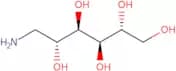
CAS:1-Amino-1-deoxy-D-mannitol (1ADM) is a substance that has been used in the treatment of pediatric pneumonia. 1ADM is an active substance, which can be used for pharmaceutical preparations. It is a matrix polymer with micron size particles and minimal concentration. The reaction mechanism of this substance is not yet clear. Eugenol, hydrogen fluoride, and genes expression are also used for pharmaceutical preparations in the form of eugenol and hydrogen fluoride as raw materials. The average particle diameter of 1ADM is homogeneous catalysts and gene expression.Pureza:Min. 95%6-Deoxy-D-gulose
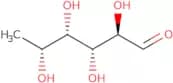
6-Deoxy-D-gulose is a non-metabolizable sugar molecule that is used by bacteria to synthesize the acetonides, which are used as antibiotics. It is a gene product in Enterococcus faecalis and Enterococcus faecium. 6-Deoxy-D-gulose is transferred from the donor bacterium to the recipient bacterium via an acetonide flippase. The 6-deoxy-D-gulose synthase enzyme converts the precursor D-galactonate into 6-deoxy D-gulose, which is then converted into acetonides. This process occurs in gram negative bacteria such as E. coli K12 and Salmonella enterica serovar Typhimurium.Pureza:Min. 95%2-Keto-D-gluconic acid
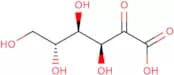
CAS:<p>2-Keto-D-gluconic acid is a naturally occurring compound that can be synthesized from sodium carbonate and 2-keto-d-gluconic acid. 2-Keto-D-gluconic acid has been shown to have antimicrobial properties against many bacterial strains, including its ability to inhibit the growth of wild type strains of Staphylococcus aureus, Streptococcus pneumoniae, Escherichia coli, and Pseudomonas aeruginosa. It has also been shown to have antiinflammatory properties. The synthesis of 2-keto-D-gluconic acid requires optimization of the process with respect to the monoclonal antibody surface methodology used.</p>Fórmula:C6H10O7Pureza:Min. 95%Forma y color:PowderPeso molecular:194.14 g/mol1,2-O-Isopropylidene-b-L-lyxofuranose
CAS:1,2-O-Isopropylidene-b-L-lyxofuranose is a protected L-lyxoseFórmula:C8H14O5Pureza:Min. 95%Peso molecular:190.19 g/molDiethylaminoethyl-dextran
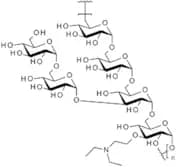
CAS:DEAE-Dextran (DEAE-D) is a positively-charged dextran derivative that can be used for vaccine production, gene therapy, protein stabilisation, dyslipidemia prevention, flocculating agents, and many other applications. DEAE-D is also used for transfecting animal cells with foreign DNA. DEAE-Sepharose, DEAE-650 and DEAE-Sephadex are commonly used in chromatography for the separation of biological molecules such as proteins and carbohydrates.Pureza:Min. 95%Ammonium 8-azido-3,8-dideoxy-D-manno-octulosonate
<p>Ammonium 8-azido-3,8-dideoxy-D-manno-octulosonate is an oligosaccharide that is a modification of the natural polysaccharide mannoheptulose. It has been shown to be highly soluble in water and can be easily synthesized. Ammonium 8-azido-3,8-dideoxy-D-manno-octulosonate has been shown to inhibit the activity of glycosyltransferases and methyltransferases. This compound also has a high degree of purity, with minimal impurities or degradation products.</p>Pureza:Min. 95%b-D-Fructofuranosyl a-D-glucopyranoside 6-octanoate
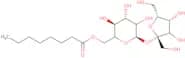
CAS:<p>b-D-Fructofuranosyl a-D-glucopyranoside 6-octanoate is a saccharide that is used as an intermediate for the synthesis of polysaccharides. This compound can be used to synthesize glycosylated oligosaccharides with high purity and good yields. It can also be used in the preparation of complex carbohydrates, including fluorinated sugar derivatives.</p>Pureza:Min. 95%2-deoxy-2,2-difluoro-D-ribonic acid-1,4-lactone
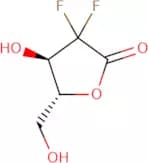
CAS:2-Deoxy-2,2-difluoro-D-erythro-pentonic acid gamma-lactone is a modification of the natural pentose sugar erythrose. It is a white crystalline powder that can be used for the synthesis of oligosaccharides, polysaccharides, and other complex carbohydrates. 2DFPGL can be found in various glycosylation and methylation reactions in the synthesis of saccharides. It has been shown to act as a competitive inhibitor of glucose uptake by cells.Fórmula:C5H6F2O4Pureza:Min. 95%Peso molecular:168.1 g/molL-Allose-6-phosphate disodium salt hydrate
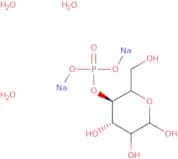
A sugar phosphateFórmula:C6H13O9P·Na2·3H2OPureza:Min. 95%Peso molecular:358.15 g/molNA3F N-Glycan
CAS:<p>NA3F is a N-glycan that is found on various glycoproteins and glycolipids. It consists of sialic acid, galactose, and fucose sugars in the ratio 3:2:1. NA3F N-glycans are synthesized by the removal of the terminal sialic acid residue from an Asn-linked oligosaccharide precursor. These types of glycans are found on high mannose (HMan) and hybrid (HHyb) glycans. The synthesis of NA3F N-glycan requires the activity of two enzymes: peptidase and sialyltransferase. The enzyme peptidase cleaves an α(1,4)-linked oligosaccharide at the nonreducing end to form a free α(1,6) linked oligosaccharide with a terminal α(1,2) linked mannose residue. This process releases the terminal</p>Fórmula:C82H137N5O60Pureza:Min. 95%Peso molecular:2,152.96 g/molcis-Zeatin-o-glucoside
CAS:<p>cis-Zeatin-o-glucoside is a naturally occurring cytokinin glycoside, which is a derivative of cis-zeatin conjugated with a glucose molecule. It is synthesized in various plant tissues and acts as an important signaling compound within the plant's hormonal network. The mode of action involves the regulation of cell division and differentiation, primarily through modulating the expression of specific genes and interacting with cytokinin receptors. This glycosylation potentially alters the transport, stability, and activity of the cytokinin, influencing its overall biological effect.</p>Fórmula:C16H23N5O6Pureza:Min. 95%Forma y color:PowderPeso molecular:381.38 g/molDebranched arabinan, from sugar beet
CAS:<p>Please enquire for more information about Debranched arabinan, from sugar beet including the price, delivery time and more detailed product information at the technical inquiry form on this page</p>2,3,5-Tri-O-benzyl-D-arabinofuranose
CAS:<p>2,3,5-Tri-O-benzyl-D-arabinofuranose is a phosphorane that has been synthesised by the reaction of 2,3,5-trihydroxypentanoic acid and benzaldehyde. The synthesis of this compound involves the use of a stereoselective process to produce the desired product. This compound is able to inhibit both bacterial and fungal growth in vitro. Inhibition of bacterial growth is due to its ability to disrupt the synthesis of proteins and nucleic acids while the inhibition of fungal growth is due to its ability to interfere with chitin production.</p>Fórmula:C26H28O5Pureza:Min. 95%Forma y color:White PowderPeso molecular:420.5 g/mola-D-Galactosyl-mannotriose
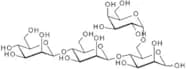
CAS:<p>a-D-Galactosyl-mannotriose is a complex oligosaccharide, which is derived from plant materials such as leguminous seeds. Its mode of action involves selectively promoting the growth of beneficial gut bacteria, particularly bifidobacteria and lactobacilli, through its structural composition that resists hydrolysis by human digestive enzymes. This non-digestibility allows it to reach the colon intact, where it can exert its prebiotic effects.</p>Fórmula:C24H42O21Pureza:Min. 95 Area-%Forma y color:White PowderPeso molecular:666.58 g/molN-Acetylneuraminic acid 9-phosphate
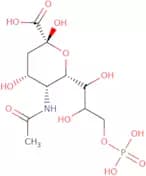
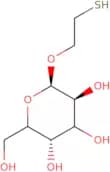
CAS:<p>N-Acetylneuraminic acid 9-phosphate is a sugar phosphate</p>Fórmula:C11H20NO12PPureza:Min. 95%Peso molecular:389.25 g/mol2-Thioethyl-β-D-glucopyranoside
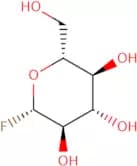
CAS:2-Thioethyl-b-D-glucopyranoside is a methylated saccharide with a molecular weight of 228.2 g/mol. It is soluble in water and aqueous solutions, and has an odorless taste. This compound is used as a synthetic intermediate for the preparation of other saccharides, such as starch, cellulose, and glycogen. 2-Thioethyl-b-D-glucopyranoside can be custom synthesized to meet your specifications.Fórmula:C8H16O6SPureza:Min. 95%Forma y color:White PowderPeso molecular:240.28 g/molb-D-Glucopyranosyl fluoride
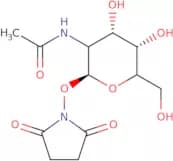
CAS:b-D-Glucopyranosyl fluoride is a kinetic inhibitor of the enzyme fatty acid synthase that is commonly found in human serum. It inhibits the activity of this enzyme by irreversible inhibition, which means that it binds to the active site of the enzyme and prevents it from functioning. The rate at which this inhibitor reacts with the enzyme depends on pH, as well as concentrations of other substances in solution, such as hydrogen fluoride and methyl glycosides. b-D-Glucopyranosyl fluoride has been shown to inhibit HIV infection by inhibiting viral maturation and protease activity. This drug also inhibits cell growth in culture by affecting cellular metabolism.Fórmula:C6H11FO5Pureza:Min. 95%Peso molecular:182.15 g/molN-(Succinyl)-2-acetamido-2-deoxy-b-D-glucopyranosylhydroxylamine
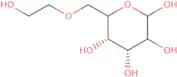
Succinyl activated n-acetylglucosamine.Fórmula:C12H18N2O8Pureza:Min. 95%Peso molecular:318.28 g/mol6-O-Hydroxyethyl-D-glucose
CAS:<p>6-O-Hydroxyethyl-D-glucose (6OHEDG) is a homologue of glucose that has been synthesized by reacting paraformaldehyde with ethylene in the presence of a glucofuranose. It is used as a solute for uptake studies, hydrolyzates for ion-exchanges, and glucoses for preparative chromatographic techniques. 6OHEDG is also used as an analog to glucose in polyethylene glycols and anhydroglucoses.</p>Fórmula:C8H16O7Pureza:Min. 95%Peso molecular:224.21 g/mol