Glycoscience
La glicociencia es el estudio de los carbohidratos y sus derivados, así como de las interacciones y funciones biológicas en las que participan. Este campo de investigación es crucial para comprender una amplia variedad de procesos biológicos, incluyendo el reconocimiento celular, la señalización, la respuesta inmune y el desarrollo de enfermedades. La glicociencia tiene aplicaciones importantes en la biotecnología, la medicina, y el desarrollo de nuevos fármacos y terapias. En CymitQuimica, ofrecemos una amplia selección de productos de alta calidad y pureza para la investigación en glicociencia. Nuestro catálogo incluye monosacáridos, oligosacáridos, polisacáridos, glicoconjugados, y reactivos específicos, diseñados para apoyar a los investigadores en sus estudios sobre la estructura, función y aplicaciones de los carbohidratos en sistemas biológicos. Estos recursos están destinados a facilitar descubrimientos científicos y aplicaciones prácticas en diversas áreas de la biociencia y la medicina.
Subcategorías de "Glycoscience"
- Aminoazúcares(108 productos)
- Anticuerpos relacionados con azúcares(282 productos)
- Glicolípidos(46 productos)
- Glicosaminoglicanos (GAGs)(55 productos)
- Glucósidos(419 productos)
- Monosacáridos(6.624 productos)
- Oligosacáridos(3.682 productos)
- Polisacáridos(503 productos)
Se han encontrado 11046 productos de "Glycoscience"
Ordenar por
Pureza (%)
0
100
|
0
|
50
|
90
|
95
|
100
Isosaccharinic acid
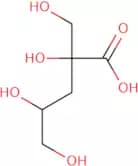
CAS:<p>Isosaccharinic acid is a bacterial strain that produces isosaccharinic acid as its main fatty acid. The thermodynamic data for the reaction mechanism of the conversion of glucose to isosaccharinic acid has been determined. Isosaccharinic acid formation is catalyzed by an enzyme called glycosyl-glycerate dehydrogenase, which converts glycerate to 3-hydroxypropanoic acid and then to 3-oxopropanoate before it undergoes decarboxylation and reduction to form isosaccharinic acid. Radionuclides such as TcO4 are used in chemical ionization mass spectrometry for the detection of this compound in samples. Neutral pH, high activation energies, and low binding constants are all factors that affect the stability of this molecule.</p>Fórmula:C6H12O6Pureza:Min. 95%Peso molecular:180.16 g/molL-Glucuronic acid sodium salt
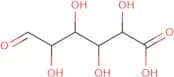
CAS:<p>L-Glucuronic acid sodium salt is a natural product that is used as an excipient and additive in pharmaceuticals. L-Glucuronic acid sodium salt is the sodium salt of L-glucuronic acid, which is a natural compound found in plants, animals and humans. It is used as a protective agent for drugs because it can be easily metabolized by the liver and has low toxicity. L-Glucuronic acid sodium salt inhibits the uptake of radioactive isotopes into cells, which may be due to its ability to bind to cytosolic proteins. The binding of L-glucuronic acid sodium salt to these proteins blocks the binding sites for radioactive isotopes on these proteins. This inhibition leads to reduced uptake of radioactive isotopes by cells.</p>Fórmula:C6H9NaO7Pureza:Min. 95%Peso molecular:216.12 g/molDigalactosylceramide
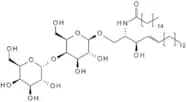
CAS:<p>Digalactosylceramide is a bioactive glycosphingolipid, which is derived from the cellular membranes of certain bacteria and plants. This compound plays a significant role in modulating immune responses through its interaction with the immune system. Its mode of action involves binding to specific receptors on immune cells, influencing cell signaling pathways that are crucial for the regulation of the immune response, including the modulation of cytokine production and immune cell activation.</p>Fórmula:C46H87NO13Pureza:Min. 95%Forma y color:PowderPeso molecular:862.18 g/molD-Glycero-D-manno-heptose
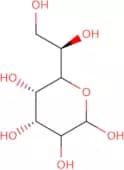
CAS:<p>A seven carbon sugar</p>Fórmula:C7H14O7Pureza:Min. 98 Area-%Forma y color:Colorless Clear LiquidPeso molecular:210.2 g/molβ-D-Galactopyranosyl-(1-4)-β-D-galactopyranosyl-(1-4)-D-galactose
CAS:<p>b-D-Galactopyranosyl-(1-4)-b-D-galactopyranosyl-(1-4)-D-galactose is a fluorinated saccharide that contains three fluorine atoms. The chemical formula for this product is C8H12F3O11. It is a white powder and the molecular weight of the compound is 514.06 g/mol. b-D-Galactopyranosyl-(1-4)-b-D-galactopyranosyl-(1-4)-D-galactose can be custom synthesized to meet your desired specifications, such as modification, purity, and other criteria. This product has been shown to be useful in glycosylation reactions and click chemistry applications.</p>Fórmula:C18H32O16Pureza:Min. 95%Peso molecular:504.44 g/molD-Glucose ethylenedithioacetal
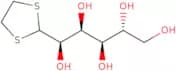
CAS:D-Glucose ethylenedithioacetal is a biological agent. It is a white to off-white crystalline powder that has a molecular weight of 204.3. D-Glucose ethylenedithioacetal is soluble in water and ethanol, but not in ether or chloroform. It is stable in air, but will react with alkali to form the corresponding salt of D-glucose.Fórmula:C8H16O5S2Pureza:Min. 95%Peso molecular:256.34 g/molDaunorubicin-d3
<p>Daunorubicin-d3 is a fluorinated, monosaccharide, synthetic, oligosaccharide and complex carbohydrate. Custom synthesis of Daunorubicin-d3 is available with glycosylation, methylation and other modifications. Daunorubicin-d3 has CAS No. 1614-68-8 and purity >99%.</p>Fórmula:C27H26D3NO10Pureza:Min. 95%Peso molecular:530.54 g/molPorphyran
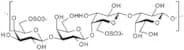
CAS:Porphyran is an agar-like polysaccharide with a linear backbone consisting of 3 linked β-D-galactosyl units alternating with either 4-linked α-L-galactosyl 6-sulphate or 3-6-anhydro-α-L-galactosyl units.The composition includes 6-O-sulphated L-galactose, 6-O-methylated D-galactose, L-galactose, 3,6-anhydro-L-galactose, 6-O-methyl D-galactose and ester sulphate. Some of the ester is present as 1,4-linked L-galactose 6-sulphate. The precise composition of porphyran shows seasonal and environmental variations. Porphyran is not used commercially, but the seaweed, Porphyra umbilicalis, is edible and is consumed in Wales (Laver). It is also made into a delicacy called Laverbread. The image was kindly provided by Prof Mike Guiry from Cork who runs ‘The Seaweed Site’.Pureza:(%) Min. 80%Forma y color:PowderUDP-b-L-fucose diammonium salt
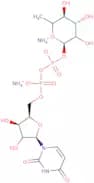
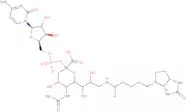
Synthetically produced sugar nucleotideFórmula:C15H22N2O16P2·N2H8Pureza:Min. 95%Peso molecular:584.37 g/molCMP-N-acetylneuraminic acid 9-sp-biotin
<p>CMP-N-acetylneuraminic acid 9-sp-biotin is a biotinylated sugar nucleotide</p>Pureza:Min. 95%1,2-¹³C2-D-Rhamnose
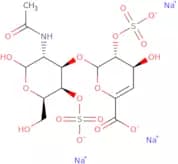
Enantiomer of natural L-Rha 13C-labelled at carbons 1 and 2Fórmula:C2C4H12O5Pureza:Min. 95%Forma y color:White PowderPeso molecular:166.14 g/molChondroitin disaccharide di-diSB trisodium salt
CAS:Chondroitin disaccharide di-diSB trisodium salt is a chondroitin sulfate binding agent that can be used in the diagnosis of subcutaneous tumors. It binds to the chondroitin sulfate component of proteoglycans and stains these proteins under light microscopy. This agent can also be used to detect monoclonal antibodies that bind to the chondroitin sulfate component of proteoglycans. The detection of this agent may be done by enzyme-linked immunosorbent assay or fluorescence microscopy.Fórmula:C14H18NNa3O17S2Pureza:Min. 95%Forma y color:PowderPeso molecular:605.39 g/molCellooctaose
CAS:Cellooctaose is a synthetic, water-soluble oligosaccharide with a molecular weight of 1,000 daltons. It is produced by the reaction of propionate and intramolecular hydrogen with a water molecule to form glycosidic bonds. Cellooctaose can be used as a coating for pharmaceutical tablets and capsules to prevent dissolution in gastric acid. Cellooctaose is homologous to cellulose and has been used in recombinant protein production for the purpose of modifying viscosity. Cellooctaose has also been shown to inhibit the growth of cancer cells via lysosomal membrane permeability enhancement. This may be due to its ability to bind to fatty acids on the surface of cancer cells, which then leads to increased cell death.Fórmula:C48H82O41Pureza:Min. 95%Forma y color:PowderPeso molecular:1,315.14 g/mol1-[[4-(Hydroxymethyl)phenyl]carbamate]-2,3,5-triacetate-β-D-glucopyranuronic acid methyl ester
CAS:1-[[4-(Hydroxymethyl)phenyl]carbamate]-2,3,4-triacetate-β-D-glucopyranuronic acid methyl ester is an enzymically cleavable spacer used for anthracycline prodrugs.Fórmula:C21H25NO12Peso molecular:483.42 g/mol(±)-Muscarine chloride
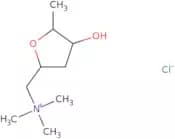
CAS:Producto controlado<p>Muscarine chloride is a potent acetylcholine receptor agonist that causes activation of the postsynaptic membrane by increasing the K+ concentration and hyperpolarizing the membrane. Muscarine chloride increases spontaneous activity in muscle and ganglion cells, which may be due to its ability to activate cholinergic receptors. Muscarine chloride has been shown to cause paralysis of skeletal muscle when injected into frog sciatic nerve, which is caused by its ability to block nerve impulses. Muscarine chloride is effective at doses as low as 0.1 ug/kg and can be used for research purposes when activating acetylcholine receptors.br> br></p>Fórmula:C9H20NO2•ClPureza:Min. 95%Forma y color:PowderPeso molecular:209.71 g/molDihydrozeatin-7-glucoside
CAS:Dihydrozeatin-7-glucoside (DZG) is a plant hormone that belongs to the group of abscisic acid. It is biosynthesized from zeatin, an intermediate in the synthesis of the plant hormone gibberellin. DZG has been shown to regulate water loss in plants and plays a role in the regulation of photosynthesis and seed germination. The uptake of DZG by plant cells is complex and can be influenced by both physiological and environmental factors. It can be conjugated with small molecules such as typhasterol, which is found in tobacco leaves, or tabacum l., which is found in certain species of tobacco plants. Dihydrozeatin-7-glucoside also interacts with other hormones such as 24-epibrassinolide and regulates various biochemical processes such as protein synthesis and cell growth.Fórmula:C16H25N5O6Pureza:Min. 95%Peso molecular:383.4 g/molBlood Group A trisaccharide, spacer-biotin conjugate
CAS:Blood group A antigen conjugated to spacer arm and biotinFórmula:C39H67N5O18SPureza:Min. 95 Area-%Forma y color:PowderPeso molecular:926.04 g/mol3-Deoxy-2-keto-D-xylonate lithium
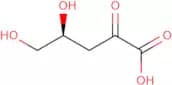
CAS:3-Deoxy-2-keto-D-xylonate lithium salt is a synthetic compound that is used in the synthesis of protamine. It is produced by the reduction of an aldehyde with borohydride. 3-Deoxy-2-keto-D-xylonate lithium salt has been shown to be active against E. cloacae, which can cause diarrhea and other gastrointestinal disorders. 3-Deoxy-2-keto-D-xylonate lithium salt inhibits the growth of E. cloacae by inhibiting glycolaldehyde reductase and aldolases, which are enzymes that are essential for glycolysis and citrate metabolism, respectively. The cleavage products formed by this reaction inhibit bacterial growth by interfering with cell wall biosynthesis, preventing protein synthesis, or blocking ATP production (oxidative phosphorylation).Fórmula:C5H8O5•LixPureza:Min. 95%Forma y color:PowderPeso molecular:148.11 g/molChondroitin disaccharide di-UA2S disodium salt
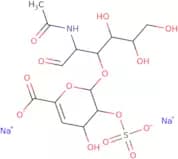
CAS:<p>Chondroitin disaccharide di-UA2S disodium salt is a high purity, custom synthesis, sugar, click modification, fluorination, glycosylation, synthetic oligosaccharide. It is a complex carbohydrate of the monosaccharide and saccharides which are composed of glucose and glucuronic acid. The molecular weight is 721.00 g/mol with a CAS number of 149368-04-7. This product has been modified to include methyl groups on N-6 and N-2 positions in the side chains of both uronic acids. Chondroitin disaccharide di-UA2S disodium salt is an oligosaccharide that has been synthesized from chondroitin sulfate with a molecular weight of 5400.00 g/mol.</p>Fórmula:C14H19NNa2O14SPureza:Min. 90 Area-%Forma y color:PowderPeso molecular:503.34 g/molBlood Group B trisaccharide, spacer-biotin conjugate
CAS:Blood group B antigen conjugated to spacer arm and biotinFórmula:C37H64N4O18SPureza:Min. 95%Forma y color:PowderPeso molecular:884.99 g/mol



![1-[[4-(Hydroxymethyl)phenyl]carbamate]-2,3,5-triacetate-β-D-glucopyranuronic acid methyl ester](/_next/image/?url=https%3A%2Fstatic.cymitquimica.com%2Fproducts%2F3D%2Fthumb-webp%2FMH184603.webp&w=3840&q=75)