Glycoscience
Subcategorías de "Glycoscience"
- Aminoazúcares(108 productos)
- Anticuerpos relacionados con azúcares(284 productos)
- Glicolípidos(46 productos)
- Glicosaminoglicanos (GAGs)(55 productos)
- Glucósidos(422 productos)
- Monosacáridos(6.675 productos)
- Oligosacáridos(4.043 productos)
- Polisacáridos(517 productos)
Se han encontrado 11405 productos de "Glycoscience"
32-β-D-Glucosyl-cellobiose
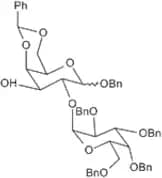
CAS:Producto controlado32-β-D-Glucosyl-cellobiose is a fluorinated carbohydrate that is custom synthesized to meet the needs of the customer. It is a complex carbohydrate that can be modified by methylation, glycosylation, or click modification. It is made of one monosaccharide and two sugars. This product is highly pure and can be used in various applications such as pharmaceuticals, agrochemicals, and food production.Fórmula:C18H32O16Pureza:Min. 95%Peso molecular:504.4 g/molBenzyl 2-O-(2,3,4,6-tetra-O-benzyl-a-D-galactopyranosyl)-4,6-O-benzylidene-D-galactopyranose
Benzyl 2-O-(2,3,4,6-tetra-O-benzyl-a-D-galactopyranosyl)-4,6-O-benzylidene-D-galactopyranose is a custom synthesis that belongs to the class of carbohydrates. It is an oligosaccharide with a molecular weight of 536.8 and a CAS number of 48737-65-1. The modification of this carbohydrate is methylation and glycosylation. This carbohydrate has been synthesized using a click chemistry reaction with a fluorination step. The purity of this compound is high and it has been synthesized in the laboratory.Fórmula:C54H56O11Pureza:Min. 95%Peso molecular:881.04 g/mol2,5-Anhydro-D-glucitol-1,6-bis-(dibenzylphosphate)
CAS:2,5-Anhydro-D-glucitol-1,6-bis-(dibenzylphosphate) is a synthetic carbohydrate with a complex structure. It can be used in the synthesis of glycosides and saccharides. This product has a molecular weight of 486.83 g/mol, a melting point of 169 oC, and an octanol/water partition coefficient of 3.00.Fórmula:C34H38O11P2Pureza:Min. 95%Peso molecular:684.61 g/mol(2E)-4-[2-Nitro-3-[(2,3,4,6-tetra-O-acetyl-b-D-glucopyranosyl)oxy]phenyl]-4-oxo-2-butenoic acid methyl ester
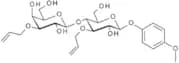
CAS:(2E)-4-[2-Nitro-3-[(2,3,4,6-tetra-O-acetyl-b-D-glucopyranosyl)oxy]phenyl]-4-oxo-2-butenoic acid methyl ester is a carbohydrate that can be custom synthesized. It is a synthetic glycoside of 2,3,4,6-tetraO acetyl b D glucopyranosyloxy nitrophenol and 4-(2E)-butene-2,4 diol. This compound has been fluorinated and methylated to produce a high purity product. In addition to its use as an intermediate in the synthesis of saccharides and oligosaccharides this compound can also be used as a sugar for click modification.Fórmula:C25H27NO15Pureza:Min. 95%Peso molecular:581.48 g/mol4-Methoxyphenyl 4-O-(3-O-allyl-b-D-galactopyranosyl)-3-O-allyl-b-D-glucopyranoside
4-Methoxyphenyl 4-O-(3-O-allyl-b-D-galactopyranosyl)-3-O-allyl-b-D-glucopyranoside is a custom synthesis product that is used as a synthetic intermediate in the modification of complex carbohydrates. This product is a fluorinated sugar, with a high purity and high quality. It has been modified to include methyl groups at specific positions on the sugar molecule. The CAS number for this product is 8721401.Fórmula:C25H36O12Pureza:Min. 95%Peso molecular:528.55 g/mol1,2,3,5-Tetra-O-acetyl-D-ribofuranose
CAS:1,2,3,5-Tetra-O-acetyl-D-ribofuranose is a dietary supplement that can be found in the form of palladium complexes. This compound has been shown to have anti-inflammatory properties and may be effective against cancer cells. 1,2,3,5-Tetra-O-acetyl-D-ribofuranose is an acetylated pyridazine derivative with antimicrobial and antibacterial effects. It has also been shown to inhibit the synthesis of purines and pyrimidines by cleaving the 6th carbon from ribose. 1,2,3,5-Tetra-O-acetyl-D-ribofuranose is synthesized by chlorination of 2,6-, 3-, 5-, or 7-(chloropurinomethyl)pyridine with mercuric chloride or nitrosyl chloride. The cleavage products are hydroxyl group
Pureza:Min. 95%5-Deoxy α-L-arabinose and 5-Deoxy β-L-arabinose
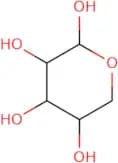
CAS:5-Deoxy alpha-L-arabinose and 5-Deoxy beta-L-arabinose are enantiopure compounds that are used in the synthesis of 5-deoxy-l-ribose, which is a precursor to nucleic acids. The reaction products are produced by hydrolyzing rhamnan with hydrochloric acid. This product can be used as a substrate for DNA polymerase and RNA polymerase, which are enzymes involved in the synthesis of nucleic acids. This product also has an acidic nature, which makes it suitable for use in phase chromatography. It has been shown to have stereoselective properties and can be used as an acid catalyst for other reactions.
Fórmula:C5H10O4Pureza:Min. 95 Area-%Peso molecular:134.13 g/molRef: 3D-W-201034
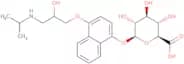
-Unit-ggA consultar1gA consultar5gA consultar10gA consultar500mgA consultar2500mgA consultar4'-Hydroxypropranolol-4'-O-b-D-glucuronide
CAS:Propranolol is a drug that belongs to the class of beta blockers, which are used to control high blood pressure in women and neonates. Propranolol is metabolized by glucuronidation and hydroxylation into 4'-hydroxypropranolol-4'-O-b-D-glucuronide. The hydroxy group on propranolol is metabolized by hydroxylation in the liver. This metabolic pathway leads to the formation of 4'-hydroxypropranolol-4'-O-b-D-glucuronide, which is excreted through urine samples and plasma concentrations. The hydroxy group on propranolol is also metabolized by glucuronidation, leading to the formation of low bioavailability of propranolol in humans. Propranolol has been shown to inhibit platelet aggregation at higher doses, but its effects on platelet aggregation are not predictable at lower doses.Fórmula:C22H29NO9Pureza:Min. 95%Peso molecular:451.47 g/mol2,3,4,6-Tetra-O-benzyl-(+)-1-deoxynojirimycin
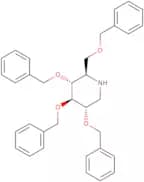
CAS:2,3,4,6-Tetra-O-benzyl-(+)-1-deoxynojirimycin is a synthetic atypical carbohydrate that has been shown to have anti-hyperglycemic and anti-hyperlipidemic effects. It is a benzylated derivative of the natural product 1-deoxynojirimycin. This compound has been shown to be effective in treating metabolic disorders such as polycystic ovary syndrome and hypercholesterolemia. 2,3,4,6-Tetra-O-benzyl-(+)-1-deoxynojirimycin may act by mimicking the actions of insulin and binding to insulin receptors on cells. This binding prevents the insulin receptor from being phosphorylated by an enzyme called protein kinase A (PKA), thereby inhibiting the action of PKA.Fórmula:C34H37NO4Pureza:Min. 95%Peso molecular:523.66 g/mol1,2:5,6-Di-O-isopropylidene-a-D-galactofuranose
CAS:1,2:5,6-Di-O-isopropylidene-a-D-galactofuranose is an oligosaccharide that is a modification of the natural monosaccharide D-galactofuranose. This carbohydrate has been synthesized by methylation and glycosylation. The chemical structure of this oligosaccharide has been shown to be resistant to digestion by mammalian enzymes. This product is for research purposes only and should not be used as a food additive or in any drug product.Fórmula:C12H20O6Pureza:Min. 95%Peso molecular:260.28 g/molD-Xylose-2-C-D
CAS:Please enquire for more information about D-Xylose-2-C-D including the price, delivery time and more detailed product information at the technical inquiry form on this pageFórmula:C5H10O5Pureza:Min. 95%Peso molecular:151.14 g/mol1-Amino-1,5-dideoxy-L-erythro-2-pentulose
CAS:1-Amino-1,5-dideoxy-L-erythro-2-pentulose is a glycoconjugate that contains an amino sugar. It is also a complex carbohydrate that is methylated and fluorinated. 1-Amino-1,5-dideoxy-L-erythro-2-pentulose is a polysaccharide made up of saccharides and oligosaccharides. The saccharides in this compound are modified with the addition of sugars (e.g., glycosylation). This product has been custom synthesized to order and can be ordered as a high purity product.
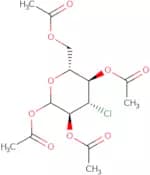
Fórmula:C5H11NO3Pureza:Min. 95%Peso molecular:133.15 g/mol1,2,4,6-Tetra-O-acetyl-3-chloro-3-deoxy-D-glucopyranose
CAS:1,2,4,6-Tetra-O-acetyl-3-chloro-3-deoxy-D-glucopyranose (1) is a synthetic oligosaccharide that has been modified with a fluorine atom at the 6 position of the glucose moiety. This modification has been shown to have increased stability in acidic environments. Glycosylation can be achieved by reacting 1 with an appropriate glycosylant such as bromoacetyl bromide or chloroacetyl chloride. The saccharide unit may also be methylated at the 2 and 4 positions of the glucose moiety to confer protection against enzymatic degradation. Click modification can be used to attach other molecules such as proteins or peptides to 1,2,4,6-tetra-O-acetyl-3-chloro-3-deoxy--D--glucopyranose via a covalent bond betweenFórmula:C14H19ClO9Pureza:Min. 95%Peso molecular:366.75 g/mol3-O-(2-Acetamido-2-deoxy-b-D-glucopyranosyl)-L-fucopyranose
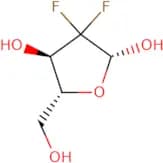
A carbohydrate compound for use in research and developmentFórmula:C14H25NO10Pureza:Min. 95%Peso molecular:367.35 g/mol2'-Deoxy-2',2'-difluoro-b-D-ribofuranose
CAS:2'-Deoxy-2',2'-difluoro-b-D-ribofuranose is a synthetic carbohydrate that has been modified with a methyl group at the 2' position of the ribose sugar. The modification increases its stability and prevents degradation by enzymes. This product can be used in the synthesis of oligosaccharides and glycosylations, or as a custom synthesis for other applications. 2'-Deoxy-2',2'-difluoro-b-D-ribofuranose is also available in high purity, making it ideal for use in pharmaceuticals and other sensitive applications.Pureza:Min. 95%6-Bromo-6-deoxy-b-cyclodextrin
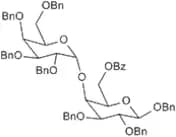
CAS:This beta-cyclodextrin (β-CD) derivative is a functionalized cyclic oligosaccharide composed of seven glucose units, characterized by a hydrophilic exterior and a lipophilic cavity (bigger than α-CD and smaller than γ-CDs), which allows it to encapsulate various guest molecules. This structural feature facilitates its use in multiple applications, including pharmaceuticals, food enhancement, and cosmetics. In the pharmaceutical industry, it enhances the solubility and stability of poorly water-soluble drugs, improving their bioavailability and efficacy while also masking unpleasant tastes. The food sector utilizes it as a stabilizer for flavors, colors, and nutrients, extending shelf life by protecting sensitive ingredients from degradation. In cosmetics, it serves as a complexing agent for fragrances and active components, ensuring their stability and controlled release. Its use expands to many other fields, including nanotechnology for drug delivery systems, environmental remediation for extracting organic pollutants, textiles for slow-release fragrances, and analytical chemistry for chiral separation.Fórmula:C42H63Br7O28Pureza:Min. 95%Forma y color:White PowderPeso molecular:1,575.26 g/molBenzyl 4-O-(2,3,4,6-tetra-O-benzyl-a-D-galactopyranosyl)-2,3-di-O-benzyl-6-O-benzoyl-b-D-galactopyranoside
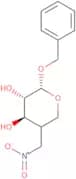
Benzyl 4-O-(2,3,4,6-tetra-O-benzyl-a-D-galactopyranosyl)-2,3-di-0benzyl 6-O-benzoyl-b-D-galactopyranoside is a synthetic carbohydrate that belongs to the class of oligosaccharides. It has been modified by fluorination and methylation. This compound is also glycosylated and click modified.Fórmula:C68H68O12Pureza:Min. 95%Peso molecular:1,077.26 g/mol4-Benzyl-4-deoxy-4-C-nitromethyl-b-D-arabinopyranoside
CAS:4-Benzyl-4-deoxy-4-C-nitromethyl-b-D-arabinopyranoside is an Oligosaccharide, sugar, Synthetic, Fluorination, Custom synthesis, Methylation, Monosaccharide, Polysaccharide, saccharide. It is a 4-benzyl glycosylamine derivative of arabinose that has been fluorinated and nitrated. This product also has Click modification and complex carbohydrate. The CAS No. for this product is 383173-66-8.Fórmula:C13H17NO6Pureza:Min. 95%Peso molecular:283.28 g/molEthyl 2,3,6-tri-O-benzoyl-b-D-thioglucopyranoside
Ethyl 2,3,6-tri-O-benzoyl-b-D-thioglucopyranoside is a synthetic monosaccharide with a complex carbohydrate structure. It can be custom synthesized to order and is available in high purity. This product is a glycosylation reagent that can be used for the synthesis of oligosaccharides and polysaccharides. The product has been shown to react with primary alcohols and amines in the presence of catalysts such as TMSOTf, DCC, or EDC to form ether bonds or amine bonds respectively. Ethyl 2,3,6-tri-O-benzoyl-b-D-thioglucopyranoside also reacts with thiols in the presence of catalysts such as HOBt or HOAt to form thioether bonds.
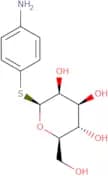
Pureza:Min. 95%4-Aminophenyl b-D-thiomannopyranoside
CAS:4-Aminophenyl b-D-thiomannopyranoside is a drug that has been used to treat spittlebugs, tropical vegetation, and brain tumours. It is also used to diagnose the process flow of population functions. This drug is a substrate for the enzyme transducer, which converts it into an active form. The enzyme recording then converts this active form back into 4-aminophenyl b-D-thiomannopyranoside.Fórmula:C12H17NO5SPureza:Min. 95%Peso molecular:287.33 g/mol



![(2E)-4-[2-Nitro-3-[(2,3,4,6-tetra-O-acetyl-b-D-glucopyranosyl)oxy]phenyl]-4-oxo-2-butenoic acid me…](/_next/image/?url=https%3A%2Fstatic.cymitquimica.com%2Fproducts%2F3D%2Fthumb-webp%2FMN16816.webp&w=3840&q=75)