Antimicrobianos
Los antimicrobianos son agentes que destruyen o inhiben el crecimiento de microorganismos, incluyendo bacterias, virus, hongos y parásitos. Estos compuestos son esenciales en la prevención y tratamiento de infecciones, desempeñando un papel crucial en la medicina, la agricultura y la industria alimentaria. En CymitQuimica, ofrecemos una extensa gama de antimicrobianos de alta calidad y pureza, adecuados para diversas aplicaciones científicas e industriales. Nuestro catálogo incluye antibióticos, antifúngicos, antivirales y desinfectantes, todos diseñados para satisfacer las necesidades de investigación y desarrollo, así como para aplicaciones clínicas y de producción. Con nuestros productos, los profesionales pueden garantizar la eficacia y seguridad en el control de infecciones y en la protección de la salud pública.
Subcategorías de "Antimicrobianos"
- Antibióticos(4.131 productos)
- Antifúngicos(909 productos)
- Antiparasitarios(703 productos)
- Antivirales(766 productos)
Se han encontrado 2425 productos de "Antimicrobianos"
Ordenar por
Pureza (%)
0
100
|
0
|
50
|
90
|
95
|
100
3-(Dichloroacetyl)-2,2,5-trimethyloxazolidine
CAS:3-(Dichloroacetyl)-2,2,5-trimethyloxazolidine is an oxazolidine derivative, which is a synthetic compound primarily used in the agricultural industry. It is derived through a chemical synthesis process involving the condensation of dichloroacetic acid with trimethyloxazolidine under controlled conditions. This compound functions as a pre-emergent herbicide by inhibiting the biosynthesis of essential enzymes in target plant species.Fórmula:C8H13Cl2NO2Pureza:Min. 95%Peso molecular:226.1 g/molPF 1022A
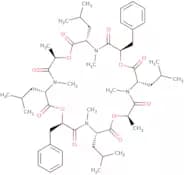
CAS:<p>PF 1022A is a cyclooctadepsipeptide, which is a type of cyclic peptide composed of amino acids and hydroxy acids. It is derived from the fermentation products of the fungus *Mycelia sterilia*, a member of the *Rosellinia* genus. Its mode of action involves disrupting glutamate-gated chloride channels in parasitic nematodes, which leads to paralysis and eventual death of the parasite.</p>Fórmula:C52H76N4O12Pureza:Min. 95%Peso molecular:949.18 g/molCycloheximide, Antibiotic for Culture Media Use Only
CAS:Cycloheximide, Antibiotic for Culture Media Use Only, is an antifungal agent derived from the Streptomyces griseus bacterium. Its primary mode of action involves the inhibition of eukaryotic protein synthesis by interfering with the translocation step on the 80S ribosome. This leads to rapid arrest of protein assembly, effectively limiting fungal and certain yeast growth in culture.Fórmula:C15H23NO4Peso molecular:281.35 g/molRef: 3D-C-9217
10gA consultar25gA consultar50gA consultar100gA consultar250gA consultar-Unit-ggA consultarZiresovir
CAS:<p>Respiratory syncytial virus (RSV) fusion (F) protein inhibitor</p>Fórmula:C22H25N5O3SPureza:Min. 95%Forma y color:PowderPeso molecular:439.53 g/molAcetyl-pepstatin
CAS:Acetyl-pepstatin is a potent protease inhibitor, which is synthesized from a naturally occurring peptide source. Its primary mode of action involves the inhibition of aspartic proteases, a class of enzymes responsible for protein digestion and processing within biological systems. By specifically targeting these enzymes, Acetyl-pepstatin effectively halts the hydrolytic activity, which makes it an invaluable tool in the study of protease function and the regulation of proteolytic pathways.Fórmula:C31H57N5O9Pureza:Min. 95%Peso molecular:643.8 g/molN-(4-(tert-Butyl)phenyl)-N-(2-(cyclohexylamino)-2-oxo-1-(pyridin-3-yl)ethyl)-1H-imidazole-4-carboxamide
CAS:N-(4-(tert-Butyl)phenyl)-N-(2-(cyclohexylamino)-2-oxo-1-(pyridin-3-yl)ethyl)-1H-imidazole-4-carboxamide is a synthetic small molecule, which is a product of advanced organic synthesis. This compound is a derivative of imidazole carboxamides, primarily sourced through intricate organic reactions involving selective functionalization and cyclization processes to achieve its precise molecular architecture.Fórmula:C27H33N5O2Pureza:Min. 95%Peso molecular:459.6 g/mol3'-N-Desmethyl-3'-N-tosyl azithromycin
CAS:3'-N-Desmethyl-3'-N-tosyl azithromycin is a semi-synthetic macrolide antibiotic analog, which is a derivative of azithromycin, a well-known member of the macrolide class of antibiotics. This compound is synthesized through chemical modifications of the parent molecule, azithromycin, to potentially enhance its pharmacokinetic and pharmacodynamic properties.Fórmula:C44H76N2O14SPureza:Min. 95%Peso molecular:889.15 g/molPPA-904
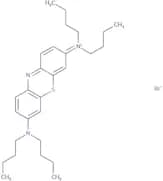
CAS:PPA-904 is an organophosphate compound, which is a chemically synthesized product. It functions as an additive, often utilized in industrial applications due to its unique chemical properties. As an organophosphate, PPA-904 acts through phosphorylation processes, interacting with various substrates to alter their chemical and physical characteristics. This mechanism is utilized to enhance material properties such as stability, functionality, or resistance to environmental conditions.Fórmula:C28H42BrN3SPureza:Min. 95%Peso molecular:532.6 g/molRSV-IN-1
CAS:RSV-IN-1 is a small molecule inhibitor, which is a synthetic compound with potent antiviral activity against Respiratory Syncytial Virus (RSV). Its primary source is chemical synthesis, designed to specifically target and inhibit the function of RSV’s viral polymerase complex. The mode of action involves the interruption of viral RNA synthesis, thereby preventing the replication and proliferation of RSV within host cells.Fórmula:C20H21N5O4SPureza:Min. 95%Peso molecular:427.5 g/molAzabon
CAS:<p>Azabon is a synthetic terpenoid compound, which is derived from renewable natural sources through a series of hydrogenation and isomerization processes. Its mode of action involves inhibiting specific enzymatic pathways, potentially interfering with cellular processes that are dependent on those enzymes. Primarily, Azabon is investigated for its applications in biochemical research, particularly for its effects on metabolic pathways that involve terpenoid interactions.</p>Fórmula:C14H20N2O2SPureza:Min. 95%Peso molecular:280.39 g/molAlthiomycin
CAS:<p>Althiomycin is a macrolide antibiotic, which is derived from Actinobacteria, specifically the genus Streptomyces. Its mode of action involves binding to the 50S subunit of the bacterial ribosome, thereby inhibiting protein synthesis. This mechanism effectively suppresses bacterial growth by interfering with the translation process, ultimately leading to pathogen elimination.</p>Fórmula:C16H17N5O6S2Pureza:Min. 95%Peso molecular:439.50 g/molMomfluorothrin
CAS:Momfluorothrin is a synthetic pyrethroid insecticide, which is a man-made derivative based on the natural pyrethrins. It functions primarily as a neurotoxic agent, targeting the sodium channels in the nervous system of insects, leading to paralysis and eventual death. This specific mode of action involves delaying the closing of the sodium channels, resulting in prolonged nerve impulses.Fórmula:C19H19F4NO3Pureza:Min. 95%Peso molecular:385.4 g/molErythromycin iactobionate
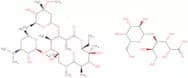
CAS:<p>Erythromycin lactobionate is a macrolide antibiotic, which is derived from the bacterium *Saccharopolyspora erythraea*. Its mode of action involves binding to the 50S subunit of the bacterial ribosome, thereby inhibiting protein synthesis and leading to the suppression of bacterial growth. This mechanism effectively targets gram-positive bacteria and some gram-negative bacteria, making it a crucial agent in the fight against various bacterial infections.</p>Fórmula:C49H87NO24Pureza:Min. 95%Forma y color:White To Off-White SolidPeso molecular:1,074.21 g/molIohexol
CAS:<p>Iohexol is a non-ionic, water-soluble radiopaque contrast agent, which is synthesized from iodinated organic compounds. With its high iodine content, Iohexol acts as an excellent medium for absorbing X-rays, thereby enhancing the contrast in radiographic images. The compound’s mode of action involves the attenuation of X-ray beams, with its iodine atoms providing the requisite density to create a contrast between different structures and fluids within the body.</p>Fórmula:C19H26I3N3O9Pureza:Min. 98 Area-%Peso molecular:821.14 g/molEnzaplatovir
CAS:Enzaplatovir is a novel antiviral agent, which is a synthetic compound developed through advanced medicinal chemistry techniques. It functions as an inhibitor of RNA-dependent RNA polymerase, a critical enzyme in the replication cycle of various RNA viruses. By targeting this enzyme, Enzaplatovir effectively impedes viral RNA synthesis, thus disrupting viral replication.Fórmula:C20H19N5O3Pureza:Min. 95%Peso molecular:377.4 g/molFervenulin
CAS:<p>Fervenulin is a synthetic compound, which is a chemically designed product developed for laboratory use. It is synthesized through a series of organic reactions, allowing for precise control over its molecular structure and properties. The mode of action for Fervenulin involves altering microbial growth pathways, particularly targeting specific enzymes and cellular processes critical for microbial proliferation. This mode of action effectively inhibits or modifies the activity of these cellular components, providing a tool for microbiologists to investigate microbial behavior under controlled conditions.</p>Fórmula:C7H7N5O2Pureza:Min. 95%Peso molecular:193.16 g/molFosravuconazole L-lysine ethanolate
CAS:<p>Fosravuconazole L-lysine ethanolate is an antifungal prodrug, which is a derivative of the widely used antifungal agent ravuconazole. This compound is synthesized through chemical modification to enhance its bioavailability and aqueous solubility, addressing limitations found in its parent compound. Fosravuconazole is designed to undergo in vivo conversion to ravuconazole, its active form, by enzymatic processes within the body.</p>Fórmula:C31H40F2N7O8PSPureza:Min. 95%Peso molecular:739.7 g/molSulfadiazine-d4
CAS:<p>Sulfadiazine-d4 is an isotopically labeled antibiotic, which is a derivative of sulfadiazine containing four deuterium atoms. This compound is synthesized using advanced chemical techniques to replace hydrogen atoms with deuterium in the molecular structure. The mechanism of action involves inhibition of bacterial dihydropteroate synthase, an enzyme critical in the folate synthesis pathway. By preventing the production of folic acid, sulfadiazine-d4 effectively halts bacterial growth and replication.</p>Fórmula:C10H6D4N4O2SPureza:Min. 95%Peso molecular:254.3 g/mol4-Epitetracycline hydrochloride
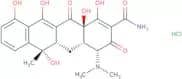
CAS:<p>4-Epitetracycline hydrochloride is a tetracycline antibiotic derivative, which is a secondary metabolite derived from bacterial sources, particularly Streptomyces species. It functions primarily by inhibiting protein synthesis in bacteria through binding to the 30S ribosomal subunit, preventing the attachment of aminoacyl-tRNA to the RNA-ribosome complex. This action hinders bacterial growth by interfering with vital processes necessary for bacterial survival and replication.</p>Fórmula:C22H25ClN2O8Pureza:Min. 95%Forma y color:PowderPeso molecular:480.9 g/molAcetyllovastatin
CAS:Acetyllovastatin is a semi-synthetic derivative of lovastatin, which is a member of the statin class of pharmaceuticals. It is derived from the natural product lovastatin, originally isolated from the mold Aspergillus terreus, through acetylation to enhance its pharmacological properties. The mode of action of acetyllovastatin involves the inhibition of HMG-CoA reductase, a key enzyme in the mevalonate pathway responsible for cholesterol biosynthesis. By competitively inhibiting this enzyme, acetyllovastatin effectively reduces intracellular cholesterol levels, leading to upregulation of LDL receptors and increased clearance of low-density lipoprotein (LDL) from the bloodstream.Fórmula:C26H38O6Pureza:Min. 95%Peso molecular:446.6 g/mol