Antimicrobianos
Subcategorías de "Antimicrobianos"
- Antibióticos(4.138 productos)
- Antifúngicos(907 productos)
- Antiparasitarios(703 productos)
- Antivirales(766 productos)
Se han encontrado 2431 productos de "Antimicrobianos"
HCV-IN-31
CAS:HCV-IN-31 is a chemical inhibitor specifically designed for hepatitis C virus (HCV) research, which is synthesized through advanced organic chemistry techniques. It acts by interfering with the viral replication machinery, effectively reducing the replication rate of the virus in host cells. The inhibition mechanism primarily targets nonstructural proteins crucial for HCV RNA replication, thereby offering a potent blockade to viral proliferation.Fórmula:C12H17FN6O3Pureza:Min. 95%Peso molecular:312.3 g/molBafilomycin C1
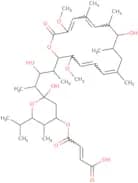
CAS:Bafilomycin C1 is a macrolide antibiotic, which is derived from the bacterium Streptomyces sp. Its mode of action involves the inhibition of vacuolar H+-ATPase (V-ATPase), an enzyme complex responsible for acidifying various intracellular compartments. This inhibition disrupts pH regulation within cells, affecting numerous cellular processes such as protein degradation and trafficking.
Fórmula:C39H60O12Pureza:Min. 95%Peso molecular:720.9 g/molDermaseptin
CAS:Dermaseptin is a type of antimicrobial peptide, which is sourced predominantly from the skin secretions of frogs, specifically from the Phyllomedusinae subfamily. These peptides function by disrupting the microbial cell membranes through their amphipathic and cationic nature, leading to cell lysis and death. Dermaseptins exhibit a broad spectrum of antimicrobial activity, including action against bacteria, fungi, protozoa, and certain viruses, making them of significant interest in biomedical research.
Fórmula:C152H257N43O44S2Pureza:Min. 95%Peso molecular:3,455.1 g/molFludazonium chloride
CAS:Fludazonium chloride is a quaternary ammonium compound, which is chemically synthesized. It functions primarily as an antibacterial agent by disrupting microbial cell membranes, leading to cell lysis and death. This compound is particularly effective against a broad spectrum of bacteria due to its ability to interact with phospholipid bilayers.Fórmula:C26H20Cl5FN2O2Pureza:Min. 95%Peso molecular:588.7 g/molBlasticidin S
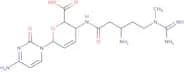
CAS:Blasticidin S is an antibiotic, which is derived from the bacterium *Streptomyces griseochromogenes*. It operates by inhibiting protein synthesis in both prokaryotic and eukaryotic cells. This inhibition is achieved by interfering with the peptide bond formation in the ribosome, thus preventing the elongation of the polypeptide chain. Blasticidin S is particularly useful in molecular biology and cell culture applications, where it is employed to selectively kill non-transformed cells. This allows for the maintenance and expansion of cells that have been stably transfected with a blasticidin resistance gene, thereby ensuring the selection and propagation of cells with the desired genetic modifications. Its precise mechanism and specific action make Blasticidin S a valuable tool for researchers working on gene expression studies, recombinant protein production, and other genetic engineering endeavors.Fórmula:C17H26N8O5Pureza:Min. 95%Peso molecular:422.4 g/mol6'-N-Cbz-kanamycin A
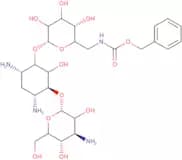
CAS:6'-N-Cbz-kanamycin A is a semi-synthetic aminoglycoside antibiotic derivative, specifically a Cbz (carbobenzyloxy) protected form of kanamycin A. It is derived from the natural product kanamycin, which is an antibiotic obtained from the bacterium *Streptomyces kanamyceticus*. The modification involves the introduction of a protective Cbz group at the 6' position, which can improve solubility, stability, or enable further chemical modifications.
Fórmula:C26H42N4O13Pureza:Min. 95%Peso molecular:618.63 g/molPeramivir
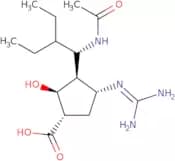
CAS:Selective and potent inhibitor of sialidases (neuraminidases) in influenza A and B viruses. The compound binds tightly to the viral neuraminidase active site in late stages of viral life-cycle. It inhibits shedding sialic acids from host cell surface glycans, which interact with viral hemagglutinin, and consequently prevents release of new viral particles from the host cell surface.
Fórmula:C15H28N4O4Pureza:Min. 95%Forma y color:PowderPeso molecular:328.41 g/mol(-)-Actinonin
CAS:Antibiotic peptide; inhibitor of aminopeptidase M and leucine aminopeptidaseFórmula:C19H35N3O5Pureza:Min. 95%Peso molecular:385.5 g/molCloxacillin benzathine
CAS:Cloxacillin benzathine is a beta-lactam antibiotic, which is synthesized from Penicillium fungi-derived penicillins. It acts by inhibiting bacterial cell wall synthesis. The mechanism involves the irreversible inhibition of penicillin-binding proteins (PBPs). This disruption in the bacterial cell wall structure ultimately leads to cell lysis and death.Fórmula:C54H56Cl2N8O10S2Pureza:Min. 95 Area-%Forma y color:White PowderPeso molecular:1,112.11 g/molMorinamide hydrochloride
CAS:Morinamide hydrochloride is a synthetic antitubercular agent, which is derived from chemical synthesis processes. Its mode of action involves disrupting the synthesis of mycolic acids in the cell walls of Mycobacterium tuberculosis, thereby inhibiting bacterial growth and proliferation. The compound serves primarily as an antimicrobial agent targeting tuberculosis infections. In a laboratory setting, Morinamide hydrochloride is utilized in the study of bacterial resistance mechanisms and the development of novel therapeutic agents. Its specific action on mycolic acid synthesis makes it a valuable tool for researchers aiming to elucidate the pathways involved in mycobacterial cell wall construction and to develop more targeted chemotherapeutic interventions. Due to its crucial role, understanding the mechanisms and efficacy of Morinamide hydrochloride can greatly benefit scientific efforts in combating tuberculosis, especially in light of increasing drug resistance.
Fórmula:C10H15ClN4O2Pureza:Min. 95%Peso molecular:258.7 g/molErythromycin B
CAS:Erythromycin B is a semisynthetic macrolide antibiotic, which is derived from the actinomycete *Saccharopolyspora erythraea*. Its mode of action involves inhibiting bacterial protein synthesis by binding to the 50S ribosomal subunit. This interference with protein synthesis effectively hampers bacterial growth, making it a potent bacteriostatic agent.Fórmula:C37H67NO12Pureza:90%NmrPeso molecular:717.93 g/molLysostaphin, from staphylococcus staphylolyticus
CAS:Lysostaphin, from Staphylococcus staphylolyticus is a zinc metalloenzyme with action on bacterial cell walls by cleaving polyglycine cross-links and is used for treating staphylococcal infections and in research applications.Pureza:Min. 95%Forma y color:PowderNifurquinazol
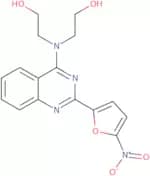
CAS:Nifurquinazol is an antimicrobial agent, which is a synthetic compound derived from the nitrofuran class of antibiotics. Its mode of action involves inhibition of bacterial enzymes critical for DNA and protein synthesis, thereby interfering with microbial cell replication and survival.
Fórmula:C16H16N4O5Pureza:Min. 95%Peso molecular:344.32 g/molMtbHU-IN-1
CAS:MtbHU-IN-1 is a small-molecule inhibitor designed specifically for targeting the HU protein in Mycobacterium tuberculosis. This compound is derived through rational drug design and computational modeling efforts, exploiting the vulnerabilities of the bacterial DNA-binding proteins. Its mode of action involves binding to the HU protein, inhibiting its function, which is crucial for DNA structuring and stability within the bacterial cell. By disrupting HU protein function, MtbHU-IN-1 impairs bacterial chromosomal architecture, leading to an inability to replicate and ultimately cell death.Fórmula:C44H36N4O12S2Pureza:Min. 95%Peso molecular:876.9 g/molSulbactam Related Compound A
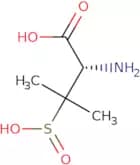
CAS:Sulbactam Related Compound A is a chemical compound often used in pharmaceutical research and development. It is typically derived from the synthetic modification of existing antibiotics to explore new potential therapeutic benefits. The compound functions as a beta-lactamase inhibitor, which is of significant interest to researchers due to its potential to enhance the efficacy of beta-lactam antibiotics. By inhibiting the action of bacterial beta-lactamase enzymes, it permits these antibiotics to remain effective against resistant strains of bacteria.Fórmula:C5H11NO4SPureza:Min. 95%Peso molecular:181.21 g/mol1-Ethyl-6-fluoro-7-(piperazin-1-yl)quinolin-4(1H)-one
CAS:1-Ethyl-6-fluoro-7-(piperazin-1-yl)quinolin-4(1H)-one is a fluoroquinolone antibiotic, which is a synthetic derivative sourced from the quinolone family. This compound functions by targeting bacterial DNA gyrase and topoisomerase IV, which are crucial enzymes involved in the replication and transcription of bacterial DNA. By inhibiting these enzymes, the antibiotic effectively disrupts DNA replication in susceptible bacterial strains, leading to cell death.
Fórmula:C15H18FN3OPureza:Min. 95%Peso molecular:275.32 g/molOmomycin
CAS:Omomycin is a novel antibiotic, specifically a macrolide, which is derived from microbial sources, primarily soil-dwelling actinomycetes. Its mode of action involves inhibiting bacterial protein synthesis by binding to the 50S ribosomal subunit. This interaction prevents the translocation of peptides during translation, thereby halting bacterial growth and proliferation.Fórmula:C29H39NO4Pureza:Min. 95%Peso molecular:465.6 g/molSparsomycin
CAS:Sparsomycin is an antibiotic compound, which is a secondary metabolite isolated from Streptomyces species. Its mode of action involves the inhibition of protein synthesis by targeting the large subunit of the ribosome, specifically binding to the 50S subunit in bacterial ribosomes and the 60S subunit in eukaryotic ribosomes. This binding interferes with peptide bond formation, thereby disrupting the translational process essential for protein synthesis.
Fórmula:C13H19N3O5S2Pureza:Min. 95%Peso molecular:361.4 g/mol7-Deazaadenosine, Antibiotic for Culture Media Use Only
CAS:7-Deazaadenosine is a chemical compound used as an antibiotic for culture media, which is a synthetic nucleoside analog derived from adenosine. Its structure is modified by replacing a nitrogen atom in the purine ring with a carbon atom, thus altering its biological interactions. The primary mode of action of 7-Deazaadenosine involves its incorporation into nucleic acids, where it acts as an inhibitor of nucleic acid-processing enzymes. This interference can effectively impede processes like DNA and RNA synthesis.Fórmula:C11H14N4O4Pureza:Min. 97.0 Area-%Peso molecular:266.25 g/molRef: 3D-W-203540
1gA consultar100mgA consultar250mgA consultar500mgA consultar2500mgA consultar-Unit-ggA consultarAztreonam-d6
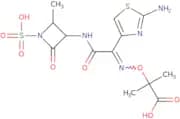
CAS:Aztreonam-d6 is an isotopically labeled antibiotic, which is a synthetic monobactam derived from bacterial fermentation processes with deuterium enrichment. With a beta-lactam structure, Aztreonam-d6 acts by inhibiting bacterial cell wall synthesis, specifically targeting the penicillin-binding protein 3 (PBP3) in Gram-negative bacteria. This action disrupts cell wall construction, leading to cell lysis and death, making it an effective option against certain resistant bacterial strains.Fórmula:C13H17N5O8S2Pureza:Min. 95%Peso molecular:441.5 g/mol