Antimicrobianos
Los antimicrobianos son agentes que destruyen o inhiben el crecimiento de microorganismos, incluyendo bacterias, virus, hongos y parásitos. Estos compuestos son esenciales en la prevención y tratamiento de infecciones, desempeñando un papel crucial en la medicina, la agricultura y la industria alimentaria. En CymitQuimica, ofrecemos una extensa gama de antimicrobianos de alta calidad y pureza, adecuados para diversas aplicaciones científicas e industriales. Nuestro catálogo incluye antibióticos, antifúngicos, antivirales y desinfectantes, todos diseñados para satisfacer las necesidades de investigación y desarrollo, así como para aplicaciones clínicas y de producción. Con nuestros productos, los profesionales pueden garantizar la eficacia y seguridad en el control de infecciones y en la protección de la salud pública.
Subcategorías de "Antimicrobianos"
- Antibióticos(4.130 productos)
- Antifúngicos(909 productos)
- Antiparasitarios(703 productos)
- Antivirales(766 productos)
Se han encontrado 2424 productos de "Antimicrobianos"
Ordenar por
Pureza (%)
0
100
|
0
|
50
|
90
|
95
|
100
Phenamacril
CAS:<p>Phenamacril is a synthetic fungicide, which is derived from chemical synthesis processes with a unique mode of action that targets fungal signaling pathways. It operates by inhibiting the myosin-5 ATPase activities within filamentous fungi, disrupting key cellular functions and effectively halting fungal growth.</p>Fórmula:C12H12N2O2Pureza:Min. 95%Peso molecular:216.24 g/mol11-Deoxyfusidic acid
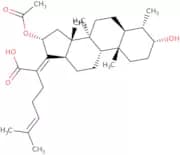
CAS:<p>11-Deoxyfusidic acid is a steroidal antibiotic, which is derived from the fermentation broth of certain strains of fungi, specifically within the Fusidium genus. Its mode of action involves inhibiting bacterial protein synthesis by interacting with elongation factor G (EF-G) on the ribosome, thus disrupting essential processes and impeding bacterial growth.</p>Fórmula:C31H48O5Pureza:Min. 95%Peso molecular:500.71 g/molThienamycin
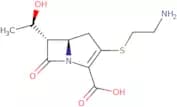
CAS:<p>Thienamycin is a β-lactam antibiotic, which originates from the fermentation of the bacterium *Streptomyces cattleya*. Its mode of action involves inhibiting the synthesis of bacterial cell walls. Thienamycin accomplishes this by binding to penicillin-binding proteins (PBPs) critical for peptidoglycan construction, thereby disrupting cell wall integrity and leading to bacterial lysis.</p>Fórmula:C11H16N2O4SPureza:80%MinForma y color:PowderPeso molecular:272.32 g/molCyclosporin L
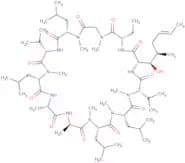
CAS:<p>Cyclosporin L is an immunosuppressive agent, which is a cyclic polypeptide derived from the soil fungus Tolypocladium inflatum. It primarily functions by inhibiting the activity of calcineurin, a key phosphatase involved in the activation of T-cells. This inhibition prevents the transcription of interleukin-2 and other cytokines critical for T-cell proliferation.</p>Fórmula:C61H109N11O12Pureza:90%MinPeso molecular:1,188.59 g/mol4''-(p-Fluorobenzyl)tylosin A
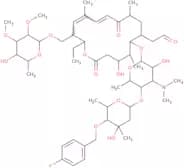
CAS:4''-(p-Fluorobenzyl)tylosin A is a semi-synthetic derivative of tylosin, which is a macrolide antibiotic produced by fermentation of the bacterium *Streptomyces fradiae*. This compound demonstrates a modified structure by incorporating a p-Fluorobenzyl group at the 4'' position of tylosin, enhancing its pharmaceutical properties. The mode of action involves binding to the 50S subunit of the bacterial ribosome, thereby inhibiting protein synthesis and exerting its bacteriostatic effects against Gram-positive bacteria.Fórmula:C53H82FNO17Pureza:Min. 95%Peso molecular:1,024.2 g/mol4'-Ethynyl-2'-deoxyadenosine
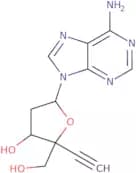
CAS:4'-Ethynyl-2'-deoxyadenosine is a deoxynucleoside analogue, which is synthesized through chemical processes. This compound acts as an antiviral agent, primarily targeting the viral replication machinery. Its mode of action involves the incorporation into viral DNA by mimicking natural nucleosides, which subsequently inhibits the enzymatic activity of reverse transcriptase. This inhibition disrupts the synthesis of viral DNA, effectively curtailing viral replication.Fórmula:C12H13N5O3Pureza:Min. 95%Peso molecular:275.26 g/molSARS-CoV-IN-2
CAS:<p>SARS-CoV-IN-2 is a highly specific and potent antiviral inhibitor, which is chemically synthesized to target SARS-CoV-2, the virus responsible for COVID-19. This compound functions by interfering with the viral replication process, specifically targeting the viral 3CL protease enzyme, crucial for viral polyprotein cleavage. By inhibiting this protease, SARS-CoV-IN-2 effectively hampers the replication cycle of the virus, limiting its ability to proliferate within the host cells.</p>Fórmula:C24H18ClFEN3OPureza:Min. 95%Peso molecular:455.72 g/molClarithromycin - EP
CAS:<p>A macrolide, broad-spectrum antibiotic that targets cytochrome P4503A4 (CYP3A4). Clarithromycin has been used to potentiate the pharmacological effects of some drugs that are metabolised by the cytochrome P450.</p>Fórmula:C38H69NO13Pureza:Min. 95%Peso molecular:747.95 g/molTylosin D
CAS:<p>Tylosin D is an antibiotic product, which is derived from the bacterium *Streptomyces fradiae*. Its mode of action involves binding to the 50S subunit of the bacterial ribosome, thereby inhibiting protein synthesis essential for bacterial growth and replication. This mechanism is particularly effective against Gram-positive bacteria and mycoplasma species, making it a crucial agent in combatting infections in the veterinary field.</p>Fórmula:C46H79NO17Pureza:Min. 95%Peso molecular:918.1 g/molMethicillin sodium hydrate
CAS:<p>Methicillin sodium hydrate is a semi-synthetic β-lactam antibiotic, which is a derivative of the naturally occurring antibiotic penicillin. It is sourced from the modification of the penicillin nucleus, specifically designed to resist degradation by the bacterial enzyme penicillinase. This enzyme, produced by certain bacterial strains, can render penicillin ineffective. Methicillin operates by inhibiting the synthesis of bacterial cell walls, specifically binding to penicillin-binding proteins (PBPs). This action disrupts the cross-linking of peptidoglycan chains, a critical component for bacterial cell wall integrity, ultimately leading to cell lysis and death.</p>Fórmula:C17H21N2NaO7SPureza:Min. 95%Peso molecular:420.4 g/molAtherosperminine
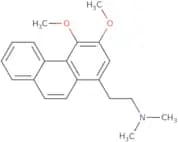
CAS:Producto controladoAtherosperminine is an alkaloid compound, which is a bioactive chemical derived from plants. Specifically, it is sourced from members of the Lauraceae family, such as Atherosperma moschatum. This compound exhibits a range of pharmacological activities that are of significant interest to researchers. The mode of action of atherosperminine involves interactions with various biological pathways, potentially affecting physiological processes and exhibiting therapeutic effects.Fórmula:C20H23NO2Pureza:Min. 95%Peso molecular:309.4 g/mol(4S)-2-[Carboxy[[[3-(2-chloro-6-fluorophenyl)-5-methylisoxazol-4-yl]carbonyl]amino]methyl]-5,5-dimethylthiazolidine-4-carboxylic aci d disodium salt (penicilloic acids of flucloxacillin disodium salt)
CAS:<p>(4S)-2-[Carboxy[[[3-(2-chloro-6-fluorophenyl)-5-methylisoxazol-4-yl]carbonyl]amino]methyl]-5,5-dimethylthiazolidine-4-carboxylic acid disodium salt, known as the penicilloic acids of flucloxacillin disodium salt, is a β-lactam antibiotic. This compound is derived from the penicillin family and exhibits potent antibacterial properties. The mode of action involves the inhibition of bacterial cell wall synthesis, primarily targeting the transpeptidase enzyme, which plays a crucial role in cross-linking the peptidoglycan layers of the bacterial cell wall. By acylating this enzyme, the penicilloic acids disrupt the integrity of the cell wall, leading to cell lysis and death of the bacteria.</p>Fórmula:C19H17ClFN3Na2O6SPureza:Min. 95%Peso molecular:515.9 g/molLTAS-IN-1
CAS:<p>LTAS-IN-1 is a synthetic chemical compound designed as an advanced inhibitor, which is developed through a series of intricate chemical synthesis processes. The mode of action of LTAS-IN-1 involves the selective inhibition of specific enzyme targets, effectively modulating their biological pathways. This selective inhibition allows researchers to investigate the compound's effects on various cellular and molecular processes.</p>Fórmula:C24H17N3O5Pureza:Min. 95%Peso molecular:427.4 g/molBensulide-oxon
CAS:<p>Bensulide-oxon is a metabolite derived from the organophosphate pesticide bensulide, which is predominantly used in agricultural settings. It forms as a result of environmental or biological processes that involve the oxidation of bensulide. As a potent acetylcholinesterase (AChE) inhibitor, bensulide-oxon disrupts normal neuronal signaling by preventing the breakdown of the neurotransmitter acetylcholine, leading to an accumulation that affects the nervous systems of target organisms.</p>Fórmula:C14H24NO5PS2Pureza:Min. 95%Peso molecular:381.5 g/molChloraniformethan
CAS:Please enquire for more information about Chloraniformethan including the price, delivery time and more detailed product information at the technical inquiry form on this pageFórmula:C9H7Cl5N2OPureza:Min. 95%Peso molecular:336.4 g/molBiotinamidocaproate tobramycin amide
CAS:<p>Biotinamidocaproate tobramycin amide is a chemical conjugate, serving as an innovative antimicrobial agent derived from the integration of biotin with tobramycin, an aminoglycoside antibiotic. This product embodies the amalgamation of tobramycin’s robust antibacterial properties with biotin’s ability to guide compounds specifically to targets through biotin-avidin interactions.</p>Fórmula:C34H62N8O12SPureza:Min. 95%Peso molecular:806.97 g/molAcephate d3
CAS:<p>Acephate d3 is an isotopically labeled organophosphorus insecticide, which is a synthetic chemical compound used primarily for its insecticidal properties. It is derived by incorporating deuterium, a stable hydrogen isotope, into the molecular structure of acephate. The inclusion of deuterium isotopes is instrumental in tracing and studying the biochemical pathways and metabolic degradation of acephate within target organisms and ecosystems.</p>Fórmula:C4H10NO3PSPureza:Min. 95%Peso molecular:186.19 g/molTebufloquin
CAS:<p>Tebufloquin is an insecticide, which is a synthetic compound designed to target specific pests. It is derived from chemical synthesis with a mode of action that interferes with critical biological pathways in insects, rendering them unable to survive or reproduce. Tebufloquin works primarily by targeting the nervous system of insects, leading to paralysis and eventual death.</p>Fórmula:C17H20FNO2Pureza:Min. 95%Peso molecular:289.34 g/mol(4E)-1-(3,4-Dichlorophenyl)-4-[(4-ethoxyphenyl)methylidene]pyrazolidine-3,5-dione
CAS:(4E)-1-(3,4-Dichlorophenyl)-4-[(4-ethoxyphenyl)methylidene]pyrazolidine-3,5-dione is a synthetic compound belonging to the class of pyrazolidine diones. This compound is mainly derived from chemical synthesis in a laboratory setting. It acts through its interaction with specific biological pathways, potentially affecting enzyme activity or receptor sites involved in various physiological processes.Fórmula:C18H14Cl2N2O3Pureza:Min. 95%Peso molecular:377.2 g/molDeacetylanisomycin
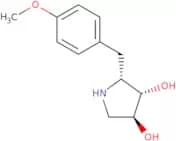
CAS:Deacetylanisomycin is a bacterial metabolite, which is derived from the soil bacterium Streptomyces griseolus. It acts as an inhibitor of protein synthesis by binding to the 60S ribosomal subunit, thus interfering with peptide bond formation during translation. This mode of action is key to its effectiveness in studying the mechanisms of protein synthesis interruption.Fórmula:C12H17NO3Pureza:Min. 95%Forma y color:White To Off-White SolidPeso molecular:223.27 g/mol


![(4S)-2-[Carboxy[[[3-(2-chloro-6-fluorophenyl)-5-methylisoxazol-4-yl]carbonyl]amino]methyl]-5,5-dim…](/_next/image/?url=https%3A%2Fstatic.cymitquimica.com%2Fproducts%2F3D%2Fthumb-webp%2FTCA72850.webp&w=3840&q=75)


![(4E)-1-(3,4-Dichlorophenyl)-4-[(4-ethoxyphenyl)methylidene]pyrazolidine-3,5-dione](/_next/image/?url=https%3A%2Fstatic.cymitquimica.com%2Fproducts%2F3D%2Fthumb-webp%2FISA23884.webp&w=3840&q=75)