Antimicrobianos
Los antimicrobianos son agentes que destruyen o inhiben el crecimiento de microorganismos, incluyendo bacterias, virus, hongos y parásitos. Estos compuestos son esenciales en la prevención y tratamiento de infecciones, desempeñando un papel crucial en la medicina, la agricultura y la industria alimentaria. En CymitQuimica, ofrecemos una extensa gama de antimicrobianos de alta calidad y pureza, adecuados para diversas aplicaciones científicas e industriales. Nuestro catálogo incluye antibióticos, antifúngicos, antivirales y desinfectantes, todos diseñados para satisfacer las necesidades de investigación y desarrollo, así como para aplicaciones clínicas y de producción. Con nuestros productos, los profesionales pueden garantizar la eficacia y seguridad en el control de infecciones y en la protección de la salud pública.
Subcategorías de "Antimicrobianos"
- Antibióticos(4.129 productos)
- Antifúngicos(887 productos)
- Antiparasitarios(701 productos)
- Antivirales(764 productos)
Se han encontrado 2423 productos de "Antimicrobianos"
Ordenar por
Pureza (%)
0
100
|
0
|
50
|
90
|
95
|
100
Ethyl 6-fluoro-7-benzofurancarboxylate
CAS:<p>Ethyl 6-fluoro-7-benzofurancarboxylate is a synthetic organic compound, belonging to the class of ester derivatives, which is primarily used in chemical research and potential pharmaceutical development. This compound is synthesized through a series of organic reactions involving fluorination and esterification processes, originating from precursors of benzofuran derivatives.</p>Fórmula:C11H9FO3Pureza:Min. 95%Peso molecular:208.18 g/molMBX-4132
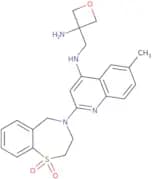
CAS:<p>Please enquire for more information about MBX-4132 including the price, delivery time and more detailed product information at the technical inquiry form on this page</p>Fórmula:C18H15FN4O2Pureza:Min. 95%Peso molecular:338.3 g/molPyflubumide-des(2-methyl-1oxopropyl)
CAS:<p>Pyflubumide-des(2-methyl-1oxopropyl) is a selective miticide, which is synthesized through advanced chemical processes. Its mode of action involves inhibiting cellular respiration in spider mites, specifically targeting the activity of mitochondrial complex II. This disrupts the energy production pathway, leading to pest mortality.</p>Fórmula:C21H25F6N3O2Pureza:Min. 95%Peso molecular:465.4 g/mol1-Ethyl-6-fluoro-7-(4-formylpiperazin-1-yl)-4-oxo-1,4-dihydroquinoline-3-carboxylic acid
CAS:<p>1-Ethyl-6-fluoro-7-(4-formylpiperazin-1-yl)-4-oxo-1,4-dihydroquinoline-3-carboxylic acid is an advanced fluoroquinolone antibiotic, which is synthetically derived. This compound operates by efficiently inhibiting bacterial DNA gyrase and topoisomerase IV, enzymes which are critical for bacterial DNA replication, transcription, and repair. The inhibition of these enzymes interferes with the DNA processes, ultimately leading to bacterial cell death.</p>Fórmula:C17H18FN3O4Pureza:Min. 95%Peso molecular:347.34 g/mol3-(2,4,6-Trimethylphenylsulfonyl)-1,2,4-triazole
CAS:<p>3-(2,4,6-Trimethylphenylsulfonyl)-1,2,4-triazole is a sulfonyl-triazole reagent, which is widely utilized in the field of organic chemistry. This compound is synthetically derived, serving as an important tool in the construction of sulfonyl-protected intermediates and heterocyclic structures. Its mode of action involves acting as a versatile electrophile in conditions favoring nucleophilic attack, facilitating the formation of carbon-nitrogen and carbon-sulfur bonds.</p>Fórmula:C11H13N3O2SPureza:Min. 95%Peso molecular:251.31 g/molBAY-Y 3118
CAS:<p>BAY-Y 3118 is a synthetic compound specifically designed as a radiolabeled dopamine D4 receptor antagonist. It is sourced from chemical synthesis processes that enable modification of molecular structures to target specific biological receptors. The mode of action of BAY-Y 3118 involves binding to the D4 subtype of dopamine receptors, which are G protein-coupled receptors located in the central nervous system. This binding is typically labeled with a radiolabel to facilitate tracking and visualization in biological assays.</p>Fórmula:C20H21ClFN3O3Pureza:Min. 95%Peso molecular:405.8 g/molClomeprop (free acid)
CAS:<p>Clomeprop (free acid) is a selective herbicide, which is synthesized chemically to target grass species. Its mode of action involves the inhibition of the enzyme acetyl-CoA carboxylase, crucial for fatty acid synthesis. This interferes with lipid production, which is vital for plant growth and development.</p>Fórmula:C10H10Cl2O3Pureza:Min. 95%Peso molecular:249.09 g/molOxfendazole
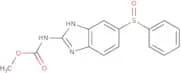
CAS:<p>Oxfendazole is a benzimidazole anthelmintic with action on microtubule formation in parasitic worms and is used for treating gastrointestinal parasites in livestock.</p>Fórmula:C15H13N3O3SPureza:Min. 98 Area-%Forma y color:White PowderPeso molecular:315.35 g/mol2-(2-Methyl-4-nitro-1H-imidazol-1-yl)ethyl benzoate
CAS:<p>2-(2-Methyl-4-nitro-1H-imidazol-1-yl)ethyl benzoate is a synthetic chemical compound, classified as an organic ester. It originates from the reaction between benzoic acid and a derivative of nitroimidazole, a class of compounds known for their bioactivity. The molecular framework includes a benzoate ester linked to an imidazole ring, which is substituted with nitro and methyl groups, contributing to its unique characteristics.</p>Fórmula:C13H13N3O4Pureza:Min. 95%Peso molecular:275.26 g/molSyncytial virus inhibitor-1
CAS:<p>Syncytial virus inhibitor-1 is a potent antiviral compound, which is a synthetic small molecule with a specific mode of action targeting respiratory syncytial virus (RSV). This compound is engineered to inhibit the fusion process between the viral envelope and the host cell membrane, thereby preventing the virus from entering and infecting the cells.</p>Fórmula:C23H26N4O3SPureza:Min. 95%Peso molecular:438.5 g/molFluconazole hydrate
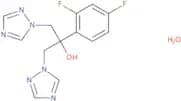
CAS:<p>Fluconazole hydrate is an antifungal medication, which is a synthetic triazole antifungal agent derived from the compound fluconazole. It functions as a powerful inhibitor of the enzyme lanosterol 14α-demethylase, a critical component in the biosynthesis of ergosterol. Ergosterol is an essential component of fungal cell membranes, and its inhibition disrupts membrane synthesis, leading to impaired fungal cell growth and replication.</p>Fórmula:C13H14F2N6O2Pureza:Min. 95%Peso molecular:324.29 g/molTadalafil-N-ethyl
CAS:Tadalafil-N-ethyl is a synthetic compound derived from Tadalafil, a well-known phosphodiesterase type 5 (PDE5) inhibitor. This product is chemically synthesized through pharmaceutical processes involving ethylation, enhancing its pharmacological profile for research purposes. Its mode of action primarily involves the selective inhibition of the PDE5 enzyme, leading to an increased concentration of cyclic guanosine monophosphate (cGMP) in the corpus cavernosum. This results in vasodilation and increased blood flow, facilitating penile erection.Fórmula:C23H21N3O4Pureza:Min. 95%Peso molecular:403.4 g/molPNU 103017
CAS:<p>PNU 103017 is an experimental neuroprotective compound, which is a derivative of pharmacological agents developed for neurological research. It is sourced through synthetic modification processes aimed at enhancing specific receptor interactions in the central nervous system. Its mode of action involves targeting and modulating specific neurotransmitter receptors, such as the sigma receptors, which play a crucial role in neuronal signaling and protection against excitotoxicity.</p>Fórmula:C28H28N2O5SPureza:Min. 95%Peso molecular:504.6 g/molBafilomycin C1
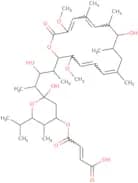
CAS:<p>Bafilomycin C1 is a macrolide antibiotic, which is derived from the bacterium Streptomyces sp. Its mode of action involves the inhibition of vacuolar H+-ATPase (V-ATPase), an enzyme complex responsible for acidifying various intracellular compartments. This inhibition disrupts pH regulation within cells, affecting numerous cellular processes such as protein degradation and trafficking.</p>Fórmula:C39H60O12Pureza:Min. 95%Peso molecular:720.9 g/mol3'-N,N-Di(desmethyl)-3'-N-formyl azithromycin
CAS:<p>3'-N,N-Di(desmethyl)-3'-N-formyl azithromycin is a semisynthetic macrolide antibiotic derivative, which is synthesized through chemical modification of azithromycin. Azithromycin is originally derived from erythromycin, which is produced by the bacterium Saccharopolyspora erythraea. The modifications in this derivative result in enhanced specificity and altered pharmacokinetic properties compared to the parent compound.</p>Fórmula:C37H68N2O13Pureza:Min. 95%Forma y color:White/Off-White SolidPeso molecular:748.94 g/molSARS-CoV-IN-1
CAS:<p>SARS-CoV-IN-1 is a small-molecule inhibitor, which is a synthetic compound designed to interfere with viral replication. This compound is sourced through rigorous combinatorial chemistry methods, enabling the precise targeting of viral enzymes. SARS-CoV-IN-1 specifically inhibits the activity of the SARS-CoV-2 main protease (Mpro), an essential enzyme responsible for processing viral polyproteins into functional units necessary for virus replication.</p>Fórmula:C23H16ClFEN3OPureza:Min. 95%Peso molecular:441.69 g/molCephamycin C
CAS:<p>Cephamycin C is a cephalosporin antibiotic, which is a type of β-lactam antibiotic. It is derived from the fermentation process of certain Streptomyces species and other actinomycetes. Its mode of action involves inhibiting bacterial cell wall synthesis by binding to penicillin-binding proteins (PBPs). This inhibition disrupts the structural integrity of the bacterial cell wall, leading to cell lysis and death.</p>Fórmula:C16H22N4O9SPureza:Min. 95%Forma y color:PowderPeso molecular:446.4 g/mol7,8-Didemethyl-8-hydroxy-5-deazariboflavin
CAS:<p>7,8-Didemethyl-8-hydroxy-5-deazariboflavin is a cofactor often referred to as a deazaflavin. It is a derivative of riboflavin and is primarily sourced from methanogenic archaea. These microorganisms are found in anaerobic environments and play a crucial role in the process of methanogenesis.</p>Fórmula:C16H17N3O7Pureza:Min. 95%Peso molecular:363.32 g/molSanfetrinem cilexetil
CAS:<p>Sanfetrinem cilexetil is an oral prodrug, which is derived from trinem antibiotics, a subgroup of β-lactams. It is a synthetic compound developed to enhance the pharmacokinetic properties of its active form, sanfetrinem. Upon oral administration, sanfetrinem cilexetil undergoes hydrolysis in the digestive tract to release the active β-lactam antibiotic, sanfetrinem.</p>Fórmula:C23H33NO8Pureza:Min. 95%Peso molecular:451.50 g/molFludazonium chloride
CAS:<p>Fludazonium chloride is a quaternary ammonium compound, which is chemically synthesized. It functions primarily as an antibacterial agent by disrupting microbial cell membranes, leading to cell lysis and death. This compound is particularly effective against a broad spectrum of bacteria due to its ability to interact with phospholipid bilayers.</p>Fórmula:C26H20Cl5FN2O2Pureza:Min. 95%Peso molecular:588.7 g/mol