Antimicrobianos
Los antimicrobianos son agentes que destruyen o inhiben el crecimiento de microorganismos, incluyendo bacterias, virus, hongos y parásitos. Estos compuestos son esenciales en la prevención y tratamiento de infecciones, desempeñando un papel crucial en la medicina, la agricultura y la industria alimentaria. En CymitQuimica, ofrecemos una extensa gama de antimicrobianos de alta calidad y pureza, adecuados para diversas aplicaciones científicas e industriales. Nuestro catálogo incluye antibióticos, antifúngicos, antivirales y desinfectantes, todos diseñados para satisfacer las necesidades de investigación y desarrollo, así como para aplicaciones clínicas y de producción. Con nuestros productos, los profesionales pueden garantizar la eficacia y seguridad en el control de infecciones y en la protección de la salud pública.
Subcategorías de "Antimicrobianos"
- Antibióticos(4.126 productos)
- Antifúngicos(874 productos)
- Antiparasitarios(699 productos)
- Antivirales(764 productos)
Se han encontrado 2423 productos de "Antimicrobianos"
Ordenar por
Pureza (%)
0
100
|
0
|
50
|
90
|
95
|
100
Doripenem
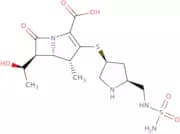
CAS:<p>Doripenem is a carbapenem antibiotic with action on bacterial cell wall synthesis and is used for treating complicated bacterial infections like intra-abdominal infections and urinary tract infections.</p>Fórmula:C15H24N4O6S2Pureza:Min. 95%Forma y color:White PowderPeso molecular:420.51 g/molDMDNA31
CAS:<p>DMDNA31 is a synthetic nucleotide analog, which is a man-made compound designed to mimic the natural building blocks of DNA. It originates from advanced chemical synthesis processes, allowing precise control over its structure to mimic specific nucleotide sequences. DMDNA31 operates by integrating into DNA strands during replication, thereby enabling the study of genetic mutations and the mapping of genomic sequences.</p>Fórmula:C50H62N4O13Pureza:Min. 95%Peso molecular:927 g/molMaribavir
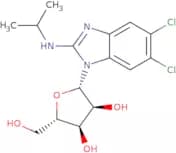
CAS:<p>Potent antiviral against HCMV and Epstein-Barr virus (EBV)</p>Fórmula:C15H19Cl2N3O4Pureza:Min. 95%Peso molecular:376.24 g/molAlamifovir
CAS:<p>Alamifovir is an antiviral agent, which is synthetically derived. The mode of action of Alamifovir involves the inhibition of viral replication within host cells by targeting specific viral enzymes crucial for the replication process. This interference with the viral life cycle diminishes the ability of the virus to propagate and spread within the host organism.</p>Fórmula:C19H20F6N5O5PSPureza:Min. 95%Peso molecular:575.42 g/molOxibendazole-amine hydrochloride
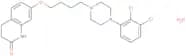
CAS:<p>Oxibendazole-amine hydrochloride is a synthetic anthelmintic compound, which is a derivative of benzimidazole, known for its broad-spectrum efficacy against various helminths. It primarily acts by disrupting the polymerization of tubulin into microtubules, effectively impairing essential cellular structures and functions within parasitic worms, leading to their death.</p>Fórmula:C10H13N3O•HClPureza:Min. 95%Forma y color:PowderPeso molecular:227.69 g/molAripiprazole monohydrate
CAS:Producto controlado<p>Aripiprazole monohydrate is an atypical antipsychotic medication, which is synthesized through chemical processes involving aryl piperazine derivatives. It acts primarily as a partial agonist at dopamine D2 and serotonin 5-HT1A receptors and as an antagonist at 5-HT2A receptors, with additional activity at other neurotransmitter receptors. This unique mechanism of action sets it apart from typical antipsychotics that predominantly function as dopamine antagonists.</p>Fórmula:C23H29Cl2N3O3Pureza:Min. 95%Forma y color:PowderPeso molecular:466.4 g/mol1-(6-Amino-3,5-difluoro-2-pyridinyl)-7-[3-[3-[[1-(6-amino-3,5-difluoro-2-pyridinyl)-3-carboxy-8-chloro-6-fluoro-1,4-dihydro-4-oxo-7- quinolinyl]amino]-2-hydroxypropoxy]-1-azetidinyl]-8-chloro-6-fluoro-1,4-dihydro-4-oxo-3-quinolinecarboxylic acid
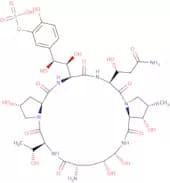
CAS:<p>1-(6-Amino-3,5-difluoro-2-pyridinyl)-7-[3-[3-[[1-(6-amino-3,5-difluoro-2-pyridinyl)-3-carboxy-8-chloro-6-fluoro-1,4-dihydro-4-oxo-7-quinolinyl]amino]-2-hydroxypropoxy]-1-azetidinyl]-8-chloro-6-fluoro-1,4-dihydro-4-oxo-3-quinolinecarboxylic acid is a fluoroquinolone antibiotic, engineered through synthetic chemistry. It is derived from chemical sources involving complex organic synthesis, highlighting its intricate molecular architecture. Its mode of action is distinctive, as it inhibits bacterial DNA gyrase and topoisomerase IV, enzymes crucial for DNA replication and transcription. This interference with bacterial DNA processes results in bactericidal effects, effectively eliminating susceptible bacterial strains.</p>Fórmula:C36H24Cl2F6N8O8Pureza:Min. 95%Peso molecular:881.52 g/molMicafungin FR-179642 impurity (acid)
CAS:<p>Micafungin is an antifungal drug that inhibits the synthesis of ergosterol, a vital component of fungal cell membranes. It is a cyclic peptide with a lipophilic fatty acid chain that has been modified to allow penetration into cells. Micafungin is active against Candida and Aspergillus species and has shown activity against some strains of Cryptococcus neoformans. The MIC (minimum inhibitory concentration) for this drug ranges from 0.06 to 1 microgram/mL, depending on the bacterial strain being tested. Micafungin FR-179642 impurity (acid) is an impurity in micafungin that can be present as trace amounts in the final product and may contribute to hemolytic activity. This impurity is formed by hydrolysis during the synthesis process.</p>Fórmula:C35H52N8O20SPureza:Min. 95 Area-%Forma y color:White PowderPeso molecular:936.9 g/molGramicidin S hydrochloride
CAS:<p>Gramicidin S hydrochloride is a cyclic peptide antibiotic, which is a derivative of the naturally occurring antibiotic gramicidin S. It is sourced from Bacillus brevis, a type of soil bacterium. This peptide operates through a unique mode of action, whereby it disrupts bacterial cell membranes. By integrating into the lipid bilayer, it increases membrane permeability, leading to leakage of essential ions and molecules, and ultimately causing cell death.</p>Fórmula:C60H92N12O10•(HCl)2Pureza:90%MinPeso molecular:1,214.37 g/molCasein
CAS:<p>Casein is a phosphoprotein, which is derived from milk. It originates primarily from cow's milk, where it constitutes about 80% of the total protein content. The mode of action for casein involves its ability to form a gel or clot in the stomach, which makes it highly efficient in nutrient delivery, especially the slow release of amino acids. This process is facilitated by its unique structural features, such as the presence of multiple phosphoryl groups that can bind calcium ions.</p>Pureza:Min. 95%Forma y color:PowderAmoxicillin
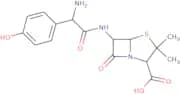
CAS:<p>Amoxicillin is an aminopenicillin antibiotic and is used for the treatment of various bacterial infections. It works by inhibiting the synthesis of bacterial cell wall mucopeptides, leading to cell lysis and death</p>Fórmula:C16H19N3O5SPureza:Min. 95%Forma y color:PowderPeso molecular:365.41 g/molCarumonam
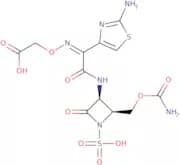
CAS:<p>Carumonam is a synthetic monobactam antibiotic, which is derived from chemically modifying aztreonam to enhance its antimicrobial properties. Its source is entirely synthetic, allowing for precise structural modifications to target specific bacterial pathogens. The mode of action involves the inhibition of bacterial cell wall synthesis. Carumonam binds to penicillin-binding proteins (PBPs) on the surface of bacterial cell walls, disrupting the peptidoglycan cross-linking process necessary for cell wall strength and integrity. This action results in bacterial cell lysis and death, making it effective against a range of Gram-negative bacteria.</p>Fórmula:C12H14N6O10S2Pureza:Min. 95%Peso molecular:466.41 g/molDesoxymycin
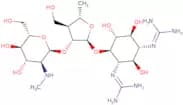
CAS:<p>Desoxymycin is an antibiotic product that belongs to the class of aminoglycosides, which is derived from natural sources such as certain species of Streptomyces bacteria. This compound exhibits its mode of action by specifically binding to the bacterial ribosomal RNA, interfering with protein synthesis. As a result, it inhibits the replication and growth of susceptible bacterial strains.</p>Fórmula:C21H41N7O11Pureza:Min. 95%Peso molecular:567.59 g/molEconazole
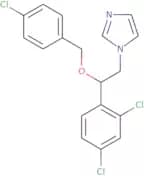
CAS:<p>Econazole is an imidazole antifungal agent with action on fungal cell membrane disruption and is used for treating fungal skin infections like athlete's foot and ringworm.</p>Fórmula:C18H15Cl3N2OPureza:Min. 98 Area-%Forma y color:White PowderPeso molecular:381.68 g/molPuberulic acid
CAS:<p>Puberulic acid is a fungal metabolite that exhibits significant antimicrobial properties. It is derived from certain species of the Penicillium genus, a well-known source of various bioactive compounds. The mode of action of puberulic acid involves the disruption of microbial cell wall synthesis, leading to inhibited growth and eventual cell death of targeted microorganisms.</p>Fórmula:C8H6O6Pureza:Min. 95%Peso molecular:198.13 g/molFengycin
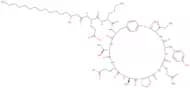
CAS:<p>Fengycin is a cyclic lipopeptide from Bacillus subtilis acts as a biosurfactant and antifungal. As a fungicide, it has a mode of action that involves the formation of ion channels in the fungal lipid membrane, leading to membrane leakage This activity is negatively correlated to cholesterol levels, and may explain why mammalian cells, with higher cholesterol present, are not sensitive to fengycin.</p>Fórmula:C72H110N12O20Pureza:Min. 90 Area-%Forma y color:PowderPeso molecular:1,463.71 g/molN-Acetylamphotericin B
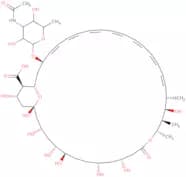
CAS:<p>N-Acetylamphotericin B is a derivative of the well-known antifungal agent Amphotericin B, which is derived from the bacterium *Streptomyces nodosus*. This compound is an acetylated version of Amphotericin B, designed to improve certain pharmacokinetic properties. It operates by binding to ergosterol, a key component of fungal cell membranes, leading to the formation of pores that disrupt membrane integrity, causing cell death. The acetylation is intended to reduce the compound's cytotoxicity and improve its solubility in aqueous solutions, potentially allowing for enhanced therapeutic applications.</p>Fórmula:C49H75NO18Pureza:(%) Min. 75%Forma y color:Yellow To Brown SolidPeso molecular:966.12 g/molLinearmycin A
CAS:<p>Linearmycin A is an antibiotic compound, which is a secondary metabolite produced by the bacterium Streptomyces sp. Its mode of action involves disrupting bacterial protein synthesis, leading to the inhibition of bacterial growth. This compound exhibits strong efficacy against various Gram-positive and some Gram-negative bacteria, making it valuable in microbiological research.</p>Fórmula:C64H101NO16Pureza:Min. 95%Peso molecular:1,140.5 g/molOleandomycin
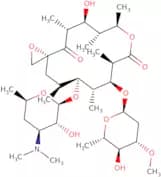
CAS:<p>Oleandomycin is a macrolide antibiotic, which is derived from the bacterium *Streptomyces antibioticus*. This antibiotic functions by binding to the 50S subunit of the bacterial ribosome, thereby inhibiting protein synthesis. The interruption of this essential process ultimately leads to the cessation of bacterial growth and replication.</p>Fórmula:C35H61NO12Pureza:Min. 95%Forma y color:White PowderPeso molecular:687.86 g/molQuinofumelin
CAS:<p>Quinofumelin is a fungicide, which is synthetically derived with a novel mode of action targeting specific biochemical pathways in fungi. Its unique mechanism disrupts crucial cellular processes within pathogenic fungi, thereby halting their growth and spread. This fungicide has been meticulously developed through advanced chemical synthesis to ensure high efficacy and specificity against a broad spectrum of fungal pathogens affecting various crops.</p>Fórmula:C20H16F2N2Pureza:Min. 95%Peso molecular:322.4 g/mol