Antimicrobianos
Los antimicrobianos son agentes que destruyen o inhiben el crecimiento de microorganismos, incluyendo bacterias, virus, hongos y parásitos. Estos compuestos son esenciales en la prevención y tratamiento de infecciones, desempeñando un papel crucial en la medicina, la agricultura y la industria alimentaria. En CymitQuimica, ofrecemos una extensa gama de antimicrobianos de alta calidad y pureza, adecuados para diversas aplicaciones científicas e industriales. Nuestro catálogo incluye antibióticos, antifúngicos, antivirales y desinfectantes, todos diseñados para satisfacer las necesidades de investigación y desarrollo, así como para aplicaciones clínicas y de producción. Con nuestros productos, los profesionales pueden garantizar la eficacia y seguridad en el control de infecciones y en la protección de la salud pública.
Subcategorías de "Antimicrobianos"
- Antibióticos(4.126 productos)
- Antifúngicos(874 productos)
- Antiparasitarios(699 productos)
- Antivirales(764 productos)
Se han encontrado 2423 productos de "Antimicrobianos"
Ordenar por
Pureza (%)
0
100
|
0
|
50
|
90
|
95
|
100
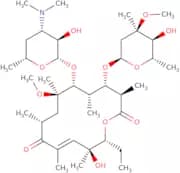
6,11-Di-O-methyl erythromycin
CAS:<p>6,11-Di-O-methyl erythromycin is a semi-synthetic derivative of erythromycin, which is a macrolide antibiotic originally sourced from the bacterium *Saccharopolyspora erythraea*. This compound is produced through chemical modification of the natural antibiotic to improve its pharmacokinetic properties, such as stability and absorption.</p>Fórmula:C39H71NO13Pureza:Min. 95%Peso molecular:761.98 g/molArtelinic acid
CAS:<p>Artelinic acid is a synthetic antimalarial agent, which is derived from artemisinin, a natural compound sourced from the sweet wormwood plant (Artemisia annua). The mode of action of Artelinic acid involves the generation of free radicals within the Plasmodium parasite, leading to oxidative stress and damage to the parasite’s cellular components, ultimately resulting in parasite death. This mechanism is particularly effective against Plasmodium species, including those strains resistant to other antimalarial drugs.</p>Fórmula:C23H30O7Pureza:Min. 95%Peso molecular:418.5 g/molPuromycin-D3
CAS:<p>Puromycin-D3 is a deuterium-labeled antibiotic, which is synthetically derived from the bacterium *Streptomyces alboniger*, with three hydrogen atoms replaced by deuterium. Its mode of action involves the inhibition of protein synthesis by mimicking the aminoacyl end of tRNA, causing premature chain termination during translation on ribosomes. This mechanism specifically targets growing peptides in cells, making it a valuable tool for studying protein synthesis.</p>Fórmula:C22H26D3N7O5Pureza:Min. 95%Peso molecular:474.53 g/mol(10E)-10,11-Didehydro-11-deoxy-6-O-methylerythromycin
CAS:<p>(E)-10,11-Didehydro-11-deoxy-6-O-methylerythromycin is a semisynthetic macrolide antibiotic, which is derived from erythromycin, a natural product obtained from the bacterium *Saccharopolyspora erythraea*. This compound functions as an inhibitor of protein synthesis by binding to the 50S ribosomal subunit of bacteria, thus preventing the growth and proliferation of susceptible bacterial strains. The alteration in its chemical structure, notably the methylation at the 6-O position, enhances its stability and improves its pharmacokinetic profile compared to the parent compound, erythromycin.</p>Fórmula:C38H67NO12Pureza:Min. 95%Peso molecular:729.94 g/molTelavancin
CAS:<p>Telavancin is a lipoglycopeptide antibiotic, which is a semi-synthetic derivative of vancomycin. Its source is derived through modifications of the glycopeptide antibiotic, specifically aimed to enhance antibacterial activity. Telavancin functions by inhibiting cell wall synthesis in Gram-positive bacteria, including methicillin-resistant Staphylococcus aureus (MRSA). It does this by binding to the D-alanyl-D-alanine terminus of cell wall precursors, disrupting peptidoglycan polymerization and, consequently, cell wall integrity. Additionally, Telavancin increases membrane permeability and disrupts membrane potential, further enhancing its bactericidal activity.</p>Fórmula:C80H106Cl2N11O27PPureza:Min. 95%Peso molecular:1,755.64 g/molSisunatovir hydrochloride
CAS:Sisunatovir hydrochloride is an antiviral agent, which is a synthetic compound with a mechanism of action specifically targeting the respiratory syncytial virus (RSV). As a potent inhibitor, Sisunatovir hydrochloride interferes with the viral replication process by binding to a specific protein essential for the virus's ability to replicate within host cells.Fórmula:C23H23ClF4N4OPureza:Min. 95%Peso molecular:482.9 g/molPiperacillin-d5
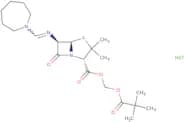
CAS:<p>Piperacillin-d5 is a stable isotopically labeled antibiotic, which is synthesized chemically to incorporate deuterium atoms. It is derived from the β-lactam group of antibiotics, sharing properties with its non-labeled counterpart, piperacillin. The incorporation of five deuterium atoms allows researchers to use it as a tracer in various pharmacokinetic and metabolic studies without altering its biological activity.</p>Fórmula:C23H22D5N5O7SPureza:Min. 95%Peso molecular:522.59 g/molPivmecillinam hydrochloride
CAS:<p>Pivmecillinam hydrochloride is an antibacterial prodrug, which is derived from the source compound mecillinam, a beta-lactam antibiotic. It functions by inhibiting bacterial cell wall synthesis, specifically targeting the penicillin-binding protein 2 (PBP2). This affinity leads to a weakening of the bacterial cell wall, causing cell lysis and death, particularly in gram-negative bacteria.</p>Fórmula:C21H33N3O5S·HClPureza:Min. 95%Peso molecular:476.03 g/molCensavudine
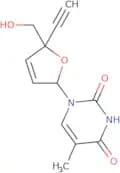
CAS:<p>Censavudine is an antiviral compound, which is a synthetic nucleoside analog designed to interfere with viral replication processes. The source of this compound lies in its chemical synthesis, which involves precise structural modifications to resemble natural nucleosides. Its mode of action involves incorporation into viral RNA by the viral polymerase, leading to chain termination. This mechanism effectively hinders the replication of viral genomes, thus preventing the proliferation of the virus within the host organism.</p>Fórmula:C12H12N2O4Pureza:Min. 95%Peso molecular:248.23 g/molSpiramycin hexanedioate
CAS:<p>Spiramycin hexanedioate is a macrolide antibiotic, which is derived from the bacterium *Streptomyces ambofaciens*. Its mode of action involves binding to the 50S ribosomal subunit of susceptible bacteria, thereby inhibiting protein synthesis. This interaction results in the interruption of bacterial growth and reproduction, particularly effective against Gram-positive organisms.</p>Fórmula:C49H84N2O18Pureza:Min. 95%Peso molecular:989.2 g/molSibofimloc
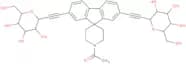
CAS:<p>Please enquire for more information about Sibofimloc including the price, delivery time and more detailed product information at the technical inquiry form on this page</p>Fórmula:C35H39NO11Pureza:Min. 95%Peso molecular:649.68 g/molSulbenicillin
CAS:<p>Sulbenicillin is a semi-synthetic penicillin antibiotic, which is derived from 6-aminopenicillanic acid, a natural precursor in the biosynthesis of penicillins. With its beta-lactam structure, Sulbenicillin disrupts bacterial cell wall synthesis by inhibiting penicillin-binding proteins, which are essential enzymes in the cross-linking of peptidoglycan layers. This disruption compromises the structural integrity of the bacterial cell wall, resulting in cell lysis and death, particularly in Gram-negative bacteria.</p>Fórmula:C16H18N2O7S2Pureza:Min. 95%Peso molecular:414.46 g/molPantoprazole magnesium
CAS:<p>Pantoprazole magnesium is a pharmaceutical compound that belongs to the class of proton pump inhibitors (PPIs). It is derived from the benzimidazole chemical family and synthesized through a chemical process that involves the formation of a magnesium salt of pantoprazole. This compound's mode of action involves the irreversible inhibition of the H+/K+ ATPase enzyme system located on the gastric parietal cell surface. By blocking this enzyme system, pantoprazole magnesium effectively reduces the secretion of gastric acid.</p>Fórmula:C32H28F4MgN6O8S2Pureza:Min. 95%Peso molecular:789.00 g/molSordarin sodium salt
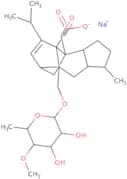
CAS:<p>Sordarin sodium salt is an antifungal agent, characterized as a semisynthetic derivative produced from the fermentation products of filamentous fungi, specifically belonging to the phylum Ascomycota. This compound exerts its effects by selectively inhibiting fungal protein synthesis. It achieves this by obstructing the function of elongation factor 2 (EF-2), an essential component of fungal ribosomal activity, thereby disrupting the translational elongation step of protein synthesis.</p>Fórmula:C27H39NaO8Pureza:Min. 95%Peso molecular:514.58 g/molThienamycin p-nitrobenzyl ester, N-methylpyrrolidinone hydrochloride
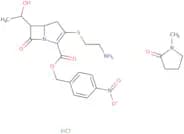
CAS:<p>Thienamycin p-nitrobenzyl ester, N-methylpyrrolidinone hydrochloride is a synthetic compound commonly utilized in biochemical research, particularly in the study of beta-lactam antibiotics. It is derived through synthetic pathways involving the modification of thienamycin, a naturally occurring beta-lactam antibiotic, to enhance its stability and facilitate its study in various experimental settings. This modification allows for investigation into the structure-activity relationships and potential enhancements of antibiotic function.</p>Fórmula:C23H31ClN4O7SPureza:Min. 95%Peso molecular:543 g/molMethicillin sodium hydrate
CAS:<p>Methicillin sodium hydrate is a semi-synthetic β-lactam antibiotic, which is a derivative of the naturally occurring antibiotic penicillin. It is sourced from the modification of the penicillin nucleus, specifically designed to resist degradation by the bacterial enzyme penicillinase. This enzyme, produced by certain bacterial strains, can render penicillin ineffective. Methicillin operates by inhibiting the synthesis of bacterial cell walls, specifically binding to penicillin-binding proteins (PBPs). This action disrupts the cross-linking of peptidoglycan chains, a critical component for bacterial cell wall integrity, ultimately leading to cell lysis and death.</p>Fórmula:C17H21N2NaO7SPureza:Min. 95%Peso molecular:420.4 g/molMacrosphelide A
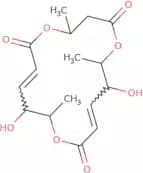
CAS:<p>Macrosphelide A is a bioactive macrocyclic lactone, which is a secondary metabolite derived from the culture of certain fungal species. It functions primarily through the disruption of cell adhesion processes, which is facilitated by its ability to interfere with the function of specific cell surface receptors. This mode of action underlies its potential as an immunosuppressive agent, where it can inhibit the activities of immune cells by altering cellular communication and adhesion.</p>Fórmula:C16H22O8Pureza:Min. 95%Peso molecular:342.34 g/molNifedipine
CAS:<p>Nifedipine is a pharmaceutical compound belonging to the class of dihydropyridine calcium channel blockers, which is synthetically derived. Its mode of action involves the inhibition of calcium ions entering vascular smooth muscle and cardiac muscle cells, leading to vasodilation. By blocking these channels, it reduces peripheral vascular resistance, thereby decreasing blood pressure and easing cardiac workload.</p>Fórmula:C17H18N2O6Pureza:Min. 98 Area-%Peso molecular:346.33 g/molClindamycin
CAS:<p>Inhibitor of protein synthesis; lincosamide class</p>Fórmula:C18H33ClN2O5SPureza:Min. 95%Peso molecular:424.98 g/molCyprazine-desisopropyl
CAS:<p>Cyprazine-desisopropyl is a metabolite, which is a derivative form resulting from the biotransformation of cyromazine, an insect growth regulator. Cyromazine is originally sourced as a triazine-class pesticide, commonly used to control insect populations by disrupting their growth processes. Cyprazine-desisopropyl, similarly, impacts the development stages of target insect species.</p>Fórmula:C6H8ClN5Pureza:Min. 95%Peso molecular:185.61 g/mol