Flavonoides
Los flavonoides son un grupo de metabolitos vegetales con propiedades antioxidantes que contribuyen al color de frutas y flores. Desempeñan un papel significativo en la protección de las plantas contra la radiación UV y los patógenos. Los flavonoides se estudian por sus potenciales beneficios para la salud, incluidas propiedades antiinflamatorias, antivirales y anticancerígenas. Son ampliamente investigados en los campos de la farmacología, la nutrición y la biología molecular.
Subcategorías de "Flavonoides"
- Antocianidinas(46 productos)
- Antocianina(46 productos)
- Catequina(88 productos)
- Chalconas(237 productos)
- Pterocarpan(28 productos)
Se han encontrado 2408 productos de "Flavonoides"
Ordenar por
Pureza (%)
0
100
|
0
|
50
|
90
|
95
|
100
7-Hydroxy-2',4'-dimethoxyisoflavone
CAS:<p>7-Hydroxy-2',4'-dimethoxyisoflavone is a synthetic isoflavone, which is derived from the structural modification of natural isoflavones found in various plants, such as soybeans and other legumes. It exerts its biological activity primarily through its interaction with cellular signaling pathways related to oxidative stress and inflammation. This compound functions by modulating enzyme activity, influencing the expression of genes involved in antioxidant defenses, and suppressing pro-inflammatory cytokines.</p>Fórmula:C17H14O5Pureza:Min. 95%Peso molecular:298.29 g/molSumatrol
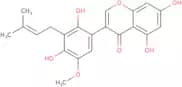
CAS:<p>Sumatrol is a selective herbicide, which is a compound derived from synthetic sources designed to inhibit the growth of unwanted vegetation. It functions primarily by disrupting specific physiological processes in plants, specifically targeting the enzymatic pathways critical for the growth of broadleaf weeds and grasses. Its action mechanism involves the inhibition of key enzymes that lead to the cessation of cellular division and growth within the targeted plant species.</p>Fórmula:C23H22O7Pureza:(%) Min. 95%Forma y color:White PowderPeso molecular:410.42 g/molKaempferol 6-C-glucoside
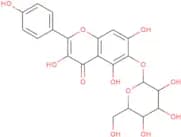
CAS:<p>Kaempferol 6-C-glucoside is a flavonoid glycoside, which is a natural compound found in various plant sources, particularly in leaves and fruits. It is a type of C-glycosyl flavonoid, where the glucose moiety is bound directly to the carbon atom of the flavonoid skeleton, differentiating it from the more common O-glycosides.</p>Fórmula:C21H20O11Pureza:Min. 95%Peso molecular:448.38 g/molCajanol
CAS:<p>Cajanol is a naturally occurring compound, which is a flavonoid isolated from the plant *Cajanus cajan* (commonly known as pigeon pea). This compound is primarily extracted from the leaves and seeds of the plant through various chromatographic techniques, ensuring high purity and bioactive consistency. Cajanol functions by interacting with cellular pathways, exhibiting antioxidant and anti-inflammatory properties. It achieves this through the scavenging of free radicals and modulation of signaling pathways involved in cellular stress responses.</p>Fórmula:C17H16O6Pureza:Min. 95%Forma y color:PowderPeso molecular:316.31 g/molVitexin-4'-rhamnoside
CAS:Vitexin-4'-rhamnoside is a flavonoid glycoside, which is a compound derived from plants such as hawthorn and certain types of buckwheat. This compound belongs to the class of natural products known as flavonoid glycosides, which are well-regarded for their diverse biological activities. Vitexin-4'-rhamnoside is characterized by its ability to scavenge free radicals, thanks to its antioxidant properties. This action is primarily achieved by donating hydrogen atoms or electrons to neutralize reactive oxygen species, thereby mitigating oxidative stress.Pureza:Min. 95%Bromoflavone
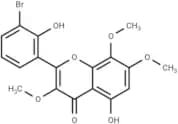
CAS:Bromoflavone (CJ-19784) is a flavonoid isolated from Aspergillus candidus. It demonstrates antitubercular activity against Mycobacterium tuberculosis (MTB) with an MIC90 of 1.2 μM. Additionally, Bromoflavone acts as an antifungal agent, inhibiting the growth of pathogenic fungi such as Candida albicans, Cryptococcus neoformans, and Aspergillus fumigatus with IC50 values of 0.11 μg/mL, 20 μg/mL, and 0.54 μg/mL, respectively.Fórmula:C18H15BrO7Forma y color:SolidPeso molecular:423.21Azicemicin B
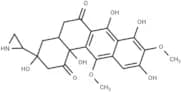
CAS:<p>Azicemicin B exhibits mild antibacterial activity, and when administered to mice via intraperitoneal injection at a dosage of 150 mg/kg, it does not result in any acute toxicity.</p>Fórmula:C22H23NO9Forma y color:SolidPeso molecular:445.419Calopogoniumisoflavone B
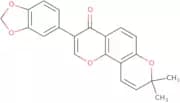
CAS:<p>Calopogoniumisoflavone B is a naturally occurring isoflavone, which is a type of phytochemical compound derived primarily from Calopogonium species. This product is isolated from the plant's roots and stems, where it functions as a secondary metabolite. Isoflavones are well known for their phytoestrogenic properties, meaning they can mimic or modulate the action of estrogen in the body by binding to estrogen receptors. This mode of action allows isoflavones to potentially influence various biological pathways related to hormone regulation and cellular growth.</p>Fórmula:C21H16O5Pureza:Min. 95%Peso molecular:348.35 g/mol2'-Amino-3'-methoxyflavone, 99%
CAS:<p>A MAP kinase inhibitor</p>Fórmula:C16H13NO3Pureza:99%Peso molecular:267.284',5,7-Trihydroxyflavone, 97%
CAS:<p>4',5,7-Trihydroxyflavone is a nonmutagenic flavonoid shown to inhibit cell proliferation, angiogenesis and protein kinase. Also induces apoptosis in breast cancer cells. It inhibit topoisomerase I-catalyzed DNA re-ligation and enhance gap junctional intercellular communication. This Thermo Scientif</p>Fórmula:C15H10O5Pureza:97%Forma y color:Cream to yellow to brown, PowderPeso molecular:270.243,5,7-Trihydroxyflavone, 97%
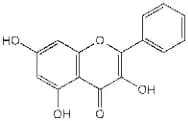
CAS:<p>This Thermo Scientific Chemicals brand product was originally part of the Alfa Aesar product portfolio. Some documentation and label information may refer to the legacy brand. The original Alfa Aesar product / item code or SKU reference has not changed as a part of the brand transition to Thermo Sci</p>Fórmula:C15H10O5Pureza:97%Forma y color:Powder, White to cream to yellowPeso molecular:270.24Hispidulin-7-O-glucoside
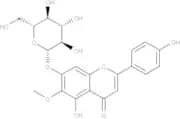
CAS:<p>Hispidulin-7-O-glucoside analytical standard provided with w/w absolute assay, to be used for quantitative titration.</p>Fórmula:C22H22O11Pureza:(HPLC) ≥98%Forma y color:PowderPeso molecular:462.41Prunetin
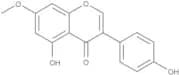
CAS:<p>Prunetin analytical standard provided with chromatographic purity, to be used as reference material for qualitative determination.</p>Fórmula:C16H12O5Pureza:(HPLC) ≥95%Forma y color:PowderPeso molecular:284.28Nepetin-7-O-glucoside
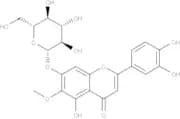
CAS:<p>Nepetin-7-O-glucoside analytical standard provided with w/w absolute assay, to be used for quantitative titration.</p>Fórmula:C22H22O12Pureza:(HPLC) ≥98%Forma y color:PowderPeso molecular:478.41Ipriflavone
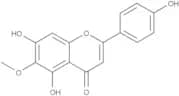
CAS:<p>Ipriflavone analytical standard provided with chromatographic purity, to be used as reference material for qualitative determination.</p>Fórmula:C18H16O3Pureza:(HPLC) ≥90%Forma y color:PowderPeso molecular:280.33Hispidulin
CAS:<p>Hispidulin analytical standard provided with w/w absolute assay, to be used for quantitative titration.</p>Fórmula:C16H12O6Pureza:(HPLC) ≥98%Forma y color:PowderPeso molecular:300.27(2R,3R)-3,3',4',5,7-Pentahydroxyflavanone
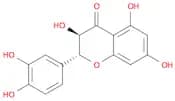
CAS:Fórmula:C15H12O7Pureza:98%Forma y color:SolidPeso molecular:304.25163-O-Methyl quercetin
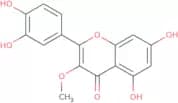
CAS:<p>3-O-Methyl quercetin is a flavonoid derivative, which is a naturally occurring compound found in various plant sources, particularly in fruits and vegetables. This compound is structurally related to quercetin, a well-known flavonoid, and differs by a methoxy group substitution at the 3-position. The biological activity of 3-O-Methyl quercetin is primarily attributed to its antioxidant and anti-inflammatory properties. It acts by scavenging free radicals and modulating enzymatic pathways that influence oxidative stress and inflammation.</p>Fórmula:C16H12O7Pureza:Min. 95 Area-%Forma y color:PowderPeso molecular:316.26 g/molRef: 3D-FM25555
Producto descatalogadoNevadensin
CAS:<p>Nevadensin is a naturally occurring flavonoid compound, which is isolated from the plant *Rosmarinus officinalis*, commonly known as rosemary. Rosemary is a member of the Lamiaceae family and is widely recognized for its antioxidant and aromatic properties. The active ingredient, nevadensin, exerts its effects primarily through the inhibition of the cyclooxygenase (COX) enzymes, particularly COX-2, which are key players in the inflammatory process. This inhibition reduces the production of pro-inflammatory mediators, contributing to its anti-inflammatory activity.</p>Fórmula:C18H16O7Pureza:Min. 98 Area-%Forma y color:Yellow PowderPeso molecular:344.32 g/molPiscerythrone
CAS:<p>Piscerythrone is a specialized chemical compound derived from certain marine organisms, which is primarily sourced from vibrant crustaceans. It acts through biochemical interactions that modulate pigmentation processes at the cellular level. The compound's mode of action involves binding to specific receptors involved in the enzymatic pathways of pigment production, influencing the synthesis and deposition of pigments such as astaxanthin.</p>Fórmula:C21H20O7Pureza:Min. 95%Peso molecular:384.38 g/mol