Anticuerpos primarios
Los anticuerpos primarios son inmunoglobulinas que se unen específicamente a un antígeno de interés, permitiendo la detección y cuantificación de proteínas, péptidos u otras biomoléculas. Estos anticuerpos son herramientas fundamentales en una amplia gama de aplicaciones, como el Western blot, la inmunohistoquímica y el ELISA. En CymitQuimica, ofrecemos una extensa selección de anticuerpos primarios de alta calidad que brindan especificidad y sensibilidad para diversas necesidades de investigación, incluidas las áreas de cáncer, inmunología y biología celular.
Subcategorías de "Anticuerpos primarios"
- Anticuerpos para la investigación del cáncer(3.609 productos)
- Anticuerpos cardiovasculares(2 productos)
- Biología del desarrollo(746 productos)
- Anticuerpos Epigenéticos(162 productos)
- Anticuerpos inmunológicos(2.691 productos)
- Anticuerpos del metabolismo(278 productos)
- Anticuerpos de microbiología(736 productos)
- Transducción de señales(2.710 productos)
- Etiquetas y marcadores celulares(33 productos)
Mostrar 1 subcategorías más
Se han encontrado 69953 productos de "Anticuerpos primarios"
Ordenar por
Pureza (%)
0
100
|
0
|
50
|
90
|
95
|
100
Anti-phospho-FoxO1 (pS218) antibody - 0.5mg/mL
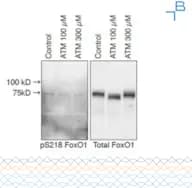
<p>Forkhead box O1 (FoxO1) is a transcriptional regulator of cell growth and proliferation controlled by a receptor tyrosine kinase signalling pathway (the vascular endothelial growth factor A (VEGF-A)/phosphatidylinositol-3-OH kinase (PI3K)/protein kinase B (PKB/Akt) pathway). FoxO1 is phosphorylated in the DNA binding domain at serine 218 by aPKCλ. FoxO1 Ser218 phosphorylation and aPKC expression correlate with poor patient prognosis in various cancers. VEGF/PI3K/Akt signalling results in FoxO1 cytoplasmic localisation and its inactivation. Cytoplasmically localised FoxO1 is associated with cellular myelocytomatosis (c-Myc) expression and endothelial cell (EC) proliferation. Abnormal atypical protein kinase C (aPKC)/FoxO1/c-Myc signalling contributes to excessive EC proliferation in angiosarcoma and when constitutively active, FoxO1 leads to lethality due to heart defects.<br>0.5 mg/ml. For use in WB (1:500), ELISA (1:1000) and IHC (1:100). Reacts with Human, rat, mouse. May also recognise the equivalent serine in FoxO3/4/6.</p>Anti-PERK antibody - serum
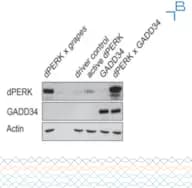
<p>Recognizes Integrated stress response (ISR) kinase, PERK, with a strong signal and low background noise.<br>When there are a large number of misfolded proteins in the cell a homeostatic mechanism called the unfolded protein response (UPR) is activated which involves restricting translation and increasing chaperone capacity. As part of this response, the ER-resident kinase PERK (eukaryotic translation initiation factor 2α kinase, also known as PEK) phosphorylates the translation initiation factor eIF2α resulting in the attenuation of translation.<br>PERK activation causes loss of cyclin D1 and G1 cell cycle arrest, negatively regulating cell proliferation. PERK-dependent activation of GSK3β during ER stress has been shown to destabilise p53.<br>Antiserum. Used for western blot (1:1000). Reacts with Drosophila melanogaster.<br>Image: Western blot analysis of fly heads (three per lane) from indicated genotypes. Blotting for actin provided the loading control. Note the increased level of PERK-WT immunoreactivity in GADD34-rescued flies. This reflects the preservation of PERK expressing retinal tissue.</p>Forma y color:PowderAnti-Kairi Virus (KRIV) Nucleocapsid ant - 0.2mg/mL
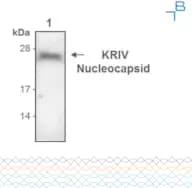
<p>KRIV belongs to the Peribunyaviridae family of viruses (previously called Bunyaviridae). KRIV was first isolated from mosquito species in Trinidad including Aedes, Wyeomia, Culex and Psorophora spp. and has since been isolated from mosquitoes and vertebrates in Central and South America. Although between 6–18% of humans and up to 48% of horses have antibodies to KRIV, it does not cause any documented clinical disease symptoms in humans or animals. KRVI consists of three genome segments (called L [large], M [medium] and S [small]) which are encapsidated by the nucleocapsid (N) protein. These segments associate with the viral RNA-dependent RNA polymerase, the L protein, to form ribonucleoprotein complexes (RNP) termed nucleocapsids. RNPs are contained within a lipid envelope also containing the viral glycoproteins, Gn and Gc.<br>1mg/ml. For use in WB and ELISA. Reacts with Kairi Virus. <br>Image: Western blot analysis of BHK-21 cells infected with the Kairi virus.</p>Anti-RAMP3 antibody - 0.2mg/mL
<p>Anti-RAMP3 antibody corresponds to a region within the human RAMP3 C-terminal protein sequence. RAMP3 is a receptor activity-modifying protein and can interact with G-protein coupled receptors (GPCRs) to alter their function. When in complex with the calcitonin like-receptor (CLR), RAMP chaperones CLR to the surface of the cell where it forms an adrenomedullin2 (AM2) receptor specific for the peptide hormone adrenomedullin. Conversely the calcitonin receptor (CTR) can translocate to the cell surface without RAMP, however RAMP requires CTR to reach the cell surface. It is evident through the use of screening that RAMP requires an interaction with a molecule to translocate to the cell surface. RAMP3 contains a single transmembrane spanning domain, an extracellular N-terminal domain and multiple glycosylation sites. Within the C-terminus two basic residues serve as an endoplasmic retrieval signal. In contrast with Human RAMP1 and 2, Human RAMP3 contains a type-1 PDZ1 recognition site which interacts with Na+/H+ exchange regulatory factor (NHERF) or N-ethylmaleimide-sensitive factor (NSF). This interaction effects GPCR function through altering receptor internalization and recycling.<br>0.22 mg/ml. For use in ELISA (1:1000). Reacts with human.</p>Anti-OTULIN antibody - serum
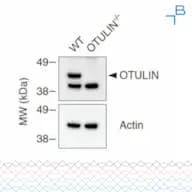
<p>The methionine 1 (M1)-specific deubiquitinase (DUB), OTULIN (linear ubiquitination-specific deubiquitinase ovarian tumour domain deubiquitinase with linear linkage specificity), acts as a negative regulator of nuclear factor κB signalling and immune homeostasis. OTULIN cleaves M1-linked polyUb with high specificity and efficiency and thus tightly regulates the linear ubiquitin chain assembly complex (LUBAC) which is responsible for catalysing the conjugation of linear methionine 1 (M1)-linked polyubiquitin (polyUb). OTULIN is also a negative regulator of tumour necrosis factor- α (TNF-α) signalling, it prevents auto-ubiquitination of LUBAC components at steady state, and the accumulation of M1-linked chains. OTULIN is critical for preventing spontaneous inflammation and maintaining immune homeostasis.<br>Serum. For use in WB (1:1000) and ELISA (1:1000). Reacts with Human.<br>Image: Anti-OTULIN antibody (crb2005228) (1:1000)<br>Western blot analysis of cell extract of HCT-116 human colon carcinoma cells wildtype and CRISPR-targeted (OTULIN-/-).<br>Lane 1: HCT-116 cells wildtype<br>Lane 2: HCT-116 cells CRISPR-targeted (OTULIN-/-)</p>Tadocizumab
CAS:<p>Anti-IL-6 receptor humanized whole antibody, immunosuppressive drug, treatment of rheumatoid arthritis, systemic juvenile idiopathic arthritis and COVID-19</p>Anti-RAMP1 antibody
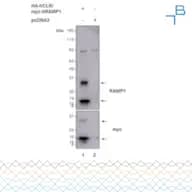
<p>Receptor activity-modifying protein 1 (RAMP1) is a receptor accessory protein specifically expressed in hematopoietic progenitor cells. RAMP1 associates with G-protein coupled receptors (GPCRs) to alter ligand specificity and mediate receptor trafficking. RAMP1 forms a receptor complex with calcitonin receptor-like receptor (CRLR) known as the calcitonin gene-related protein (CGRP) receptor. RAMPs also associate with other family B G-protein coupled receptors including the vasoactive intestinal polypeptide/pituitary AC-activating peptide 1 (VPAC1) receptor and the glucagon receptor (GCGR) where they modulate ligand and G-protein selection.</p>Anti-sCTLA-4 antibody CRB10D1 - 1mg/mL
<p>Cytotoxic T-lymphocyte-associated protein 4 (CTLA4) in an immunoglobulin superfamily receptor important for downregulating immune responses. CTLA4 is expressed in T-cells where it transmits an inhibitory signal to the cells. The secreted soluble form of CTLA-4 (sCTLA-4) lacks the transmembrane domain as well as the membrane proximal cysteine residue required for covalent homodimerization and therefore sCTLA-4 is only present in monomeric form. In human and mouse sCTLA-4 mRNA expression is mainly detected in resting T-cells, at levels similar to transmembrane CTLA-4 (Tm-CTLA-4) mRNA, however following T-cell activation, Tm-CTLA-4 is upregulated and becomes the predominant transcript. Mutations in CTLA4 are associated with multiple autoimmune diseases, including type 1 diabetes (T1D), Graves' disease (GD), rheumatoid arthritis and celiac disease, an increase of sCTLA-4 is also seen in autoimmune diseases.<br>1mg/ml. For use in WB and ELISA. Reacts with human, mouse.Host: Mouse Monoclonal IgG</p>VEGF antibody
<p>VEGF antibody was raised in mouse using highly pure recombinant human VEGF165 as the immunogen.</p>Mouse anti-human IgM
<p>Mouse anti-human IgM is a monoclonal antibody that is widely used in life sciences research. It is produced by hybridoma cells and specifically targets human IgM, a class of antibodies involved in immune response. This antibody can be used for various applications, including detection and quantification of human IgM in biological samples. Mouse anti-human IgM has been shown to neutralize the activity of human IgM and inhibit its binding to specific receptors. It can also be used as a tool for studying the role of IgM in various biological processes, such as immune signaling and disease development. The high specificity and affinity of this monoclonal antibody make it a valuable reagent for researchers in the field of immunology.</p>Dengue virus antibody
<p>Dengue virus antibody is a monoclonal antibody that specifically targets the glycoprotein antigen of the dengue virus. This antibody is produced using advanced techniques in the field of Life Sciences. It has been shown to effectively bind to and neutralize the dengue virus, preventing its replication and spread within the body. The Dengue virus antibody has high specificity and affinity for the viral glycoproteins, making it a valuable tool for research and diagnostic purposes. It can be used in various applications, including immunohistochemistry, ELISA assays, and Western blotting. The antibody is stable in both methanol and butanol solutions, allowing for flexible experimental conditions. With its ability to recognize different serotypes of the dengue virus, this monoclonal antibody provides a reliable means of detecting and studying this infectious pathogen.</p>Bt Cry1Ab antibody
<p>Bt Cry1Ab antibody was raised in mouse using Bt Cry1Ab Isolated from Bacillus thuringiensis as the immunogen.</p>Pureza:Min. 95%Apo (a) antibody
<p>Apo (a) antibody was raised in goat using human apolipoprotein (a) as the immunogen.</p>Pureza:Min. 95%Human Serum Albumin antibody
<p>Human serum albumin antibody was raised in goat using human albumin as the immunogen.</p>Pureza:Min. 95%EGFR antibody
<p>The EGFR antibody is a highly specialized product in the field of Life Sciences. This polyclonal antibody targets the epidermal growth factor receptor (EGFR), which plays a crucial role in cell signaling and proliferation. By binding to EGFR, this antibody inhibits the activation of downstream pathways, leading to the suppression of cell growth and division.</p>Rabbit anti Mouse λ Chain
<p>Rabbit anti-mouse lambda chain was raised in rabbit using murine lambda light chain as the immunogen.</p>Pureza:Min. 95%Donkey anti Sheep IgG (H + L) (rhodamine)
<p>Donkey anti-sheep IgG (H+L) (Rhodamine) was raised in donkey using sheep IgG, whole molecule as the immunogen.</p>Pureza:Min. 95%Histone H3 antibody
<p>Histone-H-3 antibody was raised in sheep using Intact calf histone H3 complexed with RNA as the immunogen.</p>Pureza:Min. 95%