Azúcares troncales y bases nucleicas
Los azúcares del esqueleto y las bases nitrogenadas son componentes esenciales de los ácidos nucleicos como el ADN y el ARN. El esqueleto está compuesto por grupos de azúcar y fosfato, mientras que las bases nitrogenadas forman el código genético mediante el emparejamiento de bases. Estos compuestos son cruciales en el estudio de la genética y la biología molecular. En CymitQuimica, puedes encontrar una variedad de azúcares del esqueleto y bases nitrogenadas para la investigación y el uso en laboratorio.
Se han encontrado 1001 productos de "Azúcares troncales y bases nucleicas"
Ordenar por
Pureza (%)
0
100
|
0
|
50
|
90
|
95
|
100
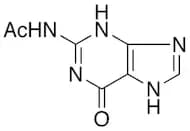
N2-Acetylguanine
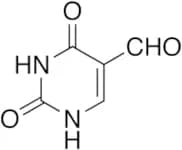
CAS:Producto controlado<p>Applications Protected guanine<br>References Tretyakova, N., et al.: Chem. Res. Toxicol., 20, 284 (2007), Rana, S., et al.: Bioorg. Med. Chem. Lett., 19, 670 (2009),<br></p>Fórmula:C7H7N5O2Forma y color:NeatPeso molecular:193.165-Formyl Uracil
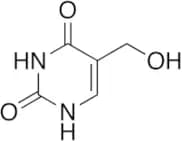
CAS:Producto controlado<p>Applications Nucleoside derivatives of 5-substituted uracil have been explored for their potential application as anti-viral agents and in the treatment of tumors.<br>References Ressner, E.C., et al.: J. Med. Chem., 19, 1, 194 (1976)<br></p>Fórmula:C5H4N2O3Forma y color:NeatPeso molecular:140.105-Hydroxymethyluracil
CAS:Producto controlado<p>Applications 5-Hydroxymethyluracil (cas# 4433-40-3) is a compound useful in organic synthesis.<br></p>Fórmula:C5H6N2O3Forma y color:NeatPeso molecular:142.11Adenine Hemisulfate
CAS:Producto controlado<p>Stability Hygroscopic<br>Applications Adenine Hemisulfate can be one of the factors that influence in vitro growth and shoot multiplication of pomegranate. It can be used in biological study along with varied levels of sucrose, light intensity, and MS medium hydrogen ion concentration where those factors can all significantly influence multiplication and growth of Punica granatum shoots.<br>References Singh, P., & Patel, R., M.: Bioscan, 9, 1031-1035 (2014)<br></p>Fórmula:C5H5N5·SO4H2Forma y color:NeatPeso molecular:368.339-(2-Propenyl)adenine
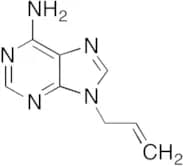
CAS:Producto controlado<p>Applications 9-(2-Propenyl)adenine is an N-substituted purine used in the preparation of mesityl dihydroisoxazolyl homo-N-nucleosides.<br>References Thalassitis, A. et al.: Bioorg. Med. Chem. Lett., 19, 6433 (2009); Chiacchio, U. et al.: Tetrahedron, 60, 441 (2004)<br></p>Fórmula:C8H9N5Forma y color:NeatPeso molecular:175.194-Thiouracil
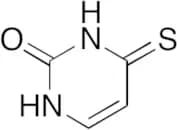
CAS:<p>Applications 4-Thiouracil is a derivative of Uracil (U801000), which is a nitrogenous base in RNA nucleic acid. 4-Thiouracil is used for tagging in cell type-specific RNA isolation from intact complex tissues.<br>References Miller, M., et al.: Nat. Methods, 6, 439 (2009); Seth, P., et al.: J. Med. Chem., 53, 8309 (2010); Cui, H., et al.: Eur. J. Med. Chem., 45, 5140 (2010);<br></p>Fórmula:C4H4N2OSForma y color:NeatPeso molecular:128.1526-Methyl-2-thiouracil
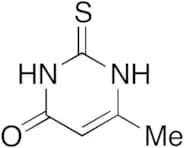
CAS:Producto controlado<p>Applications 6-Methyl-2-thiouracil is a derivative of methylthiouracil (M330710), a competitive inhibitor of Nitric Oxide Synthase (NOS). Potential anti-inflammatory agent.<br>References Palumbo, A. et al.: Biochem. Bioph. Res. Co. 282, 793(2001), Ku, S. et al.: Toxicol. App. Pharmacol., 288, 374 (2015);<br></p>Fórmula:C5H6N2OSForma y color:WhitePeso molecular:142.186-Amino-5-1,3-dimethyl-5-(formamido)uracil
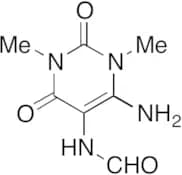
CAS:Producto controlado<p>Applications 6-Amino-5-1,3-dimethyl-5-(formamido)uracil is a substitued uracilic metabolite of methylxanthine and is also a metabolite of Theophylline (T343850). 6-Amino-5-1,3-dimethyl-5-(formamido)uracil has been used for the synthesis of 8-arylaminotheophyllines.<br>References Peri, G., et. al.: Toxicol. Lett., 18, 133 (1983); Celardo, A., et. al.: Eur. J. Drug Metab. Ph., 10, 279 (1985); Senga, K., et. al.: J. Heterocyclic Chem., 15, 641 (1978)<br></p>Fórmula:C7H10N4O3Forma y color:NeatPeso molecular:198.185,6-Dimethylthiouracil
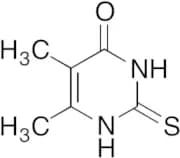
CAS:<p>Applications 5,6-Dimethylthiouracil is a heterocyclic building block.<br></p>Fórmula:C6H8N2OSForma y color:Off-WhitePeso molecular:156.215-Hydroxymethyl-2’-deoxyuridine
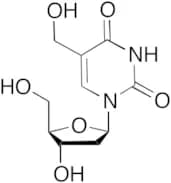
CAS:Producto controlado<p>Stability Hygroscopic<br>Applications 5-Hydroxymethyl-2’-deoxyuridine acts as a biomarker for the diagnosis for oxidative stress in humans. Used as a diagnostic to for propensitiy for the development of breast cancer.<br>References McAnulty, L. et al.: App. Physiol. Nutr. Metab., 36, 976 (2011); Djuric Z. et al.: Cancer Epidemiol. Biomarkers. Prev., 10, 147 (2001); Frenkel, K. et al.: 7, 49, (1998);<br></p>Fórmula:C10H14N2O6Forma y color:White To Off-WhitePeso molecular:258.228N2,9-Diacetylguanine
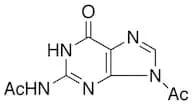
CAS:Producto controlado<p>Impurity Acicclovir EP Impurity L<br>Applications N2,9-Diacetylguanine (Acicclovir EP Impurity L) is used to synthesize acyclic analogues of deoxyguanosine.<br>References Martin, J. C., et al.: J Med Chem. 26, 759 (1983)<br></p>Fórmula:C9H9N5O3Forma y color:NeatPeso molecular:235.205-Chlorouracil
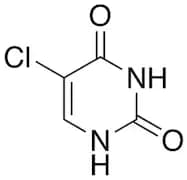
CAS:Producto controlado<p>Impurity Fluorouracil EP Impurity E<br>Applications Used for the experimental and clinical treatment of neoplastic and viral diseases. Fluorouracil EP Impurity E.<br>References Yu, H., et al.: J. Biol. Chem., 268, 15935 (1993), Staleva, L., et al.: Mutat. Res., 370, 81(1996), Harris, V., et al.: J. Mol. Biol., 326, 1389 (2003)<br></p>Fórmula:C4H3ClN2O2Forma y color:NeatPeso molecular:146.532,3’-Anhydrothymidine
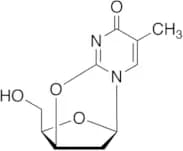
CAS:Producto controlado<p>Applications An intermediate in the preparation of thymidine derivatives<br>References el Kouni, M., et al.: Biochem. Pharmacol., 51, 1687 (1996),<br></p>Fórmula:C10H12N2O4Forma y color:NeatPeso molecular:224.216-Benzyl-2-thiouracil
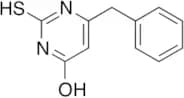
CAS:Producto controlado<p>Applications 6-Benzyl-2-thiouracil (cas# 6336-50-1) is a useful research chemical.<br></p>Fórmula:C11H10N2OSForma y color:Off-WhitePeso molecular:218.27N4-Hydroxycytosine
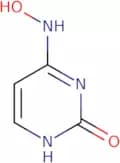
CAS:<p>N4-Hydroxycytosine is an intramolecular hydrogen that inhibits the replication of viruses by inhibiting their DNA polymerase. It is a structural analogue of cytosine and can be found in both left- and right-handed forms, which are termed isomers. The chemical study of N4-hydroxycytosine has shown it to have inhibitory effects on human immunodeficiency virus and hepatitis C virus. 13C-NMR spectroscopy has been used to identify the chemical structure of N4-hydroxycytosine and its reactivity with other molecules. N4-Hydroxycytosine can be synthesized by the reaction between formaldehyde and 2,3,5,6-tetrafluorocytosine.</p>Fórmula:C4H5N3O2Pureza:Min. 95%Forma y color:PowderPeso molecular:127.1 g/mol6-Phenyl-2-thiouracil
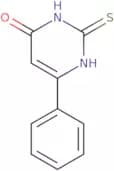
CAS:<p>6-Phenyl-2-thiouracil (6PTU) is an alkylthio group that inhibits the growth of microorganisms by binding to DNA. 6PTU binds to the oxygen nucleophiles in DNA and prevents transcription and replication. It also has a positive effect on the synthesis of proteins, which may be due to its ability to regulate gene transcription. 6PTU has been shown to inhibit cell growth in culture by blocking protein synthesis. This drug is used as an analytical method for determining urinary glucose levels in animals because it reacts with glucose in urine samples. The reaction produces a chromatographic peak that can be quantified using an electrochemical detector.</p>Fórmula:C10H8N2OSPureza:Min. 95%Forma y color:PowderPeso molecular:204.25 g/molN9-Benzyladenine
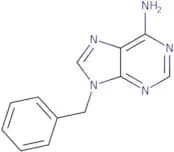
CAS:<p>N9-Benzyladenine is a drug that regulates the activity of adenosine receptors. It is an endogenous substance found in plants and animals, but can also be synthesized chemically. N9-Benzyladenine has been shown to inhibit protein synthesis by binding to cyclic nucleotide phosphodiesterases, resulting in the accumulation of cyclic AMP and activation of adenylate cyclase. This leads to an increase in intracellular cAMP levels that is mediated by Gs protein coupled receptors. N9-Benzyladenine has been shown to have anti-inflammatory properties, which may be due to its ability to inhibit the release of tumor necrosis factor-α (TNF-α).</p>Fórmula:C12H11N5Pureza:Min. 95%Forma y color:PowderPeso molecular:225.25 g/mol8-Aminopurine
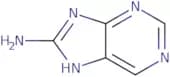
CAS:<p>8-Aminopurine is an aminopurine that is used as a research tool in magnetic resonance spectroscopy. The proton magnetic resonance spectrum of 8-aminopurine shows two characteristic peaks at 3.0 and 4.2 ppm, which are assigned to the aminopurine tautomers (3-HPA, 4-HPA). The kinetic stability of 8-aminopurine in water is pH dependent and has been shown to be strongly dependent on the presence of aldehyde oxidase (AO) activity. AO activity can be inhibited by the addition of dimethylformamide or other non-specific inhibitors such as 2,6-dichloroisonicotinic acid.</p>Fórmula:C5H5N5Pureza:Min. 95%Forma y color:White PowderPeso molecular:135.13 g/mol6-Chlorouracil
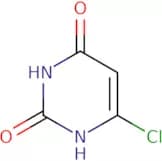
CAS:<p>Intermediate in the synthesis of alogliptin</p>Fórmula:C4H3ClN2O2Forma y color:White Slightly Yellow PowderPeso molecular:146.53 g/mol