Nucleótidos
Los nucleótidos son compuestos orgánicos que sirven como building blocks de los ácidos nucleicos, esenciales para la formación del ADN y ARN. Cada nucleótido está compuesto por una base nitrogenada, una molécula de azúcar y uno o más grupos fosfato. Estos nucleótidos se unen para formar largas cadenas, creando el material genético que lleva y transmite la información genética en todos los organismos vivos. En esta sección, encontrará una amplia variedad de nucleótidos cruciales para la investigación en genética, biología molecular y bioquímica. Son fundamentales para estudiar los procesos genéticos, sintetizar ácidos nucleicos y desarrollar herramientas diagnósticas y terapéuticas. En CymitQuimica, ofrecemos nucleótidos de alta calidad para apoyar su investigación científica y aplicaciones, asegurando precisión y fiabilidad en sus experimentos.
Subcategorías de "Nucleótidos"
Se han encontrado 2634 productos de "Nucleótidos"
Ordenar por
Pureza (%)
0
100
|
0
|
50
|
90
|
95
|
100
5-Methoxyuridine 5′-triphosphate sodium, 85mM/L aqueous solution
CAS:Please enquire for more information about 5-Methoxyuridine 5′-triphosphate sodium, 85mM/L aqueous solution including the price, delivery time and more detailed product information at the technical inquiry form on this pageFórmula:C10H17N2O16P3•NaxPureza:Min. 95%S-Adenosyl-L-methionine
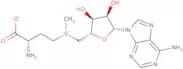
CAS:S-Adenosyl-L-methionine (SAM-e) is a co-substrate involved in methyl group transfer to nucleic acids, proteins and lipids. SAM-e is produced in the liver from adenosine triphosphate (ATP) and methionine by action of the enzyme methionine adenosyltransferase. Therapeutic use of S-adenosyl-L-methionine includes osteoarthritis, liver disease and major depressive disorder. S-Adenosyl-L-methionine is available as a dietary supplement.Fórmula:C15H22N6O5SPureza:Min. 95%Forma y color:White PowderPeso molecular:398.44 g/mol7-Deaza-7-iodoadenosine
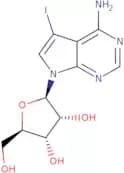
CAS:<p>7-Deaza-7-iodoadenosine is a nucleotide that has been used in experiments to assess the levels of adenosine, a dinucleotide phosphate that is involved in many cellular functions. 7-deaza-7-iodoadenosine has been shown to inhibit locomotor activity in rats and cyclase activity in 3T3-L1 preadipocytes. It also inhibits the release of inflammatory proteins from polymorphonuclear leucocytes and angiogenesis (formation of new blood vessels) in liver cells. Although this nucleotide has not been extensively studied, it has been proposed as an antiinflammatory agent because it inhibits protein synthesis and downregulates proinflammatory proteins.</p>Fórmula:C11H13IN4O4Pureza:Min. 95%Peso molecular:392.15 g/mol6-(Benzylamino)-3-methyl-1,2,3,4-tetrahydropyrimidine-2,4-dione
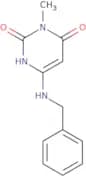
CAS:<p>6-(Benzylamino)-3-methyl-1,2,3,4-tetrahydropyrimidine-2,4-dione (BMPT) is a synthetic cytokinin that belongs to the group of 6-benzylaminopurines. BMPT is an inhibitor of cytokinin receptor kinases, as it is a benzyl uracil derivative. BMPT can be used as a building block for the synthesis of other compounds and has been used as an inhibitor of cell growth in various organisms.</p>Fórmula:C12H13N3O2Pureza:Min. 95%Peso molecular:231.25 g/molAdenosine 5′-diphosphoribose monosodium
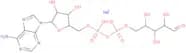
CAS:Adenosine 5′-diphosphoribose monosodium is a novel nucleotide that can be used in the synthesis of antiviral, anticancer, and anti-inflammatory drugs. Adenosine 5′-diphosphoribose monosodium is a modified form of adenosine 5′-triphosphate (ATP) with an added phosphate group at the 5′ position on the ribose sugar. It is synthesized from ATP by phosphoramidite chemistry. The CAS number for this product is 68414-18-6. Adenosine 5′-diphosphoribose monosodium has been shown to inhibit replication of human immunodeficiency virus type 1 (HIV-1) and herpes simplex virus type 1 (HSV-1).Fórmula:C15H23N5O14P2•NaPureza:Min. 95%Peso molecular:582.31 g/mol9-(2'-Deoxy-2'-fluoro-b-D-ribofuranosyl)-2-fluoroadenine
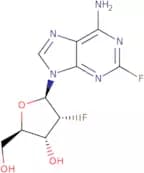
CAS:<p>9-(2'-Deoxy-2'-fluoro-b-D-ribofuranosyl)-2-fluoroadenine is a modified nucleoside that is used as an antiviral and anticancer agent. It acts as an activator for the synthesis of DNA, RNA, and protein. 9-(2'-Deoxy-2'-fluoro-b-D-ribofuranosyl)-2-fluoroadenine also inhibits the growth of cancer cells by interfering with the division process. This drug is synthesized from 9-(5'-deoxy-5'-iodo-b-D-ribofuranosyl) -2,6 difluoro adenine (diFdA). The Ribonucleosides are then prepared in a similar manner to other nucleosides by using phosphoramidites. The product is then purified using HPLC.</p>Fórmula:C10H11F2N5O3Pureza:Min. 95%Forma y color:White PowderPeso molecular:287.23 g/mol5,6-Dihydrothymidine
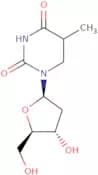
CAS:<p>5,6-Dihydrothymidine is a hydroxylated thymidine analogue. It binds to the leukocyte antigen, which is found on many different types of cells. 5,6-Dihydrothymidine inhibits the replication of herpes simplex virus and can be used for diagnostic purposes. 5,6-Dihydrothymidine has been shown to have conformational properties that are similar to those of thymine, which allows it to bind to the template strand in DNA. This binding prevents the synthesis of messenger RNA from DNA. 5,6-Dihydrothymidine is also able to inhibit cell growth in culture and can be used as a cell culture medium supplement.</p>Fórmula:C10H16N2O5Pureza:Min. 95%Forma y color:PowderPeso molecular:244.24 g/mol6-Chloro-2-iodo-9-(2',3',5'-tri-O-acetyl-b-D-ribofuranosyl)purine
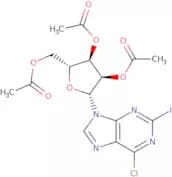
CAS:6-Chloro-2-iodo-9-(2',3',5'-tri-O-acetyl-b-D-ribofuranosyl)purine is a protected purine nucleosideFórmula:C16H16ClIN4O7Pureza:Min. 95%Peso molecular:538.68 g/mol5-Isopropyl-2'-deoxyuridine
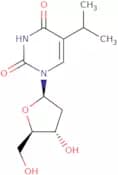
CAS:<p>5-Isopropyl-2'-deoxyuridine is a nucleoside analog that is used in the treatment of inflammatory bowel disease. It has been shown to be effective in the treatment of Crohn's disease, ulcerative colitis, and indeterminate colitis. 5-Isopropyl-2'-deoxyuridine inhibits bacterial growth by inhibiting RNA synthesis, which leads to cell death. This drug also inhibits the production of inflammatory mediators such as prostaglandins and leukotrienes that are released from cells infected with bacteria. 5-Isopropyl-2'-deoxyuridine is converted into an active form by hydrolysis or oxidation followed by phosphorylation. This drug binds to the 5' end of bacterial DNA and prevents the formation of hydrogen bonds between adjacent bases, causing strand breakage.</p>Fórmula:C12H18N2O5Pureza:Min. 95%Peso molecular:270.28 g/mol2',3'-Dideoxyadenosine-5'-triphosphate lithium
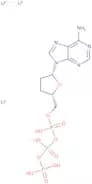
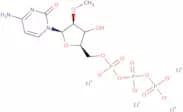
CAS:2',3'-Dideoxyadenosine-5'-triphosphate lithium salt is a nucleoside for use in research applicationsFórmula:C10H16N5O11P3•Li3Pureza:Min. 95%Forma y color:Clear liquid.Peso molecular:496 g/mol2'-O-Methylcytidine 5'-triphosphate lithium - 100mM aqueous solution
CAS:<p>2'-O-Methylcytidine 5'-triphosphate lithium is a synthetic nucleotide</p>Fórmula:C10H18N3O14P3•LixPureza:Min. 95%Forma y color:Clear LiquidPeso molecular:497.18 g/mol5-Methylcytidine
CAS:5-Methylcytidine is a methyltransferase enzyme that catalyzes the transfer of a methyl group from S-adenosylmethionine to 5-methylcytosine. This reaction is essential for DNA replication and repair. 5-Methylcytidine has been shown to be an important factor in the regulation of mitochondrial functions, as well as other cellular processes such as protein synthesis, nuclear DNA replication, and tumor suppression. It also has been shown to inhibit the replication of murine sarcoma virus and Toll-like receptor. 5-Methylcytidine can be used in chemotherapy treatment against mouse tumors and murine sarcoma virus by preventing viral RNA synthesis with monoclonal antibodies.Fórmula:C10H15N3O5Peso molecular:257.24 g/molRef: 3D-W-201877
25gA consultar50gA consultar100gA consultar250gA consultar500gA consultar-Unit-ggA consultar2′-O-Succinyladenosine 3′,5′-monophosphate
CAS:<p>Please enquire for more information about 2′-O-Succinyladenosine 3′,5′-monophosphate including the price, delivery time and more detailed product information at the technical inquiry form on this page</p>Fórmula:C14H16N5O9PPureza:Min. 95%Peso molecular:429.28 g/molCytidine 5’-phosphoromorpholidate N,N’-dicyclohexyl-4-morpholinecarboximidamide
CAS:Cytidine 5’-phosphoromorpholidate N,N’-dicyclohexyl-4-morpholinecarboximidamide is a novel cytidine phosphoramidate monophosphate that has been shown to have anticancer and antiviral properties. It can be used as a DNA nucleoside phosphoramidite in the synthesis of oligonucleotides or as an antiviral agent by inhibiting viral RNA replication. Cytidine 5’-phosphoromorpholidate N,N’-dicyclohexyl-4-morpholinecarboximidamide is chemically synthesized in high purity and quality for use in research in the field of DNA, nucleosides, and antiviral agents.Fórmula:C30H52N7O9PPureza:Min. 95%Peso molecular:685.75 g/molγ-[(6-Azidohexyl)-imido]-ATP sodium
Please enquire for more information about γ-[(6-Azidohexyl)-imido]-ATP sodium including the price, delivery time and more detailed product information at the technical inquiry form on this pageFórmula:C16H28N9O12P3•NaxPureza:Min. 95%8-Aminoguanosine
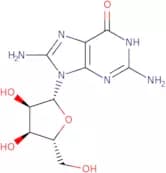
CAS:<p>8-Aminoguanosine is a synthetic purine nucleoside that inhibits DNA synthesis. It has been shown to inhibit the proliferation of HL-60 cells, which are a model for human monocytes and neutrophils. 8-Aminoguanosine has been shown to bind to the template strand of DNA and inhibit the incorporation of deoxyribonucleotide triphosphates into the newly synthesized strand. This binding prevents DNA replication by preventing access to the template strand of DNA. 8-Aminoguanosine inhibits cyclin D2, an enzyme required for cell division, at concentrations as low as 0.1 mM, and it also inhibits microtubule assembly. 8-Aminoguanosine has shown in vitro activity against various tumor cell lines including Molt-4 and MCF7 cells, and in vivo activity in a mouse model against C3H/HeJ mice transplanted with Lewis lung carcinoma cells.</p>Fórmula:C10H14N6O5Pureza:Min. 95%Forma y color:PowderPeso molecular:298.26 g/molN6-Propargyladenosine
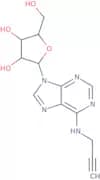
CAS:N6-Propargyladenosine is an alkyne functionalised nucleoside.Fórmula:C13H15N5O4Pureza:Min. 95%Forma y color:PowderPeso molecular:305.29 g/mol2-Deoxycytidine 3',5'-diphosphate
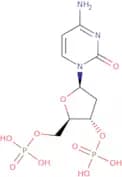
CAS:<p>2-Deoxycytidine 3',5'-diphosphate is an additive that is used in the production of DNA. It is a single-stranded nucleotide with a guanine base. 2-Deoxycytidine 3',5'-diphosphate has been shown to inhibit bacterial growth by reacting with hydrogen peroxide, which is produced during the process of oxidative phosphorylation. This reaction leads to the formation of reactive oxygen species, which damage DNA and cause cell death. The compound also binds to metal ions and prevents them from interacting with cellular components. 2-Deoxycytidine 3',5'-diphosphate can be used as a chromatographic agent for separating DNA fragments according to their size.</p>Fórmula:C9H15N3O10P2Pureza:Min. 95%Peso molecular:387.18 g/mol2',3',5'-Triacetyl -azacytidine
CAS:2',3',5'-Triacetyl-azacytidine is a transcription factor that has dose-dependent effects on the production of melanin. It inhibits the synthesis of melanin by binding to two specific transcription factors, the microphthalmia-associated transcription factor and the histone methyltransferases. This drug also inhibits tyrosinase, which is an enzyme involved in the production of melanin. 2',3',5'-Triacetyl-azacytidine has been shown to inhibit the growth of murine melanoma cells and may be useful for treating skin cancer.Fórmula:C14H18N4O8Pureza:Min. 95%Peso molecular:370.31 g/mol5′-O-DMT-LNA N-dmf guanosine
CAS:<p>5′-O-DMT-LNA N-dmf guanosine is a modified nucleoside that has anticancer, antiviral, and anti-inflammatory activities. It binds to the ribonucleotide reductase enzyme, which is an enzyme required for the production of new DNA and RNA. This binding prevents the synthesis of new DNA and RNA in cells, leading to cell death. 5′-O-DMT-LNA N-dmf guanosine has been shown to be active against cancer cells in vitro and in vivo. In addition, it also inhibits replication of human immunodeficiency virus type 1 (HIV) by binding to reverse transcriptase (RT), which is an enzyme critical for HIV replication.</p>Fórmula:C35H36N6O7Pureza:Min. 95%Peso molecular:652.7 g/mol





![γ-[(6-Azidohexyl)-imido]-ATP sodium](/_next/image/?url=https%3A%2Fstatic.cymitquimica.com%2Fproducts%2F3D%2Fthumb-webp%2FNA183120.webp&w=3840&q=75)