


Nucleósidos
Se han encontrado 3570 productos de "Nucleósidos"
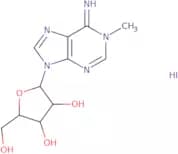
N1-Methyladenosine hydroiodide
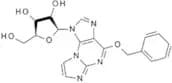
CAS:N1-Methyladenosine hydroiodide is a novel nucleoside analogue that inhibits viral replication by preventing the formation of viral DNA. It also inhibits the growth of cancer cells and is used as an anticancer drug. N1-Methyladenosine hydroiodide has been shown to be an activator of RNA polymerase II, increasing the production of messenger RNA (mRNA) in human cells. The phosphoramidite form of this compound is used for the synthesis of oligodeoxyribonucleotides, which are chemically modified in order to improve their stability and inhibit degradation by nucleases. N1-Methyladenosine hydroiodide is highly pure and has CAS No. 34308-25-3.Fórmula:C11H15N5O4·HIPureza:Min. 95%Peso molecular:409.18 g/molO6-Benzyl-N2,3-etheno guanosine
CAS:O6-Benzyl-N2,3-etheno guanosine is a phosphoramidite that can be used in the synthesis of DNA. It is a novel nucleoside analog with antiviral and anticancer properties. O6-Benzyl-N2,3-etheno guanosine has been shown to increase the antitumor activity of cisplatin in vitro and in vivo, as well as its ability to inhibit human immunodeficiency virus type 1 (HIV-1) replication. This compound also inhibits the replication of herpes simplex virus type 2 (HSV-2) without affecting the expression of cellular proteins. O6-Benzylguanosine is synthesized by reacting N2,3-ethenoguanosine with benzaldehyde in dichloromethane under microwave irradiation.Fórmula:C19H19N5O5Pureza:Min. 95%Peso molecular:397.38 g/mol2'-O-tert-Butyldimethylsilyl-5'-O-DMT-N6-methyladenosine 3'-CE phosphoramidite
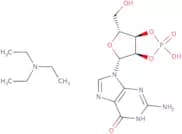
2'-O-tert-Butyldimethylsilyl-5'-O-DMT-N6-methyladenosine 3'-CE phosphoramidite is a novel, synthetic phosphoramidite that is used as an activating group for the synthesis of DNA. This nucleoside has antiviral and anticancer properties. It is also a ribonucleoside that has been modified to include a tertiary butyl dimethyl silyl group and an N6 methyl adenosine moiety.Fórmula:C47H64N7O7PSiPureza:Min. 95%Forma y color:White to off-white solid.Peso molecular:898.11 g/molGuanosine 2',3'-cyclic phosphate triethylamine salt
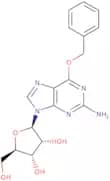
CAS:Guanosine 2',3'-cyclic phosphate triethylamine salt is a synthetic nucleoside that has antiviral and anticancer activity. It is a modified nucleoside with a cyclic phosphate group attached to the 2' position of the sugar ring. This modification prevents hydrolysis of the nucleotide by phosphodiesterases, which are enzymes that break down RNA and DNA. Guanosine 2',3'-cyclic phosphate triethylamine salt has been shown to be active against HIV-1, herpes simplex virus type 1 (HSV-1), HSV-2, and cytomegalovirus (CMV). It also inhibits the proliferation of various cancer cell lines including those from breast, prostate, lung, colon, and leukemia.Fórmula:C16H27N6O7PPureza:Min. 95%Peso molecular:446.4 g/molO6-Benzyl guanosine
CAS:O6-Benzyl guanosine is a polymerized compound that has been shown to have anticancer efficacy. It has been tested in mice with medulloblastoma, a type of brain tumor, and in rats with breast cancer. O6-Benzyl guanosine was found to be hydrophobic and bound to the methyltransferase enzyme, which resulted in the inhibition of DNA synthesis. The polymerized compound is able to form conjugates with other molecules such as iron oxide nanoparticles or hydrazone derivatives, which can be used for treatments that involve bioconjugate chemistry.Fórmula:C17H19N5O5Pureza:Min. 95%Peso molecular:373.36 g/molN4-Benzoyl-5'-O-DMT-2'-O-(2-methoxyethyl)cytidine
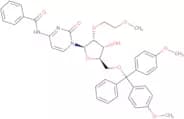
CAS:N4-Benzoyl-5'-O-DMT-2'-O-(2-methoxyethyl)cytidine is a novel ribonucleotide that has been shown to inhibit the growth of cancer cells. It has been synthesized in high purity and quality, with a high phosphoramidite content, and is available in various quantities. This product is an activator of DNA polymerase and can be used as a monophosphate or diphosphate precursor for nucleic acid synthesis. It has antiviral properties, and may be useful in the treatment of HIV infection.Fórmula:C40H41N3O9Pureza:Min. 95%Forma y color:White Off-White PowderPeso molecular:707.77 g/mol5-Chloro-2',3'-O-isopropylidenecytidine
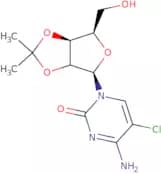
5-Chloro-2',3'-O-isopropylidenecytidine is a synthetic nucleoside that is activated by phosphorylation to form the corresponding nucleotide. It has antiviral and anticancer properties, and can be used as a building block for synthesis of other nucleosides. 5-Chloro-2',3'-O-isopropylidenecytidine is synthesized from 2,4-dichlorophenoxyacetic acid (DCA) and 2,5-dichloroaniline in the presence of sodium cyanide. The compound was first synthesized in 1972 and its chemical structure was determined in 1974. 5-Chloro-2',3'-O-isopropylidenecytidine has been shown to inhibit DNA synthesis by binding to viral diphosphate and deoxyribonucleosides. This compound also inhibits the activity of bacterial DNA gyrase and DNA top
Fórmula:C12H16ClN3O5Pureza:Min. 95%Peso molecular:317.73 g/mol8-(2-Amino-1-methyl-D3-6-phenylimidazo[4,5-b]pyridyl-2'-deoxyguanosine
CAS:Producto controlado8-(2-Amino-1-methyl-D3-6-phenylimidazo[4,5-b]pyridyl-2'-deoxyguanosine) is a modified nucleoside that is used as an antiviral agent. It is not active against DNA viruses but has been shown to inhibit the replication of RNA viruses such as human immunodeficiency virus type 1 (HIV). 8-(2-Amino-1-methyl-D3-6-phenylimidazo[4,5-b]pyridyl)-2'-deoxyguanosine has been found to be more effective than acyclovir (Zovirax), a commonly used antiviral drug. This nucleoside also has anticancer properties, which may be due to its ability to inhibit the synthesis of DNA and RNA.Fórmula:C23H20D3N9O4Pureza:Min. 95%Peso molecular:492.5 g/molOctanoyl coenzyme A potassium salt
CAS:Octanoyl CoA is a molecule that belongs to the class of acyl-coenzyme A. It is an important intermediate in fatty acid metabolism and is also used in the synthesis of long-chain fatty acids. Octanoyl CoA can be converted back to acetyl-CoA by enzymes called synthetases, which are active in energy metabolism. Octanoyl CoA has been shown to have clinical relevance for diseases such as acyl chain disorders, carnitine deficiency, and dehydrogenase deficiency. Octanoyl CoA is a potential drug target since it can be converted into octanoic acid, which has been shown to inhibit enzyme activities and protein synthesis.
Fórmula:C29H47N7O17P3S·3KPureza:Min. 95%Forma y color:PowderPeso molecular:1,008 g/mol8-(2-Amino-1-methyl-6-phenylimidazo[4,5-b]pyridyl)-2'-deoxyguanosine
CAS:8-(2-Amino-1-methyl-6-phenylimidazo[4,5-b]pyridyl)-2'-deoxyguanosine (8-APdG) is a mutagen that induces genotoxic effects and mutations in mammalian cells. It has been shown to react with DNA to form covalent complexes and induce point mutations or transversions. 8-APdG has been found in the environment as a result of environmental pollution by polycyclic aromatic hydrocarbons and tobacco smoke. 8-APdG also induces genetic damage in human lymphoblastoid cells in vitro, including mutations at the HPRT locus.Fórmula:C23H23N9O4Pureza:Min. 95%Peso molecular:489.49 g/molDecanoyl coenzyme A, free acid
CAS:Decanoyl CoA, free acid, is a substrate of the enzyme fatty acid synthetase. This enzyme catalyzes the formation of long-chain fatty acids from acetyl-CoA and malonyl-CoA. The product decanoyl-CoA is then used in other metabolic pathways to synthesize acyl chains for phospholipids, triglycerides, and cholesterol. Decanoyl CoA has been shown to inhibit carnitine acyltransferase activity in rat liver microsomes. It also inhibits mitochondrial beta-oxidation by competing with carnitine at the level of the carnitine acyltransferase reaction. The expression plasmid pET21a was used to express the decanoyl CoA synthetase protein in Escherichia coli cells grown in LB medium with aminotransferase activity as a measure of decanoyl CoA synthetase activity. Decanoyl CoAFórmula:C31H54N7O17P3SPureza:Min. 95%Peso molecular:921.78 g/molFluorous propanol cep
CAS:Producto controladoFluorous propanol cep is a novel activator of ribonucleosides and deoxyribonucleosides. It is a nucleoside phosphoramidite that can be used to synthesize modified nucleosides, and has anticancer, antiviral and antibacterial properties. Fluorous propanol cep is an excellent activator for the synthesis of ribonuclesides and deoxyribonucleosides from their corresponding monophosphate derivatives. The product has been shown to inhibit replication of the human immunodeficiency virus (HIV-1) in vitro, with IC50 values less than 1 mM.
Fórmula:C20H24F17N2O2PPureza:Min. 95%Peso molecular:678.4 g/molT-705RTP sodium
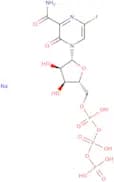
CAS:T-705RTP sodium is a novel, modified diphosphate nucleotide that activates the formation of DNA and RNA. It is used as an antiviral and anticancer agent. T-705RTP sodium has been shown to be more potent than adenosine in inhibiting viral replication and has cytotoxic effects on cancer cells. The chemical formula for T-705RTP sodium is C6H14N5O7P.Fórmula:C10H15FN3O15P3·xNaPureza:Min. 95%2'-Azido-2'-deoxyuridine-5'-triphosphate
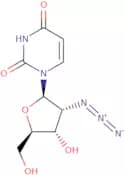
CAS:2'-Azido-2'-deoxyuridine-5'-triphosphate is a nucleotide analog that is inactive in the presence of an intact receptor. It is an allosteric inhibitor of many DNA polymerases and causes cell growth inhibition. 2'-Azido-2'-deoxyuridine-5'-triphosphate binds to the phosphate group of ATP and inhibits protein synthesis. In particular, it inhibits the polymerase activity of herpes simplex virus type 1 by binding to the active site of the enzyme, thereby preventing viral replication. 2'-Azido-2'-deoxyuridine-5'-triphosphate also binds to cytosolic Ca2+ and activates Ca2+ signaling pathways, leading to cell death.Fórmula:C9H14N5O14P3Pureza:Min. 95%Peso molecular:509.15 g/mol9-(b-D-Arabinofuranosyl)adenine 5'-triphosphate triethyammonium salt
9-(B-D-arabinofuranosyl)adenine 5'-triphosphate triethyammonium salt is a nucleoside analog that inhibits viral replication by inhibiting the DNA polymerase enzyme. It has been shown to be safe and well tolerated in healthy volunteers and patients with cancer, including those with advanced solid tumors. 9-(B-D-arabinofuranosyl)adenine 5'-triphosphate triethyammonium salt is an antiviral agent that has been shown to be active against HIV, herpes simplex virus type 1, herpes simplex virus type 2, cytomegalovirus, and varicella zoster virus. This compound also has anticancer properties and has been shown to inhibit tumor cell proliferation in vitro.Pureza:Min. 95%Cholest-5-en-3-ol, 3-(6-(((2-cyanoethoxy)(diisopropylamino)phosphino)oxy)hexyl)carbemate
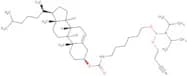
CAS:Cholest-5-en-3-ol, 3-(6-(((2-cyanoethoxy)(diisopropylamino)phosphino)oxy)hexyl)carbemate, is a novel nucleotide analog that has antiviral and anticancer properties. It is synthesized by the reaction of 2,4,6-trihydroxyacetophenone with 6-(chlorohexyl)-1,3-bis(2-(cyanoethoxy)phosphinooxy)hexane in the presence of tetrakis(triphenylphosphine), palladium chloride, and potassium carbonate. Cholest-5-en-3-ol, 3-(6((2-(cyanoethoxy)(diisopropylamino))(phosphino)oxy)(hexyl))carbamate may be used as a monophosphate or phosphoramidite to make DNA or RNA. This compound has been shown toPureza:Min. 95%2-Cyanoadenosine
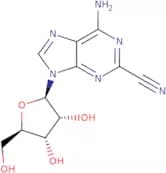
CAS:2-Cyanoadenosine is a derivative of adenosine. It is an inhibitor of the enzyme adenosine deaminase, which converts adenosine to inosine. 2-Cyanoadenosine prevents the conversion of ATP to AMP and may be useful for treating neurological disorders. 2-Cyanoadenosine has been shown to have cardiovascular effects, such as increasing the force of contraction and relaxation in isolated rat hearts.Pureza:Min. 95%2'-TFA-NH-dC
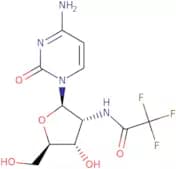
CAS:2'-TFA-NH-dC is a novel nucleoside analogue that has been modified to have antiviral and anticancer properties. The chemical structure of 2'-TFA-NH-dC closely resembles dC, which is a natural DNA nucleotide, but with the addition of an extra fluorine atom at the 2' position. This modification increases the potency of 2'-TFA-NH-dC by making it more difficult for enzymes in cells to break down the drug. The compound can be used as a monophosphate or diphosphate, and is synthesized from 2'-deoxyadenosine 5'-phosphoramidite and 1,2,4-triazole in water.Fórmula:C11H13F3N4O5Pureza:Min. 95%Peso molecular:338.24 g/mol4-(Isobutylamino)-2-(Methylthio)Pyrimidine-5-Carboxylic Acid
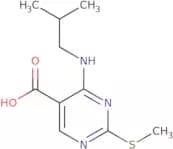
CAS:4-(Isobutylamino)-2-(Methylthio)Pyrimidine-5-Carboxylic Acid is a nucleoside analogue that inhibits viral replication by acting as an antiviral agent. It blocks the enzymatic activity of DNA polymerases, including reverse transcriptase, and prevents the synthesis of new viral DNA. 4-(Isobutylamino)-2-(Methylthio)Pyrimidine-5-Carboxylic Acid is also an activator for HIV integrase, which is an enzyme that integrates HIV DNA into the host genome. This compound has been shown to be effective against HIV and herpes viruses in vitro.Fórmula:C10H15N3O2SPureza:Min. 95%Peso molecular:241.31 g/mol4-Chloro-7-(2-C-methyl-b-D-ribofuranosyl)-7H-pyrrolo[2,3-d]pyrimidine
CAS:4-Chloro-7-(2-C-methyl-b-D-ribofuranosyl)-7H-pyrrolo[2,3-d]pyrimidine is a novel anticancer compound that inhibits the synthesis of DNA, RNA and protein. It is a phosphoramidite monophosphate that can be used in the synthesis of oligonucleotides and DNA. 4CHP is effective against Herpes simplex virus type 1 (HSV1) and cytomegalovirus (CMV). 4CHP also has antiviral activity against influenza A virus.Fórmula:C12H14ClN3O4Pureza:Min. 95%Peso molecular:299.71 g/mol


![8-(2-Amino-1-methyl-D3-6-phenylimidazo[4,5-b]pyridyl-2'-deoxyguanosine](/_next/image/?url=https%3A%2Fstatic.cymitquimica.com%2Fproducts%2F3D%2Fthumb-webp%2FNA05715.webp&w=3840&q=75)
![8-(2-Amino-1-methyl-6-phenylimidazo[4,5-b]pyridyl)-2'-deoxyguanosine](/_next/image/?url=https%3A%2Fstatic.cymitquimica.com%2Fproducts%2F3D%2Fthumb-webp%2FNA04649.webp&w=3840&q=75)


![4-Chloro-7-(2-C-methyl-b-D-ribofuranosyl)-7H-pyrrolo[2,3-d]pyrimidine](/_next/image/?url=https%3A%2Fstatic.cymitquimica.com%2Fproducts%2F3D%2Fthumb-webp%2FNC14084.webp&w=3840&q=75)