Nucleósidos
Se han encontrado 3570 productos de "Nucleósidos"
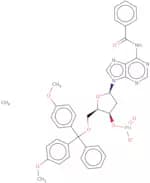
N6-Benzoyl-2'-deoxy-5-O-DMT-adenosine 3'-phosphonate triethylammonium salt
CAS:N6-Benzoyl-2'-deoxy-5-O-DMT-adenosine 3'-phosphonate triethylammonium salt is a potent antiviral agent that has been shown to inhibit the replication of DNA. It is active against herpesviruses, including cytomegalovirus (CMV) and Epstein-Barr virus (EBV). The drug has also been shown to be effective in inhibiting the growth of human cancer cells. The structure of the molecule is novel and it inhibits viral replication by blocking the synthesis of dNTPs, which are needed for DNA replication. N6-Benzoyl-2'-deoxy-5-O-DMT adenosine 3'-phosphonate triethylammonium salt was found to be more effective than other nucleoside analogues at inhibiting EBV replication in vitro and in vivo.Fórmula:C38H35N5O8P·C6H16NPureza:Min. 95%Peso molecular:822.89 g/molCholesteryl-TEG Phosphoramidite
CAS:Cholesteryl-TEG Phosphoramidite is a phosphoramidite that is used in the synthesis of DNA. It is also known as cholesterol-1,2,3,4,5-pentaethyleneglutamate phosphoramidite. Cholesteryl-TEG Phosphoramidite has been shown to have antiviral and anticancer activity. The novel properties of this compound make it an interesting candidate for further study. This chemical is synthesized by reacting cholesteryl chloride with triethylene glycol monophosphate. It is also a modified nucleoside that contains a deoxyribonucleoside and an activated ribonucleoside.
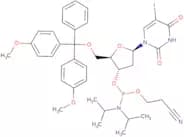
Fórmula:C70H106N3O11PPureza:Min. 95%Peso molecular:1,196.6 g/mol2'-Deoxy-5'-O-DMT-5-iodouridine 3'-CE phosphoramidite
CAS:2'-Deoxy-5'-O-DMT-5-iodouridine 3'-CE phosphoramidite is a synthetic nucleoside that has shown anticancer and antiviral properties. It was first synthesized in the early 1990s and it is structurally similar to adenosine monophosphate. The synthesis of this compound starts with 5-iodo-2'-deoxyuridine, which reacts with the 5'-O-dimethoxytrityl group to form 2'-deoxy-5'-O-DMT-5-iodouridine 3'-CE phosphoramidite. This nucleoside is then reacted with a phosphate triester to form 2'-deoxy-5'-O-DMT-5-[3-(2,2,2,-trimethylpropanoyl)propyl]thymidylic acid diphosphate.Fórmula:C39H46IN4O8PPureza:Min. 95%Forma y color:White To Off-White SolidPeso molecular:856.7 g/mol4-Amino-7H-pyrrolo[2,3-d]pyrimidine hydrogen sulfate
CAS:4-Amino-7H-pyrrolo[2,3-d]pyrimidine hydrogen sulfate is a rearrangement product of furoxan and a potential intermediate in the biosynthesis of carboxyl compounds. It is also an hypotensive agent that was found to be effective in lowering blood pressure and lowering lipid levels. 4-Amino-7H-pyrrolo[2,3-d]pyrimidine hydrogen sulfate has been shown to have chlorine and peracetic acid reactivity. The compound can be used as a reagent for the synthesis of carboxylic acid derivatives by reacting with arylhydrazones, such as 1,1'-carbonyldiimidazole or 3,4-dimethoxybenzoylhydrazone. 4-Amino-7H-pyrrolo[2,3-d]pyrimidine hydrogen sulfate can alsoPureza:Min. 95%5-Chloro-5'-deoxy-5'-iodo-2',3'-O-isopropylideneuridine
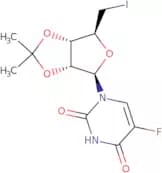
CAS:5-Chloro-5'-deoxy-5'-iodo-2',3'-O-isopropylideneuridine is a synthetic nucleoside analogue. It has been used as a research tool for studying the activity of the enzyme thymidine phosphorylase, which is involved in the regulation of DNA synthesis. 5-Chloro-5'-deoxy-5'-iodo-2',3'-O-isopropylideneuridine was synthesized by condensing 1,6-dichlorobenzene with 2,3,4,6-tetraiodopyrimidine in the presence of potassium carbonate and zinc chloride. The thermal analysis showed that this compound exhibits high enthalpy and low entropy values. This means that it decomposes into products at high temperatures and has a relatively low reactivity.Fórmula:C12H14ClIN2O5Pureza:Min. 95%Peso molecular:428.61 g/mol5-Azido- 2'- deoxycytidine
CAS:5-Azido-2'-deoxycytidine is a high purity, novel, modified, and synthesized nucleoside with anticancer and antiviral properties. It is a diphosphate that is used in the synthesis of DNA as an activator. 5-Azido-2'-deoxycytidine has been shown to inhibit the growth of cancer cells and to be active against influenza virus.Fórmula:C9H12N6O4Pureza:Min. 95%Peso molecular:268.23 g/mol5'-O-DMT-thymidine phosphoramidite dimer
5'-O-DMT-thymidine phosphoramidite dimer is a novel, synthetic nucleoside that can be used for the treatment of cancers. It is an antiviral and antibacterial agent that has been shown to have cytotoxic effects against cancer cells. 5'-O-DMT-thymidine phosphoramidite dimer is not active against bacteria or viruses that are resistant to other nucleoside analogues. This compound inhibits DNA synthesis by inhibiting the activity of DNA polymerase, which is required for the replication of DNA. The chemical structure of 5'-O-DMT-thymidine phosphoramidite dimer resembles thymidine monophosphate, but it has a different sugar group at the 5' position and contains two phosphate groups at the 3' position.Pureza:Min. 95%2'-Deoxy-N2,N8-di-DMF-5'-O-DMT-guanosine 3'-CE phosphoramidite
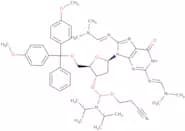
CAS:2'-Deoxy-N2,N8-di-DMF-5'-O-DMT-guanosine 3'-CE phosphoramidite is a novel nucleoside that has shown anticancer activity. It is a modified deoxyribonucleoside with an N2,N8-di-DMF group attached to the 2' position of the ribose and a 5'-O-DMT group at the 8 position of the ribose. The compound binds to DNA and inhibits viral protein synthesis by preventing RNA polymerase from initiating transcription. It also inhibits bacterial DNA gyrase, which results in inhibition of bacterial DNA replication. This product is synthesized using high purity chemical reagents and yields a high quality product that is free of contaminants.Fórmula:C46H59N10O7PPureza:Min. 95%Peso molecular:895.02 g/mol3',5'-Diamino-3',5'-dideoxy-5'-Fmoc-thymidine hydrochloride
3',5'-Diamino-3',5'-dideoxy-5'-Fmoc-thymidine hydrochloride is a nucleoside that belongs to the class of diphosphates. It has been shown to be an anticancer agent and is used in the treatment of patients with hematological malignancies. 3',5'-Diamino-3',5'-dideoxy-5'-Fmoc-thymidine hydrochloride is synthesized from 5'-deoxyuridine monophosphate and amidites, which are modified phosphoramidites. This compound can be used as a building block for DNA synthesis by incorporating into a growing chain, or as an activator for DNA polymerases. 3',5'-Diamino-3',5'-dideoxy-5'-Fmoc-thymidine hydrochloride has been shown to induce apoptosis, or programmed cell death, in cancer cells.Pureza:Min. 95%3'-O-Methyluridine-5'-triphosphate lithium salt - 100 mM in water
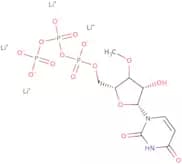
CAS:3'-O-Methyluridine-5'-triphosphate lithium salt is a nucleoside that inhibits viral replication and tumor growth. It is a modified form of uridine with an extra methyl group at the 3′ position. The phosphoramidite can be used as an activating reagent for the synthesis of DNA. 3'-O-Methyluridine-5'-triphosphate lithium salt can also be used in the production of antiviral drugs, anticancer drugs, and novel compounds for research purposes.Fórmula:C10H13N2O15P3Li4Pureza:Min. 98 Area-%Forma y color:Clear LiquidPeso molecular:521.9 g/mol8-(4-Chlorophenylthio)guanosine 3',5'-cyclic monophosphate sodium salt
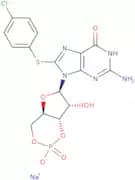
CAS:8-(4-Chlorophenylthio)guanosine 3',5'-cyclic monophosphate sodium salt (8CPTcGMP) is a fluorescent compound that is used to study the localization of proteins in living cells. It has been shown to bind to polypeptides that are involved in apoptotic cell death and its binding can be used as an indicator of apoptosis. 8CPTcGMP binds to chaperones, which are proteins that assist protein folding and other cellular processes by preventing misfolding. Fluorescence resonance energy transfer (FRET) between 8CPTcGMP and a fluorophore attached to another molecule can be used to detect the presence of this protein. The genetic code for 8CPTcGMP is ACACTCA.Fórmula:C16H14ClN5O7PS·NaPureza:Min. 95%Peso molecular:509.79 g/mol5-Fluorescein dT phosphoramidite
5-Fluorescein dT phosphoramidite is a novel modified nucleoside that has antiviral, activator, and anticancer properties. It is an analog of fluorouracil with a 5-fluorescein group at the 5' position. This phosphoramidite is synthesized from 2',3'-dideoxyuridine 5'-triphosphate and fluorescein diphosphate. It can be used to bind to DNA and inhibit viral replication. Other anticancer effects may be due to its ability to activate DNA synthesis by binding to deoxyribonucleosides or ribonucleosides in DNA. 5-Fluorescein dT phosphoramidite has high purity and quality, making it suitable for use in nucleotide sequencing, mutagenesis studies, and other applications requiring high purity nucleosides.Pureza:Min. 95%N6-Benzoyl-2'-deoxy-5'-O-DMT-adenosine 3'-succinyl CPG 1400 Å
N6-Benzoyl-2'-deoxy-5'-O-DMT-adenosine 3'-succinyl CPG 1400 Å is a nucleoside that has antiviral activity. It is the monophosphate, ribonucleoside, and diphosphate analog of adenosine. The novel analog N6-benzoyl-2'-deoxy-5'-O-DMT-adenosine 3'-succinyl CPG 1400 Å has been shown to be an effective anticancer drug and also to activate gene expression in cultured cells. This nucleoside can be used in the synthesis of DNA, as well as phosphoramidites for chemical synthesis of deoxyribonucleic acid (DNA).
Pureza:Min. 95%Forma y color:PowderN4-Acetyl-2'-deoxy-5'-O-DMT-5-iodocytidine
CAS:N4-Acetyl-2'-deoxy-5'-O-DMT-5-iodocytidine is a synthetic nucleoside that has antiviral and anticancer properties. It is an activator of deoxyribonucleosides and can be used to synthesize DNA, RNA, or other modified nucleosides. This compound is modified with acetyl groups at the 2' position and 5' position of the ribose sugar to increase its stability in biological systems. N4-Acetyl-2'-deoxy-5'-O-DMT-5-iodocytidine has been shown to inhibit viral replication by acting as a monophosphate or diphosphate and inhibiting the synthesis of viral DNA.Fórmula:C32H32IN3O7Pureza:Min. 95%Peso molecular:697.52 g/molN6-Benzoyl-3'-O-tert-butyldimethylsilyl-2'-methyladenosine
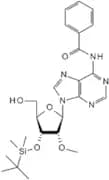
CAS:N6-Benzoyl-3'-O-tert-butyldimethylsilyl-2'-methyladenosine is a nucleoside analog. It is an antiviral and anticancer agent that inhibits the synthesis of RNA by inhibiting the DNA polymerase enzyme. N6-Benzoyl-3'-O-tert-butyldimethylsilyl-2'-methyladenosine has been shown to be active against both DNA and RNA viruses, including herpesviruses. It has also been shown to have anti-inflammatory effects.Fórmula:C24H33N5O5SiPureza:Min. 95%Forma y color:PowderPeso molecular:499.64 g/molN4-Benzoyl-3'-O-tert-butyldimethylsilyl-2'-O-(2-methoxyethyl)-5-methylcytidine
N4-Benzoyl-3'-O-tert-butyldimethylsilyl-2'-O-(2-methoxyethyl)-5-methylcytidine is an antiviral nucleoside that is a phosphoramidite. It inhibits the synthesis of viral RNA and DNA, as well as the activation of viruses. N4-Benzoyl-3'-O-tert-butyldimethylsilyl-2'-O-(2-methoxyethyl)-5 methylcytidine is a novel nucleoside analog with anticancer activity and good solubility in organic solvents. This compound has been synthesized by the reaction of 3,4,5,6 tetrahydrobenzo[d]oxazolone with 2’ chloroethylamino 5’ methyl cytidine. The purity of this compound is very high (>98%). The CAS number for this compound is 10Pureza:Min. 95%5’-O-(4-Cyanobenzyl)-2’,3’-di-O-isopropylideneadenosine
CAS:5’-O-(4-Cyanobenzyl)-2’,3’-di-O-isopropylideneadenosine is a monophosphate nucleoside. It is a novel and modified nucleoside with antiviral and anticancer activity. 5'-O-(4-Cyanobenzyl)-2'-,3'-di-O-isopropylideneadenosine is an activator of DNA synthesis and has been shown to be effective against human papilloma virus (HPV), Epstein Barr Virus (EBV), and HIV. This compound also has high purity, CAS No. 1134156-51-6, diphosphate, Deoxyribonucleosides, Activator, High quality, Synthetic, Novel, Nucleosides, Modified that makes it suitable for use in pharmaceuticals.Pureza:Min. 95%5'-O-DMT-thymidine-3'-succinyl CPG 1400 Å
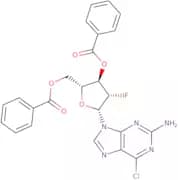
5'-O-DMT-thymidine-3'-succinyl CPG 1400 Å is a nucleoside analog that has been shown to be an effective anticancer agent. It has been shown to activate the cellular DNA synthesis by stimulating the phosphorylation of RNA polymerase II, which is involved in the transcription of DNA. 5'-O-DMT-thymidine-3'-succinyl CPG 1400 Å also inhibits viral replication and may be effective against AIDS. This nucleoside analog induces antiviral effects by inhibiting the synthesis of viral dsDNA.Pureza:Min. 95%2-Amino-6-chloro-9-(2-deoxy-3,5-di-O-benzoyl-2-fluoro-b-D-arabinofuranosyl)purine
CAS:2-Amino-6-chloro-9-(2-deoxy-3,5-di-O-benzoyl-2-fluoro-b-D-arabinofuranosyl)purine is a novel modified nucleoside with antiviral activity. It has been shown to inhibit the replication of the influenza A virus in cell culture and animal models. 2′Amino-6′chloro 9-(2′deoxy 3′,5′di O′benzoyl 2′fluoro b D arabinofuranosyl)purine is an analog of adenosine that has shown anticancer activity in vitro and in vivo. It inhibits DNA synthesis by inhibiting deoxyribonucleotide synthesis and ribonucleotide synthesis. This drug also inhibits cell proliferation and induces apoptosis.Fórmula:C24H19ClFN5O5Pureza:Min. 95%Peso molecular:511.89 g/molXTT, sodium salt
CAS:XTT is a tetrazolium compound that can be used to measure the activity of enzymes. It has been shown to inhibit the growth of tumor cells in vitro and in vivo. XTT can also be used as an antibacterial agent against C. glabrata and as an anthelmintic drug against tapeworms. This compound is not active against other bacteria, such as E. coli or S. aureus, because they are resistant to oxidative injury and have high levels of ABCG2 (ATP-binding cassette G2), which prevents intracellular accumulation of XTT.Fórmula:C22H16N7NaO13S2Peso molecular:673.53 g/molRef: 3D-X-5000
-Unit-ggA consultar1gA consultar100mgA consultar250mgA consultar500mgA consultar2500mgA consultar


![4-Amino-7H-pyrrolo[2,3-d]pyrimidine hydrogen sulfate](/_next/image/?url=https%3A%2Fstatic.cymitquimica.com%2Fproducts%2F3D%2Fthumb-webp%2FNA44317.webp&w=3840&q=75)