Nucleósidos
Los nucleósidos son building blocks fundamentales de los ácidos nucleicos, compuestos por una base nitrogenada unida a una molécula de azúcar. En esta sección, puede encontrar una amplia variedad de nucleósidos esenciales para la investigación en biología molecular, bioquímica y farmacología. Estos compuestos juegan roles cruciales en la síntesis de ADN y ARN, y son vitales en varios procesos metabólicos. Los nucleósidos se utilizan para estudiar material genético, desarrollar terapias antivirales y anticancerígenas, y comprender los mecanismos celulares. En CymitQuimica, proporcionamos nucleósidos de alta calidad para apoyar sus necesidades de investigación y desarrollo, asegurando pureza y fiabilidad para sus aplicaciones experimentales.
Se han encontrado 3569 productos de "Nucleósidos"
Ordenar por
Pureza (%)
0
100
|
0
|
50
|
90
|
95
|
100
N6-Benzoyl-2'-deoxy-5'-O-DMT-adenosine 3'-Rp-oxazaphospholidine
N6-Benzoyl-2'-deoxy-5'-O-DMT-adenosine 3'-Rp-oxazaphospholidine is an activator of DNA polymerase. It has been shown to be a potent inhibitor of viral replication and an anticancer agent in vitro. The compound has also been shown to inhibit the growth of tumor cells in vivo. N6-Benzoyl-2'-deoxy-5'-O-DMT-adenosine 3'-Rp-oxazaphospholidine is a novel nucleoside analogue that has not been previously reported.Pureza:Min. 95%5'-O-Benzoyl-2'-deoxyuridine
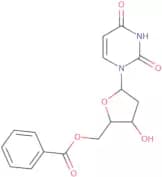
CAS:5'-O-Benzoyl-2'-deoxyuridine is a synthetic nucleoside that is a component of DNA. 5'-O-Benzoyl-2'-deoxyuridine is used as an antiviral agent and for the treatment of some cancers, including lymphomas, leukemia, and certain types of solid tumors. It has also been shown to be effective in the treatment of hepatitis B virus infection. This compound inhibits viral replication by competing with natural nucleosides for incorporation into DNA and RNA. 5'-O-Benzoyl-2'-deoxyuridine binds to double helix DNA at the groove between adenine and thymine bases and prevents further binding of nucleotides to this site. It also inhibits viral DNA synthesis by preventing conversion of ribonucleotides to deoxynucleosides. This drug is not active against bacteria or fungi; however, it can cause serious side effects such as pancreatitis and liver toxicity.Fórmula:C16H16N2O6Pureza:Min. 95%Peso molecular:332.32 g/molN4-Benzoyl-5'-O-DMT-2'-O-(2-methoxyethyl)cytidine 3'-CE phosphoramidite
Nucleoside phosphoramidite used in oligonucleotide synthesisFórmula:C49H58N5O10PPureza:Min. 95%Peso molecular:907.99 g/mol2-(Aminomethyl)pyrimidine oxalate
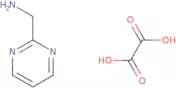
CAS:<p>2-(Aminomethyl)pyrimidine oxalate is a substance that can be found in cicer arietinum. This compound has been shown to be tumorigenic, and it is hypothesized that the tumorigenicity of this compound is due to its ability to recombine with DNA and expressed genes, which may lead to the development of tumors. 2-(Aminomethyl)pyrimidine oxalate has been shown to activate translation of genes that are involved in tumorigenesis. The gene product which has been identified as being activated by 2-(aminomethyl)pyrimidine oxalate is called rhizogenes. Rhizogenes have been shown to have virulent phenotypes when exposed to cicer arietinum. With all these properties, it is believed that 2-(aminomethyl)pyrimidine oxalate may cause cancer or other harmful effects on organisms.br><br>br></p>Fórmula:C5H7N3·C2H2O4Pureza:Min. 95%Peso molecular:199.16 g/mol8-Methoxyadenosine
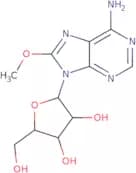
CAS:8-Methoxyadenosine is an acidic adenosine that acts as a competitive antagonist of the A1 receptor. It has a high affinity for this receptor and blocks the binding of adenosine to the receptor, thereby inhibiting its function. 8-Methoxyadenosine is also a competitive antagonist of the uridine nucleotide, which inhibits enzymatic catalysis by ribonucleoside kinase and ribonucleotide reductase. It has been shown to have properties similar to those of other pyrimidine nucleosides such as cytidine, thymine, and uridine. This molecule has a hydroxyl group in its structure, which is essential for binding to these enzymes. 8-Methoxyadenosine also has a phosphate group in its structure, which is necessary for the synthesis of DNA or RNA from deoxyribonucleotides. The benzoate group in 8-methoxyadenosine's structure makesPureza:Min. 95%Bis(2-cyanoethyl)-N,N-diisopropyl phosphoramidite
CAS:Bis(2-cyanoethyl)-N,N-diisopropyl phosphoramidite is a potent inhibitor that targets human immunodeficiency virus (HIV) and cancer. It acts as an analog of substrates for human plasma membrane kinases, which are essential for the replication of HIV. Bis(2-cyanoethyl)-N,N-diisopropyl phosphoramidite has been shown to inhibit lung metastasis in mice, indicating its potential therapeutic use against cancer. This compound also exhibits inhibitory activities against Escherichia coli alkaline phosphatase and other enzymes, suggesting its pharmacological activity may extend beyond HIV and cancer treatment. Overall, Bis(2-cyanoethyl)-N,N-diisopropyl phosphoramidite is a promising inhibitor with potential applications in multiple fields.Fórmula:C12H22N3O2PPureza:Min. 90 Area-%Forma y color:Slightly Yellow Clear LiquidPeso molecular:271.3 g/mol9-Deaza-2'-deoxyguanosine
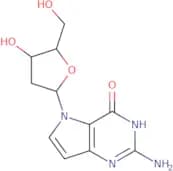
CAS:9-Deaza-2'-deoxyguanosine is a novel synthetic nucleoside that activates the ribonucleotide reductase enzyme. The activation of this enzyme was found to be dependent on the presence of diphosphate, which is a cofactor for this enzyme. 9-Deaza-2'-deoxyguanosine has been shown to inhibit the growth of cells in culture and to induce apoptosis. It also inhibits viral replication by interfering with the synthesis of viral DNA. In addition, 9-Deaza-2'-deoxyguanosine can inhibit tumor cell proliferation and promote differentiation in vitro.Fórmula:C11H14N4O4Pureza:Min. 95%Peso molecular:266.25 g/mol5’-Azido-2’,5’-dideoxyuridine
CAS:<p>5’-Azido-2’,5’-dideoxyuridine (5ADU) is a pyrimidine nucleoside that has been used to treat cancer. It is converted to 5-azidouracil which inhibits the synthesis of thymidylate, an essential component of DNA. 5ADU is also active against herpes virus and can be used as an antiviral agent. This drug has been shown to protect against radiation damage by inhibiting the formation of free radicals. The protonation of 5ADU leads to a stereochemical rearrangement that prevents the formation of free radicals. 5ADU does not inhibit bacterial enzymes, but it does have some effect on viruses, such as herpes virus, because they contain DNA or RNA similar to human cells.</p>Fórmula:C9H11N5O4Pureza:Min. 95%Peso molecular:253.21 g/molN4-Acetyl-3'-O-acetyl-2'-deoxycytidine
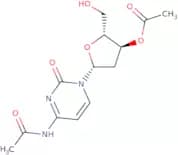
CAS:N4-Acetyl-3'-O-acetyl-2'-deoxycytidine is a novel, modified nucleoside that contains a phosphoramidate linkage. It has been shown to have anticancer and antiviral properties. N4-Acetyl-3'-O-acetyl-2'-deoxycytidine is also an activator of the immune system and has been shown to be effective against HIV.Pureza:Min. 95%5'-O-DMT-N2-isopropylphenoxyacetyl-2'-O-(2-methoxyethyl)guanosine 3'-O succinate TEA salt
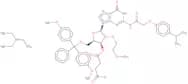
<p>5'-O-DMT-N2-isopropylphenoxyacetyl-2'-O-(2-methoxyethyl)guanosine 3'-O succinate TEA salt is a modified nucleoside with anticancer activity. It is a diphosphate that can be used for the synthesis of DNA and RNA. This product is synthesized by the reaction of 5'-O-dimethoxytritylthymidine (5'-DMTT), 2'-O-(2-methoxyethyl)hydroxylamine hydrochloride, and succinic anhydride in the presence of triethylamine. The product is purified by column chromatography, followed by recrystallization from hot acetonitrile. CAS No.: 102972-73-0</p>Fórmula:C49H52N5O13·C6H16NPureza:Min. 95%Peso molecular:1,021.16 g/mol5-Hydroxymethyl-dc ce-phosphoramidite (hmdc)
CAS:<p>Please enquire for more information about 5-Hydroxymethyl-dc ce-phosphoramidite (hmdc) including the price, delivery time and more detailed product information at the technical inquiry form on this page</p>Fórmula:C50H57N6O9PPureza:Min. 95%Peso molecular:917 g/mol5-Phenylcytidine
CAS:5-Phenylcytidine is a nitro compound that is used as an antiviral agent. It inhibits the replication of the virus by interfering with viral DNA synthesis and preventing the assembly of viral proteins. 5-Phenylcytidine is also capable of inhibiting influenza A virus in vitro at concentrations below 1 μM and has been shown to inhibit herpes simplex virus type 1 (HSV-1) in cell culture. The antiviral activity of 5-phenylcytidine may be due to its ability to form a stable reaction product with cytosine in alkaline conditions, which prevents the incorporation of this nucleobase into DNA or RNA.Pureza:Min. 95%N4-Benzoyl-2'-deoxy-3'-O-levulinoylcytidine
<p>N4-Benzoyl-2'-deoxy-3'-O-levulinoylcytidine is a nucleoside that is used as an antiviral and anticancer agent. It is a modified deoxyribonucleoside that has antiviral activity against HSV-1, HSV-2, and HIV. N4-Benzoyl-2'-deoxy-3'-O-levulinoylcytidine also has anticancer effects against leukemia cells in mice. This drug is synthesized from 2′,3′,5′triacetyladenosine by the reaction of 4-(1H)-benzoyloxymethyl)phenylacetic acid with triethylamine and levulinic acid chloride.</p>Fórmula:C21H23N3O7Pureza:Min. 95%Peso molecular:429.43 g/mol8-(4-Amino-(2',3',4',5',6'-D5-biphenyl)-2'-deoxyguanosine
Producto controlado<p>8-(4-Amino-(2',3',4',5',6'-D5-biphenyl)-2'-deoxyguanosine is a novel, diphosphate nucleoside with antiviral and anticancer activity. It has been shown to activate the transcription of genes that are involved in cell growth and differentiation. This drug also inhibits the synthesis of viral DNA by binding to the viral DNA polymerase, thereby inhibiting its function. 8-(4-Amino-(2',3',4',5',6'-D5-biphenyl)-2'-deoxyguanosine can be used as a phosphoramidite for the preparation of oligonucleotides for use in gene therapy.</p>Fórmula:C22H17N6O4D5Pureza:Min. 95%Forma y color:PowderPeso molecular:439.48 g/molIsowyosine
CAS:<p>Isowyosine is a protein that catalyzes the synthesis of purines, which are essential for DNA synthesis and repair. Isowyosine is found in mammalian cells, where it has been observed to play a role in the translation of messenger RNA (mRNA). Isowyosine also plays a role in the synthesis of viral proteins and viral replication. It has been shown to be active against various viruses, including herpes simplex virus and influenza virus. Isowyosine may also have anti-cancer properties due to its ability to inhibit tumor growth.</p>Fórmula:C14H17N5O5Pureza:Min. 95%Forma y color:PowderPeso molecular:335.32 g/mol3'-Azido-2'-deoxy-5'-O-DMT-thymidine
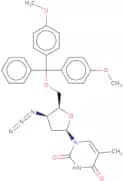
CAS:3'-Azido-2'-deoxy-5'-O-DMT-thymidine is a novel and potent activator of ribonucleotide reductase. It has been shown to be an effective inhibitor of DNA synthesis and antiviral agent, with a low cytotoxicity profile. 3'-Azido-2'-deoxy-5'-O-DMT-thymidine is synthesized from DMT, which is readily available in the form of its monophosphate or diphosphate. The compound has been shown to inhibit viral replication by inhibiting viral reverse transcriptase activity. 3'-Azido-2'-deoxy-5'-O-DMT-thymidine also inhibits DNA synthesis in cancer cells.Fórmula:C31H31N5O6Pureza:Min. 95%Peso molecular:569.61 g/mol4’-a-C-Methyluridine
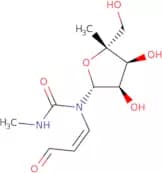
CAS:<p>4' - a-C-Methyluridine is a modified nucleoside that is used as a building block in the synthesis of DNA. It can be used for the treatment of viral infections and cancer. 4' - a-C-Methyluridine has antiviral activity against herpes simplex virus type 1 and cytomegalovirus. 4' - a-C-Methyluridine also has anticancer activity, which may be due to its ability to inhibit proliferation of cells by blocking the synthesis of DNA and RNA.</p>Pureza:Min. 95%3'-O-Allyluridine
<p>3'-O-Allyluridine is a nucleoside that has antiviral, anticancer, and antibacterial activities. 3'-O-Allyluridine is an activator of RNA polymerase and is used to synthesize DNA in vitro. It can be used as a substrate for phosphoramidites in the synthesis of oligonucleotides with modified backbones. 3'-O-Allyluridine has been shown to inhibit the growth of cancer cells by blocking the synthesis of DNA and RNA. The drug also inhibits the production of ribonucleases, which are enzymes that break down RNA in cells.</p>Fórmula:C12H16N2O6Pureza:Min. 95%Peso molecular:284.27 g/molN,7-Dimethyl- 2'- O- methylguanosine
CAS:<p>N,7-Dimethyl-2'-O-methylguanosine (DMOG) is a modified nucleoside with antiviral and anticancer properties. DMOG can be used as an activator of transcription, which activates the synthesis of viral RNA and dsDNA. This compound has shown to inhibit the activity of HIV by preventing reverse transcriptase from synthesizing DNA from viral RNA. It also inhibits tumor cell proliferation by inhibiting DNA synthesis and protein synthesis. DMOG is synthesized in high purity by chemical phosphoramidite chemistry.</p>Fórmula:C13H20N5O5Pureza:Min. 95%Peso molecular:326.33 g/mol5-Fluorocytosine arabinoside
CAS:<p>5-Fluorocytosine arabinoside (5FCA) is an analog of fluorocytosine and a degradable prodrug that is converted to fluorouracil (5FU) in the human liver. It acts as an inhibitor of DNA synthesis and has been used for the treatment of leukemias. 5-Fluorocytosine arabinoside is rapidly degraded by tissue culture cells, which may be due to its reactive functional groups. The inhibitory activity of this drug against cell culture was found to be minimal at low concentrations and reached a maximum at concentrations greater than 1 mM. The affinity ligands for this compound are reactive functional groups such as sulfhydryl, hydroxyl, and carboxyl groups, but not ester or amide bonds. This drug can be used in the synthesis of affinity ligands with a reactive functional group.</p>Fórmula:C9H12FN3O5Pureza:Min. 95%Peso molecular:261.21 g/mol