Nucleósidos
Los nucleósidos son building blocks fundamentales de los ácidos nucleicos, compuestos por una base nitrogenada unida a una molécula de azúcar. En esta sección, puede encontrar una amplia variedad de nucleósidos esenciales para la investigación en biología molecular, bioquímica y farmacología. Estos compuestos juegan roles cruciales en la síntesis de ADN y ARN, y son vitales en varios procesos metabólicos. Los nucleósidos se utilizan para estudiar material genético, desarrollar terapias antivirales y anticancerígenas, y comprender los mecanismos celulares. En CymitQuimica, proporcionamos nucleósidos de alta calidad para apoyar sus necesidades de investigación y desarrollo, asegurando pureza y fiabilidad para sus aplicaciones experimentales.
Se han encontrado 3569 productos de "Nucleósidos"
Ordenar por
Pureza (%)
0
100
|
0
|
50
|
90
|
95
|
100
Guanosine 3',5'-diphosphate tetralithium salt
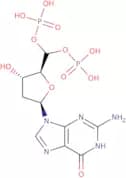
CAS:Guanosine 3',5'-diphosphate tetralithium salt is a nucleoside that has antiviral and anticancer properties. It is synthesized by reacting guanosine with lithium tetrabutylammonium tetraiodide. This nucleotide can be used as a precursor for DNA synthesis, deoxyribonucleosides, and phosphoramidites. Guanosine 3',5'-diphosphate tetralithium salt has been shown to activate the synthesis of proteins in the absence of adenosine triphosphate (ATP).Fórmula:C10H11Li4N5O11P2Pureza:Min. 95%Peso molecular:466.93 g/mol5'-O-Trityl-3'-b-hydroxythymidine
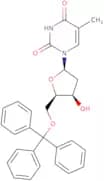
CAS:<p>5'-O-Trityl-3'-b-hydroxythymidine is a nucleoside that is synthesized by the reduction of a pyrimidine with xylene. This molecule has been shown to have antibacterial activity, and also activates p53 in human cells. 5'-O-Trityl-3'-b-hydroxythymidine has been shown to inhibit the growth of cancer cells in a dose dependent manner. The functional theory for this finding is that 5'-O-Trityl-3'-b-hydroxythymidine may bind to DNA, preventing RNA polymerase from transcribing DNA into mRNA.</p>Fórmula:C29H28N2O6Pureza:Min. 95%Peso molecular:500.54 g/mol6-Chloro-7-deaza-9-(a-D-ribofuranosyl)purine
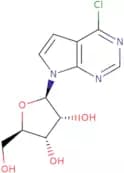
CAS:6-Chloro-7-deaza-9-(a-D-ribofuranosyl)purine is an anticancer drug that belongs to the class of nucleosides. It inhibits DNA and RNA synthesis by blocking the incorporation of nucleotides into DNA or RNA. This drug may also inhibit viral replication by blocking viral polymerase activity. 6-Chloro-7-deaza-9-(a-D-ribofuranosyl)purine has been shown to be a potent activator of phosphoramidites, which are used in chemical synthesis. This novel compound is synthesized using modified diphosphate chemistry and purified to high purity.Fórmula:C11H12ClN3O4Pureza:Min. 95%Peso molecular:285.68 g/molUridylyl-3'-5'-cytidine ammonium salt
<p>Uridylyl-3'-5'-cytidine ammonium salt is a monophosphate of cytidine. It is an antiviral agent that inhibits the replication of human immunodeficiency virus type 1 (HIV-1). Uridylyl-3'-5'-cytidine ammonium salt is synthesized by the reaction of uridyl 3'-5' -adenosine monophosphate with cytidine. This compound has been shown to be effective in inhibiting the proliferation of cancer cells. Uridylyl-3'-5'-cytidine ammonium salt has shown activity against a variety of cancers, including breast, lung, and colon cancers.</p>Fórmula:C18H27N6O13PPureza:Min. 95%Peso molecular:566.41 g/mol7H-Pyrrolo[2,3d]pyrimidine
CAS:7H-Pyrrolo[2,3d]pyrimidine is a pyrimidine compound that has been shown to have potent antitumor activity. It inhibits the enzyme acyl-coenzyme A carboxylase (ACC) and blocks the production of malonyl-CoA, an intermediate in the metabolism of fatty acids. Malonyl-CoA is an allosteric activator of ACC, which is an important enzyme for regulating fatty acid synthesis. 7H-Pyrrolo[2,3d]pyrimidine also inhibits the expression of the gene encoding cb2 receptor, which is involved in inflammatory processes. The compound binds to a hydroxyl group on ACC to inhibit its activity. 7H-Pyrrolo[2,3d]pyrimidine has been shown to be effective against miapaca-2 cells and other cancer cell lines at concentrations as low as 1 nM. This compound also has aFórmula:C6H5N3Pureza:Min. 95%Peso molecular:119.12 g/mol2'-Ethylfluoro-5-methyluridine
<p>2'-Ethylfluoro-5-methyluridine is a nucleoside analog. It has been modified with an ethyl group at the 2' position of the sugar moiety and a fluoro atom in the 5-position of the uracil base that replaces the methyl group. This modification increases its cellular uptake and antiviral activity. It is being studied as a potential anticancer drug.</p>Pureza:Min. 95%N6-Benzoyl-7-deaza-2'-deoxy-5'-O-tert-butyldimethylsilyl-7-iodoadenosine
CAS:N6-Benzoyl-7-deaza-2'-deoxy-5'-O-tert-butyldimethylsilyl-7-iodoadenosine is a novel nucleoside that has been shown to have anticancer and antiviral properties. It is a phosphoramidite of 7-iodoadenosine that has been modified to contain a benzoyl group at the 6 position. N6-Benzoyl-7-deaza-2'-deoxy-5'-O-tert-butyldimethylsilyl-(7)iodoadenosine can be used for the synthesis of oligonucleotides and DNA, as well as for the activation of latent HIV genes. This compound is also used in vitro to study the interactions between phosphoramidites and nucleosides.Fórmula:C24H31IN4O4SiPureza:Min. 95%Peso molecular:594.52 g/mol2'/3'-(N-Methylanthraniloyl)-adenosine-5'-triphosphate triethylammonium salt
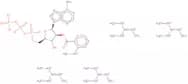
CAS:<p>2'/3'-(N-Methylanthraniloyl)-adenosine-5'-triphosphate triethylammonium salt is a phosphoramidite, deoxyribonucleoside that is active as an antiviral. It inhibits the production of viral DNA and RNA by binding to the polymerase enzyme that copies the viral genome. This drug has been shown to be effective in vitro and in vivo against a wide range of viruses, including HIV, herpes simplex virus type 1 and 2, cytomegalovirus, varicella zoster virus, influenza A virus, and poliovirus. It also has anticancer activity by inhibiting cell proliferation.</p>Fórmula:C18H23N6O14P3Pureza:Min. 95%Peso molecular:640.33 g/molAracytidylyl-(5′→5′)-cytidine
CAS:Please enquire for more information about Aracytidylyl-(5′→5′)-cytidine including the price, delivery time and more detailed product information at the technical inquiry form on this pageFórmula:C18H25N6O12PPureza:Min. 95%Peso molecular:548.4 g/molN4-Benzoyl-3'-O-tert-butyldimethylsilyl-2'-deoxycytidine
<p>N4-Benzoyl-3'-O-tert-butyldimethylsilyl-2'-deoxycytidine is a monophosphate nucleoside analogue. It has antiviral and anticancer properties, as well as the ability to activate DNA synthesis. This product is synthesized from 2'-deoxycytidine and 4-benzoyl chloride in the presence of tert-butyldimethylsilyl chloride. It is available for sale as a white powder with a purity of 99%.</p>Fórmula:C22H31N3O5SiPureza:Min. 95%Forma y color:PowderPeso molecular:445.58 g/mol3'-Azido-N4-benzoyl-2',3'-dideoxy5'-O-DMT-cytidine
<p>3'-Azido-N4-benzoyl-2',3'-dideoxy5'-O-DMT-cytidine is a novel nucleoside analog that has antiviral activity against herpes simplex virus type 1. It is a modified nucleoside phosphoramidite with an azido group at the 3' position and a benzoyl group at the 2' position of cytidine. This product can be used for the synthesis of oligonucleotides with high purity and high quality. This product has CAS number 271462-87-6.</p>Pureza:Min. 95%N6-Benzoyl-5'-O-DMT-adenosine 3'-CE phosphoramidite
N6-Benzoyl-5'-O-DMT-adenosine 3'-CE phosphoramidite is a novel nucleoside that has been modified to protect the 2' hydroxyl group from attack by nucleases. This modification makes N6-Benzoyl-5'-O-DMT-adenosine 3'-CE phosphoramidite resistant to degradation and allows for its use in a variety of applications, such as anticancer, antiviral, and DNA sequencing.Pureza:Min. 95%E-5-(2-Carbomethoxyvinyl)-2'-deoxy-5'-O-DMT-uridine
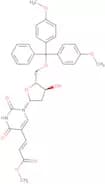
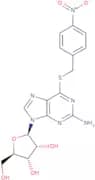
CAS:E-5-(2-Carbomethoxyvinyl)-2'-deoxy-5'-O-DMT-uridine is a monophosphate nucleoside analog that has been modified to be resistant to antiviral ribonucleases. This drug is phosphorylated in vivo to the corresponding diphosphate and triphosphate, which inhibits viral DNA synthesis and thus prevents the virus from replicating. E-5-(2-Carbomethoxyvinyl)-2'-deoxy-5'-O-DMT-uridine can be used as an antiviral agent against herpes simplex virus (HSV).Fórmula:C34H34N2O9Pureza:Min. 95%Peso molecular:614.66 g/molS-(4-Nitrobenzyl)-6-thioguanosine
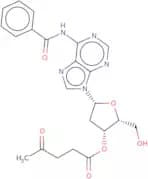
CAS:<p>S-(4-Nitrobenzyl)-6-thioguanosine is a transport inhibitor that has been shown to be active against leukemia. This drug inhibits the uptake of leukocytes into the bone marrow, which prevents their proliferation and development. S-(4-Nitrobenzyl)-6-thioguanosine also inhibits the synthesis of adenosine in erythrocytes, which leads to the accumulation of uridine and then to an increase in the levels of ATP. This drug can be used to treat chronic lymphocytic leukemia.</p>Fórmula:C17H18N6O6SPureza:Min. 95%Peso molecular:434.43 g/molN6-Benzoyl-2'-deoxy-3'-O-levulinoyladenosine
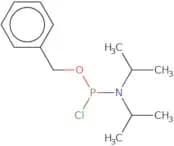
<p>N6-Benzoyl-2'-deoxy-3'-O-levulinoyladenosine is an antiviral monophosphate nucleoside that has been shown to have significant activity against HIV and herpes simplex virus. It is also an anticancer drug and a novel synthetic nucleoside. N6-Benzoyl-2'-deoxy-3'-O-levulinoyladenosine has been shown to inhibit the growth of cancer cells in culture, as well as in animal models. It also inhibits the production of DNA and RNA, which may be due to its ability to act as a competitive inhibitor of DNA polymerase or RNA polymerase.</p>Fórmula:C22H23N5O6Pureza:Min. 95%Peso molecular:453.46 g/molBenzyl-N, N-diisopropylchlorophosphoramidite
CAS:Benzyl-N, N-diisopropylchlorophosphoramidite is a novel nucleoside phosphoramidite with anticancer activity. It is synthesized from benzyl alcohol and diisopropylamine by reaction with phosphorus oxychloride in the presence of a base. This compound can be used to activate DNA for subsequent coupling reactions or for modification of DNA. Benzyl-N, N-diisopropylchlorophosphoramidite has been shown to have antiviral and antitumour activities in vitro and in vivo.Fórmula:C13H21NOPClPureza:Min. 95%Peso molecular:273.74 g/mol5-[N-(2-Aminoethyl)-3-E-acrylamido]-2'-deoxy-5'-O-DMT-uridine
CAS:5-[N-(2-Aminoethyl)-3-E-acrylamido]-2'-deoxy-5'-O-DMT-uridine is a novel, activator ribonucleoside phosphoramidite. It is used in the synthesis of oligodeoxynucleotides and has antiviral, anticancer, and antimalarial activities. 5-[N-(2-Aminoethyl)-3-E-acrylamido]-2'-deoxy-5'-O-DMT-uridine is synthesized from 2'-deoxyadenosine monophosphate (dAMP) and N-(2 aminopropyl)-3-(E acryloyl) aminopropylphosphoramidite (APEAP). This nucleoside can be used as a building block for DNA synthesis or for other purposes such as the treatment of cancer and HIV.Fórmula:C35H38N4O8Pureza:Min. 95%Peso molecular:642.72 g/mol2'-Deoxyuridine-5'-diphosphate sodium
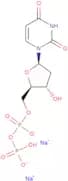
CAS:2'-Deoxyuridine-5'-diphosphate sodium salt is a novel antiviral agent that inhibits viral replication by inhibiting the activity of viral DNA polymerase. It is a synthetic nucleoside that is not found in nature, but is an analog of deoxyuridine monophosphate. This compound has been shown to be effective against tumor cells and has high purity with a CAS number 102814-06-2. 2'-Deoxyuridine-5'-diphosphate sodium salt is also used as an activator for phosphoramidites and modified nucleosides.Fórmula:C9H14N2O11P2•Na2Pureza:Min. 95%Forma y color:PowderPeso molecular:434.14 g/mol4-Amino-2,6-dimethyl-8-(2'-deoxy-3',5'-di-O-toluoyl-b-D-ribofuranosyl)-7-pteridone
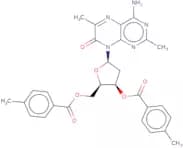
<p>4-Amino-2,6-dimethyl-8-(2'-deoxy-3',5'-di-O-toluoyl-b-D-ribofuranosyl)-7-pteridone is a high purity, modified nucleoside that is synthesized from 2,4,6,8 tetramethylpyridine and 2'-deoxyribofuranosyl bromide. 4ADTP is an antiviral and anticancer agent that inhibits the viral DNA polymerase in the herpes family of viruses and the DNA polymerase in cancer cells. This drug has been shown to be active against HIV type 1 (HIV1) and HIV type 2 (HIV2).</p>Fórmula:C29H29H5O6Pureza:Min. 95%Peso molecular:543.57 g/mol2'-Amino-2'-deoxyuridine-5'-triphosphate
CAS:<p>2'-Amino-2'-deoxyuridine-5'-triphosphate (2dUDP) is a nucleotide that has been shown to be a potent inhibitor of cytosolic Ca2+ release. 2dUDP binds to the Ryanodine receptor (RYR) and inhibits the release of Ca2+ from the sarcoplasmic reticulum. It is also fluorescent, and can be used to detect Ca2+ in cells. This nucleotide has been shown to inhibit populations of heterologous and homologous RYR receptors.</p>Fórmula:C9H16N3O14P3Pureza:Min. 95%Peso molecular:483.16 g/mol


![7H-Pyrrolo[2,3d]pyrimidine](/_next/image/?url=https%3A%2Fstatic.cymitquimica.com%2Fproducts%2F3D%2Fthumb-webp%2FNP32608.webp&w=3840&q=75)





![5-[N-(2-Aminoethyl)-3-E-acrylamido]-2'-deoxy-5'-O-DMT-uridine](/_next/image/?url=https%3A%2Fstatic.cymitquimica.com%2Fproducts%2F3D%2Fthumb-webp%2FNA08231.webp&w=3840&q=75)