Nucleósidos
Los nucleósidos son building blocks fundamentales de los ácidos nucleicos, compuestos por una base nitrogenada unida a una molécula de azúcar. En esta sección, puede encontrar una amplia variedad de nucleósidos esenciales para la investigación en biología molecular, bioquímica y farmacología. Estos compuestos juegan roles cruciales en la síntesis de ADN y ARN, y son vitales en varios procesos metabólicos. Los nucleósidos se utilizan para estudiar material genético, desarrollar terapias antivirales y anticancerígenas, y comprender los mecanismos celulares. En CymitQuimica, proporcionamos nucleósidos de alta calidad para apoyar sus necesidades de investigación y desarrollo, asegurando pureza y fiabilidad para sus aplicaciones experimentales.
Se han encontrado 3569 productos de "Nucleósidos"
Ordenar por
Pureza (%)
0
100
|
0
|
50
|
90
|
95
|
100
3'-O-tert-Butyldimethylsilyl-2'-deoxy-5'-O-DMT-adenosine
CAS:3'-O-tert-Butyldimethylsilyl-2'-deoxy-5'-O-DMT-adenosine is a nucleoside with a novel chemical structure. It is a deoxyribonucleoside monophosphate, which has antiviral and anticancer properties. 3'-O-tert-Butyldimethylsilyl-2'-deoxy-5'-O-DMT-adenosine inhibits the formation of diphosphate from ATP, which prevents DNA and RNA synthesis in cells. This drug also binds to the enzyme ribonuclease, preventing the breakdown of RNA. The phosphoramidites used for synthesizing 3'-O-tert-Butyldimethylsilyl-2'-deoxy-5'-O-DMT adenosine are of high quality and can be used for making other nucleosides.Fórmula:C37H45N5O5SiPureza:Min. 95%Peso molecular:667.87 g/molAdenosine-5'-O-diphospho-(1''-(4-nitrophenoxy)-ribose) sodium
CAS:Adenosine-5'-O-diphospho-(1''-(4-nitrophenoxy)-ribose) sodium is a nucleic acid analog that is used in antiviral, anticancer, and gene therapy. It is a modified nucleotide with a phosphoramidite group at the 5' position. The phosphoramidite group is used for the synthesis of DNA or RNA. It has been shown to activate cellular processes such as transcription, translation, and replication in vitro. This compound also inhibits cancer cell growth in vivo and has been shown to be effective against bacterial infections caused by Mycobacterium tuberculosis and Mycobacterium avium complex.Fórmula:C21H26N6O16P2·xNaPureza:Min. 95%Peso molecular:680.41 g/mol4-Amino-6-hydroxy-2-methylpyrimidine
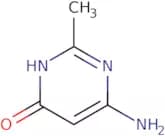
CAS:<p>4-Amino-6-hydroxy-2-methylpyrimidine (4AMMP) is a heterocyclic compound that belongs to the group of pyrimidines. It has been shown to react with morpholine and acrylic acid in an oxidation sequence. The reaction proceeds through an elimination, forming formaldehyde, which condenses with hydrolyzed piperazine to give the final product. 4AMMP can also be alkylated with a variety of reagents such as methyl iodide or dimethyl sulfate.</p>Fórmula:C5H7N3OPureza:Min. 95%Forma y color:PowderPeso molecular:125.13 g/mol4-Chloro-6-imidazol-1-yl-pyrimidine
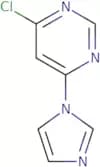
CAS:<p>4-Chloro-6-imidazol-1-yl-pyrimidine is a quaternary ammonium compound that can be used to make antireflection coatings. It has been shown to have a high degree of compatibility with polymers, such as allyl carbonate, which are used in functional groups. 4-Chloro-6-imidazol-1-yl-pyrimidine has also been shown to react with stannous octoate, and the reaction time is dependent on the concentration of both compounds. This molecule has been found to be biodegradable and liquid crystal compositions can be made from it by changing the ratio of molecules to liquid crystals. 4-Chloro-6-imidazol-1-yl pyrimidine reacts with hydroxyl groups in epoxy resins and diolefinic hydrocarbons, forming crosslinks in sealants or coatings. The sealant</p>Fórmula:C7H5ClN4Pureza:Min. 95%Peso molecular:180.59 g/molLamivudine 5'-diphosphate ammonium salt
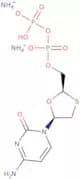
CAS:<p>Lamivudine is a monophosphate antiviral drug that inhibits the synthesis of DNA. It has been shown to inhibit the replication of human immunodeficiency virus-1 (HIV-1) in vitro, and to protect monkeys from simian acquired immune deficiency syndrome (SAIDS). Lamivudine 5'-diphosphate ammonium salt is an antiviral agent that belongs to the group of deoxyribonucleosides. It has been shown to be effective against HIV-1 and SAIDS in animals. The mechanism of action is not fully understood, but it may work by inhibiting viral RNA synthesis or by preventing viral DNA integration into host cell DNA.</p>Fórmula:C8H19N5O9P2SPureza:Min. 95%Peso molecular:423.28 g/mol1,5-Anhydro-2,3-dideoxy-2-(N6-benzoyladenin-1-yl)-D-glucitol
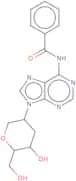
1,5-Anhydro-2,3-dideoxy-2-(N6-benzoyladenin-1-yl)-D-glucitol is a novel modified nucleoside that is used as an activator in the synthesis of oligodeoxynucleotides and ribonucleosides. It is also used for the synthesis of phosphoramidites for DNA and RNA molecules. This product is available in high purity and quality.Fórmula:C18H19N5O4Pureza:Min. 95%Peso molecular:369.38 g/mol8-Amino-2'-deoxy-N6,N8-di-DMF-5'-O-DMT-adenosine 3'-CE phosphoramidite
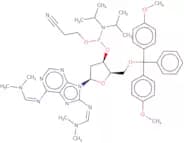
CAS:8-Amino-2'-deoxy-N6,N8-di-DMF-5'-O-DMT-adenosine 3'-CE phosphoramidite is a novel nucleoside analog with antiviral and anticancer properties. It is synthesized by reacting 8-aminoimidazo[2,1-b]thiazole 1,3(2H)-dione (AITD) with N6,N8-diisopropyl dATP to form the aminothiazole phosphate intermediate. This intermediate is then reacted with 5'-O-(4,4'-dimethoxytrityl)-2',3',5' triphosphate (DMTrP) to produce the desired product. The synthesis of 8AAODMTAP has been shown to be more efficient than other synthesized nucleosides due to its high purity and lack of impurities.Fórmula:C46H59N10O6PPureza:Min. 95%Peso molecular:879 g/mol2-Amino-4-(4-methoxyphenyl)pyrimidine
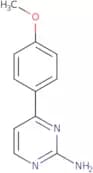
CAS:<p>2-Amino-4-(4-methoxyphenyl)pyrimidine (AMP) is a synthetic nucleoside analog. It has antiviral activity and is used for the treatment of hepatitis B virus infection. AMP inhibits viral DNA polymerase and prevents the synthesis of viral DNA and RNA. It has been modified to include a methoxy group at the 4 position, which provides additional stability against the enzyme ribonuclease. AMP is also an activator of ribonucleotide reductase and can be used as a substrate to synthesize deoxyribonucleosides, phosphoramidites, diphosphate, or monophosphate nucleotides for DNA synthesis.<br>AMP has CAS number 99844-02-7 and is available in high purity.</p>Fórmula:C11H11N3OPureza:Min. 95%Peso molecular:201.22 g/mol2',3'-Dideoxyguanosine-5'-O-(1-thiotriphosphate)
CAS:2',3'-Dideoxyguanosine-5'-O-(1-thiotriphosphate) (2,3'-ddGTP) is a nucleoside that is synthesized using phosphoramidite chemistry. It has antiviral and anticancer activity, as well as the ability to activate cellular transcription. 2,3'-Dideoxyguanosine-5'-O-(1-thiotriphosphate) can be used in the synthesis of modified nucleosides or in the synthesis of novel nucleosides. The compound was found to inhibit DNA replication by binding to the enzyme ribonucleotide reductase. 2,3'-Dideoxyguanosine-5'-O-(1-thiotriphosphate) can also be used for DNA sequencing and as a cytotoxic agent in cancer chemotherapy.Fórmula:C10H16N5O11P3SPureza:Min. 95%Peso molecular:507.25 g/molN6-Benzoyl-7-deaza-2'-deoxyadenosine
CAS:N6-Benzoyl-7-deaza-2'-deoxyadenosine is a novel synthetic monophosphate activator that can be used to induce cell death in cancer cells. It is structurally similar to the natural nucleotide adenosine, and it binds to the same receptors on cells as adenosine. N6-Benzoyl-7-deaza-2'-deoxyadenosine has been shown to inhibit viral replication by interfering with DNA synthesis and RNA transcription, which are essential for viral reproduction.Fórmula:C18H18N4O4Pureza:Min. 95%Peso molecular:354.36 g/mol8-Bromo-N6-(dimethylaminomethylidene)-2'-deoxyadenosine
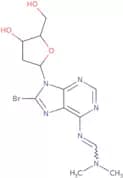
CAS:8-Bromo-N6-(dimethylaminomethylidene)-2'-deoxyadenosine is a phosphoramidite that is used in the preparation of antiviral nucleosides and monophosphate. It has been shown to have anticancer activity. 8-Bromo-N6-(dimethylaminomethylidene)-2'-deoxyadenosine is synthesized by reacting an acid halide with a 2'-deoxyribonucleotide. This reaction produces a 2'-bromo adenosine derivative, which is then reacted with dimethylamine to produce the desired product. The synthesis of 8-bromo-N6-(dimethylaminomethylidene)-2'-deoxyadenosine can be performed on a large scale using an automated process.Fórmula:C13H17BrN6O3Pureza:Min. 95%Peso molecular:385.22 g/mol2′-O-Succinyladenosine 3′,5′-monophosphate
CAS:<p>Please enquire for more information about 2′-O-Succinyladenosine 3′,5′-monophosphate including the price, delivery time and more detailed product information at the technical inquiry form on this page</p>Fórmula:C14H16N5O9PPureza:Min. 95%Peso molecular:429.28 g/mol2’-O,4’-C-Methylenecytidine
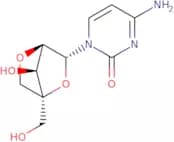
CAS:<p>2’-O,4’-C-Methylenecytidine is a nucleoside that has been used to synthesize oligonucleotides. It has been shown to form duplexes with complementary DNA and RNA strands. 2’-O,4’-C-Methylenecytidine forms bicyclic analogues with high efficiency and can be used as an n-type structural probe.</p>Pureza:Min. 95%5,6-Dihydro-2'-deoxy-5'-O-DMT-uridine 3'-CE phosphoramidite
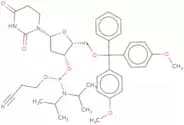
<p>5,6-Dihydro-2'-deoxy-5'-O-DMT-uridine 3'-CE phosphoramidite is a modified nucleoside that is used as an activator in DNA synthesis. It has been shown to have anticancer properties by inhibiting the growth of cancer cells. 5,6-Dihydro-2'-deoxy-5'-O-DMT-uridine 3'-CE phosphoramidite is synthesized from the monophosphate form and can be used for the synthesis of both DNA and RNA.</p>Fórmula:C39H49N4O8PPureza:Min. 95%Peso molecular:732.82 g/mol2'-Deoxy-5-(trifluoromethyl)cytidine
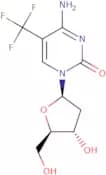
CAS:2'-Deoxy-5-(trifluoromethyl)cytidine is a synthetic nucleoside analogue that inhibits the cytidine deaminase enzyme. It is used in the treatment of some types of leukemia and other cancers. The compound, which has a trifluoromethyl group on the 2' position, binds to the active site of cytidine deaminase and prevents it from functioning. This leads to an accumulation of thymidylate, which is required for DNA synthesis. The tumor tissue also contains high concentrations of this drug and its metabolites, making it more effective against cancer cells than normal cells. 2'-Deoxy-5-(trifluoromethyl)cytidine has been shown to inhibit anabolism in tumor tissue in the presence of high concentrations of phosphorylases, which are enzymes that catalyze reactions that break down carbohydrates and proteins into smaller molecules such as glucose or amino acids.Fórmula:C10H12F3N3O4Pureza:Min. 95%Peso molecular:295.22 g/mol5'-O-DMT-2'-O-(2-methoxyethyl)uridine
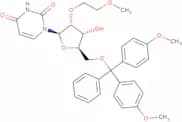
CAS:<p>5'-O-DMT-2'-O-(2-methoxyethyl)uridine is a modified nucleoside that is an antiviral and anticancer agent. It was first synthesized in the early 1980s, and has been shown to be active against a variety of viruses, such as herpes simplex virus (HSV), varicella zoster virus (VZV), cytomegalovirus (CMV), hepatitis B virus (HBV), and Epstein-Barr virus (EBV). 5'-O-DMT-2'-O-(2-methoxyethyl)uridine inhibits the growth of cancer cells by interfering with DNA synthesis. This drug also has been shown to be an activator for DNA polymerases and is used as a building block for antiretroviral drugs.</p>Fórmula:C33H36N2O9Pureza:Min. 95%Peso molecular:604.65 g/molChemical phosphorylating reagent (cpr)
CAS:Chemical phosphorylating reagent (CPR) is a powerful tool for the study of kinases, which are enzymes that regulate cellular processes such as cell division and apoptosis. CPR has been shown to be effective in inhibiting the activity of certain kinases that are involved in tumor growth and progression. It has also been used as an anticancer agent, inducing apoptosis in cancer cells. CPR is an analog of toxaphene and labetalol, two compounds with known kinase inhibitor activity. This reagent has been tested on human urine samples and Chinese hamster ovary cells, demonstrating its potential as a valuable research tool for studying kinase signaling pathways and developing new cancer therapies.Fórmula:C5H10O5Pureza:Min. 95%Peso molecular:150.13 g/molN5-Benzoyl-2'-deoxy-5'-O-DMT-adenosine 3'-succinyl CPG 500 Å
N5-Benzoyl-2'-deoxy-5'-O-DMT-adenosine 3'-succinyl CPG 500 Å is a modified nucleoside that is used for the synthesis of DNA and RNA. It is an activator of antiviral and anticancer drugs. N5-Benzoyl-2'-deoxy-5'-O-DMT-adenosine 3'-succinyl CPG 500 Å has been shown to be an effective cancer treatment agent in vivo, as well as an inhibitor of viral replication. It can also be used in the synthesis of nucleosides and phosphoramidites.Pureza:Min. 95%Forma y color:Powder3',5'-Di-o-acetyl-5-fluoro-O4-(2,4,6-trimethylphenyl)-2'-o-methyluridine
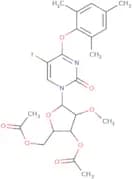
CAS:<p>3',5'-Di-O-acetyl-5-fluoro-O4-(2,4,6-trimethylphenyl)-2'-O-methyluridine is a novel monophosphate nucleoside analog that is activated by T4 polynucleotide kinase. It is synthesized from the corresponding phosphoramidite and reacts with the 5'-OH group of a ribonucleoside to form a 3',5'-di-O-acetylribonucleoside. The diacetyl group confers increased stability to the molecule and also provides an acetyl group for incorporation into DNA. This compound has antiviral activity against herpes simplex virus type 1 (HSV1) in cell culture and has shown anticancer properties in animal studies.</p>Fórmula:C23H27FN2O8Pureza:Min. 95%Peso molecular:478.5 g/mol3’-O-tert-Butyldiphenylsilylthymidine
CAS:Used as a protected thymidine nucleoside in chemical synthesis, specifically as an intermediate in the preparation of other thymidine derivatives, particularly 5'-modified nucleosides and oligonucleotides. The tert-butyldiphenylsilyl (TBDPS) group is a silyl protecting group selectively attached to the 3' hydroxyl group of thymidine.Fórmula:C26H32N2O5SiPureza:Min. 95%Forma y color:White PowderPeso molecular:480.63 g/mol