Nucleósidos
Se han encontrado 3569 productos de "Nucleósidos"
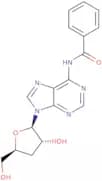
N6-Benzoyl-3'-deoxyadenosine
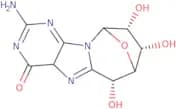
CAS:N6-Benzoyl-3'-deoxyadenosine is a nucleoside analogue that is used as a substrate for DNA polymerase. The efficiency of this compound has been shown to be higher than other nucleotides. In addition, N6-Benzoyl-3'-deoxyadenosine has been shown to be an efficient donor in the ligation reaction and can also act as a competitive inhibitor of topoisomerase II. N6-Benzoyl-3'-deoxyadenosine is a scissile substrate for DNA topoisomerase II and cleaves at the same site as dATP. This compound has been shown to be active against both Gram-positive bacteria and Mycobacterium tuberculosis with high selectivity.Fórmula:C17H17N5O4Pureza:Min. 95%Peso molecular:355.35 g/mol8,5’(S)-Cycloguanosine
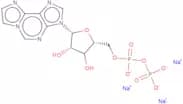
CAS:Please enquire for more information about 8,5’(S)-Cycloguanosine including the price, delivery time and more detailed product information at the technical inquiry form on this pageFórmula:C10H10N5O5Pureza:Min. 95%1,N6-Ethenoadenosine-5'-diphosphate, Sodium salt
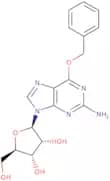
CAS:Emission max - 415nmMolar extinction coefficient ε [L·mol⁻¹·cm⁻¹] - 6000Fluorescent analogue of 5'-ADP, NA10698Fórmula:C12H15N5O10P2Pureza:Min. 95%Peso molecular:451.22 g/molO6-Benzyl guanosine
CAS:O6-Benzyl guanosine is a polymerized compound that has been shown to have anticancer efficacy. It has been tested in mice with medulloblastoma, a type of brain tumor, and in rats with breast cancer. O6-Benzyl guanosine was found to be hydrophobic and bound to the methyltransferase enzyme, which resulted in the inhibition of DNA synthesis. The polymerized compound is able to form conjugates with other molecules such as iron oxide nanoparticles or hydrazone derivatives, which can be used for treatments that involve bioconjugate chemistry.Fórmula:C17H19N5O5Pureza:Min. 95%Peso molecular:373.36 g/mol5-Aminoallyluridine 5'-triphosphate sodium salt - 100mM aqueous solution
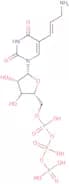
CAS:5-Aminoallyluridine 5'-triphosphate sodium salt is a modified nucleoside that has antiviral and anticancer activity. It is a prodrug of 5-aminoallyluridine and is activated by deoxyribonucleotide ribonucleotides in the cell. This drug also can be used as an activator for other drugs, such as cytosine arabinoside, which are inactive or less active when administered alone.Fórmula:C12H20N3O15P3·xNaPureza:Min. 95%Peso molecular:539.22 g/mol2'-Deoxy-8-(9H-fluoren-2-ylamino)-guanosine
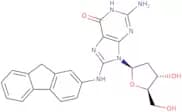
CAS:2'-Deoxy-8-(9H-fluoren-2-ylamino)-guanosine (FdA) is a synthetic nucleoside that was designed for use as a dietary supplement to inhibit carcinogenesis. It is an analog of guanosine and is phosphorylated by cellular kinases to form 2'-deoxy-8-(9H-fluoren-2-ylamino)-inosine monophosphate. FdA inhibits the process of DNA replication in mammalian cells, which may be due to its ability to bind single stranded DNA. This drug has been shown to reduce the mutation frequency and increase the life span of mice with bladder cancer.Fórmula:C23H22N6O4Pureza:Min. 95%Peso molecular:446.46 g/mol6-(4-Iodobenzyl)-1-Methyl Pyrimidine-2,4-(1H,3H)-Dione
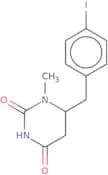
CAS:6-(4-Iodobenzyl)-1-Methyl Pyrimidine-2,4-(1H,3H)-Dione is a nucleoside analog that has shown to be an activator of the ribonucleotide reductase enzyme. It has also been shown to have anticancer activity. 6-(4-Iodobenzyl)-1-Methyl Pyrimidine-2,4-(1H,3H)-Dione inhibits DNA synthesis by binding to the DNA molecule at the site of incorporation and preventing its duplication. This compound also inhibits RNA synthesis by binding to the RNA molecule at the site of incorporation and preventing its duplication. It has been shown to inhibit cancer cell growth in culture and can be used as a chemotherapeutic agent.Fórmula:C12H11IN2O2Pureza:Min. 95%Peso molecular:342.13 g/molDihydrozeatin riboside-5'-monophosphate sodium salt
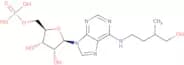
CAS:Dihydrozeatin riboside-5'-monophosphate sodium salt is a cytokinin that belongs to the group of indole compounds. It has been shown to inhibit the biosynthesis of ethylene, which prevents fruit from ripening. Dihydrozeatin riboside-5'-monophosphate sodium salt is also able to inhibit the synthesis of adenosine, another plant hormone that inhibits growth and promotes dormancy in plants. The bioassay for this product has been done with amanita muscaria, an edible mushroom found in North America and Europe. This mushroom contains dihydrozeatin as well as other related compounds such as zeatin, which can be converted into dihydrozeatin by enzymes present in the intestines. The symptoms of poisoning by this mushroom include vomiting and diarrhea, owing to its effects on intestinal motility.Fórmula:C15H22N5Na2O8P·H2OPureza:Min. 95%Forma y color:White To Off-White SolidPeso molecular:495.33 g/mol5-Chloro-2',3'-O-isopropylidenecytidine
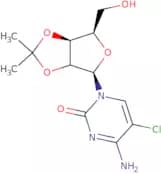
5-Chloro-2',3'-O-isopropylidenecytidine is a synthetic nucleoside that is activated by phosphorylation to form the corresponding nucleotide. It has antiviral and anticancer properties, and can be used as a building block for synthesis of other nucleosides. 5-Chloro-2',3'-O-isopropylidenecytidine is synthesized from 2,4-dichlorophenoxyacetic acid (DCA) and 2,5-dichloroaniline in the presence of sodium cyanide. The compound was first synthesized in 1972 and its chemical structure was determined in 1974. 5-Chloro-2',3'-O-isopropylidenecytidine has been shown to inhibit DNA synthesis by binding to viral diphosphate and deoxyribonucleosides. This compound also inhibits the activity of bacterial DNA gyrase and DNA top
Fórmula:C12H16ClN3O5Pureza:Min. 95%Peso molecular:317.73 g/mol8-Oxo-7-thioguanosine
CAS:8-Oxoguanosine monophosphate (8-oxoGMP) is a synthetic nucleoside that is activated by the enzyme thioredoxin reductase and phosphorylated to form 8-oxoGTP. The anticancer activity of 8-oxoGMP is due to its ability to inhibit ribonucleotide reductase, which reduces the production of DNA and RNA in cells. This product has been shown to inhibit HIV replication in vitro and in vivo. It also inhibits viral replication by inhibiting the synthesis of viral nucleic acids such as DNA, RNA, and deoxyribonucleic acid (DNA).Fórmula:C10H12N4O6SPureza:Min. 95%Forma y color:PowderPeso molecular:316.29 g/mol2-Amino-benzoyl-9-(5'-O-DMT-b-D-ribofuranosyl)purine
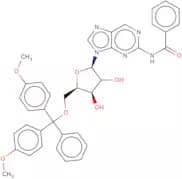
2-Amino-benzoyl-9-(5'-O-DMT-b-D-ribofuranosyl)purine is an anticancer and antiviral agent. It has been shown to be active against many viruses, including herpes simplex virus type 1, herpes simplex virus type 2, cytomegalovirus, and human immunodeficiency virus type 1. This compound also exhibits antitumor activity in mice and rats.Fórmula:C38H35N5O7Pureza:Min. 95%Peso molecular:673.71 g/mol3',5'-Di-O-p-chlorobenzoyl-2'-deoxy-5-fluorouridine
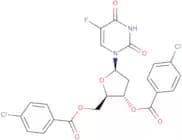
CAS:3',5'-Di-O-p-chlorobenzoyl-2'-deoxy-5-fluorouridine is a nucleoside derivative that has antiviral activity. It is synthesized by the condensation of 2,3,5-trihydroxybenzoic acid with 3'-chloro-5'-fluoroacetophenone in the presence of pyridine and triethylamine. The nucleoside has been shown to be an effective inhibitor of HIV replication in vitro. 3',5'-Di-O-p-chlorobenzoyl-2'-deoxy-5-fluorouridine also inhibits DNA synthesis in human lymphocytes at concentrations of 5 μM or less. This compound can be used as an activator for DNA polymerases and phosphoramidites for DNA synthesis.Fórmula:C23H17Cl2FN2O7Pureza:Min. 95%Peso molecular:523.29 g/mol2'-Deoxy-3'-O-DMT-N2-iBu-guanosine--succinyl-CPG 1000 Å
2'-Deoxy-3'-O-DMT-N2-iBu-guanosine--succinyl-CPG 1000 Å is a modified nucleoside that is synthesized from 2'-deoxyribonucleosides and succinic anhydride. It has antiviral, anticancer, and antimalarial activities. It can also be used to modify DNA sequences. This product is a novel phosphoramidite monomer with high purity.
Pureza:Min. 95%8-Bromo-5'-o-(dimethyoxytrityl)-N2-(dimethyl-aminomethylidene)-2'-deoxyguanosine
CAS:8-Bromo-5'-O-(dimethyoxytrityl)-N2-(dimethyl-aminomethylidene)-2'-deoxyguanosine (8-Bromo-5'-O-(DMT)-dG) is a novel nucleoside that is synthesized by reacting 8-bromo-5'-O-(dimethyoxytrityl)-2'-deoxyguanosine with dimethylaminomethylidene. It has antiviral, anticancer, and ribonucleoside activities. 8-Bromo-5'-O-(DMT)-dG is used as a building block for the synthesis of oligonucleotides, phosphoramidites, and other modified nucleosides. 8-Bromo-5'-O-(DMT)-dG is currently being developed as an anticancer drug.Fórmula:C34H35BrN6O6Pureza:Min. 95%Peso molecular:703.6 g/mol3',5'-Di-O-acetyl-N2-acetyl-O6-diphenylcarbamoyl-2'-deoxy-D-guanosine
3',5'-Di-O-acetyl-N2-acetyl-O6-diphenylcarbamoyl-2'-deoxy-D-guanosine is a synthetic nucleoside that has been modified with an acetyl group at the 3' and 5' positions of the sugar. It has antiviral, anticancer, and antiretroviral activities against HIV. This nucleoside has also been shown to inhibit human leukemia cells in vitro by binding to DNA, inhibiting its synthesis. The drug is currently undergoing clinical trials for the treatment of AIDS patients.Pureza:Min. 95%2'-O-tert-Butyldimethylsilyl-5'-O-DMT-adenosine
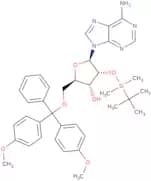
CAS:2'-O-tert-Butyldimethylsilyl-5'-O-DMT-adenosine is a modified nucleoside that is used to synthesize oligonucleotides. It is a phosphoramidite, and can be used in the synthesis of DNA or RNA. 2'-O-tert-Butyldimethylsilyl-5'-O-DMT-adenosine is an antiviral agent that has been shown to have anticancer activity in animal models. It has been shown to inhibit the production of tumor necrosis factor alpha (TNFα) and serum enzymes, such as dismutase activity, in mice with lung cancer. This drug also has a toxic effect on respiratory system cells, which may be due to its ability to induce apoptosis.
Pureza:Min. 95%Octanoyl coenzyme A potassium salt
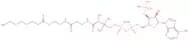
CAS:Octanoyl CoA is a molecule that belongs to the class of acyl-coenzyme A. It is an important intermediate in fatty acid metabolism and is also used in the synthesis of long-chain fatty acids. Octanoyl CoA can be converted back to acetyl-CoA by enzymes called synthetases, which are active in energy metabolism. Octanoyl CoA has been shown to have clinical relevance for diseases such as acyl chain disorders, carnitine deficiency, and dehydrogenase deficiency. Octanoyl CoA is a potential drug target since it can be converted into octanoic acid, which has been shown to inhibit enzyme activities and protein synthesis.
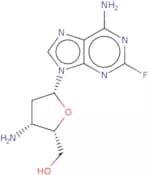
Fórmula:C29H47N7O17P3S·3KPureza:Min. 95%Forma y color:PowderPeso molecular:1,008 g/mol3'-Amino-2',3'-dideoxy-2-fluoroadenosine
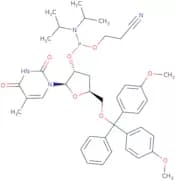
3'-Amino-2',3'-dideoxy-2-fluoroadenosine is a novel compound that inhibits the enzyme ribonucleotide reductase, which is involved in the synthesis of DNA. It also has antiviral and anticancer activities. 3'-Amino-2',3'-dideoxy-2-fluoroadenosine has high purity and high quality and can be used as an activator for phosphoramidite synthesis.Fórmula:C10H13FN6O2Pureza:Min. 95%Forma y color:PowderPeso molecular:268.25 g/mol3'-Deoxy-5'-O-DMT-5-methyluridine 2'-CE phosphoramidite
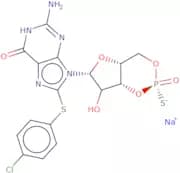
CAS:3'-Deoxy-5'-O-DMT-5-methyluridine 2'-CE phosphoramidite is a nucleotide analogue that is used in the synthesis of DNA. It is a modified nucleoside that contains an amino group at the 5' position of the pentose sugar and a methyl group at the 2' position. 3'-Deoxy-5'-O-DMT-5-methyluridine 2'-CE phosphoramidite inhibits viral replication and has shown anticancer activity. It also possesses antiviral activity against Herpes simplex virus types 1 and 2, cytomegalovirus, varicella zoster virus, Epstein Barr virus, influenza A virus type A/PR/8/34 (H1N1), and human immunodeficiency virus type 1 (HIV).Fórmula:C40H49N4O8PPureza:Min. 95%Peso molecular:744.81 g/mol8-(4-Chlorophenylthio)guanosine 3',5'-cyclic monophosphothioate Sp-isomer sodium
CAS:8-(4-Chlorophenylthio)guanosine 3',5'-cyclic monophosphothioate Sp-isomer sodium salt (8-chloro-GTP) is a modified nucleoside that inhibits the synthesis of DNA by preventing the addition of nucleotides to the 3' end of DNA. It is an antiviral and anticancer agent, and can be used as a phosphoramidite in the synthesis of DNA. 8-chloro-GTP has shown high purity and high quality in synthesized DNA. Research on this compound is still ongoing, but it has been shown to be novel and modified compared to other nucleosides.
Fórmula:C16H14ClN5O6PS2·NaPureza:Min. 95%Peso molecular:525.86 g/mol