Nucleósidos
Los nucleósidos son building blocks fundamentales de los ácidos nucleicos, compuestos por una base nitrogenada unida a una molécula de azúcar. En esta sección, puede encontrar una amplia variedad de nucleósidos esenciales para la investigación en biología molecular, bioquímica y farmacología. Estos compuestos juegan roles cruciales en la síntesis de ADN y ARN, y son vitales en varios procesos metabólicos. Los nucleósidos se utilizan para estudiar material genético, desarrollar terapias antivirales y anticancerígenas, y comprender los mecanismos celulares. En CymitQuimica, proporcionamos nucleósidos de alta calidad para apoyar sus necesidades de investigación y desarrollo, asegurando pureza y fiabilidad para sus aplicaciones experimentales.
Se han encontrado 3569 productos de "Nucleósidos"
Ordenar por
Pureza (%)
0
100
|
0
|
50
|
90
|
95
|
100
Tert-Butyl 2-Phenyl-4-(P-Tolylsulfonyloxy)-7,8-Dihydropyrido[4,3-D]Pyrimidine-6(5H)-Carboxylate
CAS:Tert-Butyl 2-Phenyl-4-(P-tolylsulfonyloxy)-7,8-dihydropyrido[4,3-D]pyrimidine-6(5H)-carboxylate is an antiviral agent that inhibits the replication of DNA and RNA. It is a phosphoramidate nucleoside analog and a novel compound that has been modified to improve its stability. Tert-butyl 2-phenyl-4-(P-tolylsulfonyloxy)-7,8-dihydropyrido[4,3-D]pyrimidine-6(5H)-carboxylate is currently being investigated for use as a drug to treat HIV/AIDS. This compound has been shown to inhibit HIV protease by binding to the active site of the enzyme and preventing it from cutting the polypeptide chain into smaller pieces. Tert butyl 2 phenyl 4Fórmula:C25H27N3O5SPureza:Min. 95%Peso molecular:481.57 g/mol5'-O-DMT-N4-ethylcytidine
5'-O-DMT-N4-ethylcytidine is a novel nucleoside analogue. It has been used as a building block for the synthesis of modified oligonucleotides. 5'-O-DMT-N4-ethylcytidine is an antiviral agent that inhibits HIV replication by inhibiting reverse transcriptase, which is an enzyme that is necessary for the production of viral DNA from host cell RNA. The drug also has anticancer activity, which may be due to its ability to inhibit DNA synthesis and cellular proliferation.Fórmula:C32H35N3O7Pureza:Min. 95%Peso molecular:573.64 g/mol7-Deaza-2-mercaptohypoxanthine
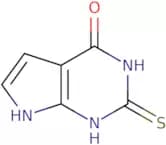
CAS:<p>7-Deaza-2-mercaptohypoxanthine is a nucleoside that has been found to have anticancer activity in vivo. It has also been shown to inhibit the replication of HIV and herpes simplex virus. 7-Deaza-2-mercaptohypoxanthine is an analog of hypoxanthine, which is a nucleoside that can be found in DNA and RNA. In addition, this compound can be used as a phosphoramidite or nucleotide analogue for the synthesis of DNA and RNA. This compound can also be used as an antiviral agent against herpes simplex virus type 1 (HSV1).</p>Fórmula:C6H5N3OSPureza:Min. 95%Peso molecular:167.19 g/mol7-Methylinosine
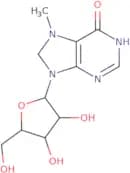
CAS:7-Methylinosine is a versatile compound that has various applications in different fields. It is used as an intermediate in the synthesis of drugs such as azasetron, eletriptan, and fructan. Additionally, it has been shown to have detergent properties that make it useful in cleaning products. 7-Methylinosine also plays a role in cholesterol metabolism and has been implicated in the development of fibrosis. Studies have found that this compound can inhibit the activity of enzymes involved in glucosinolate biosynthesis and may play a role in plant defense against pathogens. Furthermore, 7-Methylinosine has been isolated from Nocardia sp., which suggests its potential use as a source of novel bioactive compounds.Fórmula:C11H16N4O5Pureza:Min. 95%Peso molecular:284.27 g/mol5'-Amino-5'-deoxy-5'-N-MMT-thymidine 3'-CE phosphoramidite
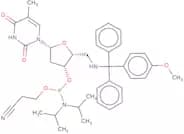
CAS:5'-Amino-5'-deoxy-5'-N-MMT-thymidine 3'-CE phosphoramidite is a high purity, novel, modified, antiviral and anticancer nucleotide. It is an analog of thymidine which has the methyl group at the 5' position replaced with a 5' amino group. This modification prevents conversion of the nucleoside to thymine and therefore inhibits DNA synthesis. The phosphoramidite is used as a building block for oligonucleotides in chemical synthesis. The phosphoramidite has shown antiviral activity against HIV by preventing reverse transcription of viral RNA into DNA. It also has been tested for its anticancer effects on human cells in vitro by inhibiting DNA synthesis and inducing apoptosis in cancer cells.Fórmula:C39H48N5O6PPureza:Min. 95%Peso molecular:713.8 g/mol2',3'-Dideoxy-2',3'-didehydroinosine
CAS:<p>2',3'-Dideoxy-2',3'-didehydroinosine is a synthetic pyrimidine compound that has been shown to inhibit tumor growth in animal models. It is used to prepare 2',3'-dideoxy-2',3'-didehydroinosine-5'-triphosphate, which inhibits the synthesis of DNA and RNA by binding to the enzyme ribonucleotide reductase. This inhibition leads to cell death by inducing crosslinkers and inhibiting polymerase chain reaction. 2',3'-Dideoxy-2',3'-didehydroinosine can be synthesized from hydrochloric acid and carbonyl compounds such as glyoxal, acetaldehyde, or benzaldehyde.<br>2',3'-Dideoxy-2',3'-didehydroinosine is an important part of phylogenetic tree analysis because it provides information about evolutionary relationships between bacteria.</p>Fórmula:C10H10N4O3Pureza:Min. 95 Area-%Forma y color:White PowderPeso molecular:234.21 g/molAdenosine 5'-diphosphate potassium salt
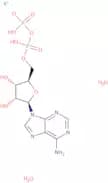
CAS:Adenosine 5'-diphosphate potassium salt can be used as a substrate for a variety of protein kinases known as AMP-activated protein kinases (AMPK)Fórmula:C10H14N5O10P2·KPureza:Min. 95%Forma y color:PowderPeso molecular:465.29 g/molCyclic diguanosine monophosphate
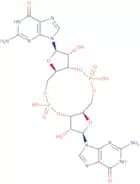
CAS:<p>Cyclic diguanosine monophosphate (c-di-GMP) is a nucleotide that is involved in bacterial cell signaling. It has been shown to be essential for the formation of bacterial biofilms and plays an important role in the development of infectious diseases. c-di-GMP is synthesized from guanosine triphosphate through a series of enzymatic reactions and then hydrolyzed by cyclic diguanosine monophosphatase, which leads to its termination as a second messenger. c-di-GMP interacts with proteins that regulate the expression of genes involved in biofilm formation, motility, and virulence. The synthesis and hydrolysis of c-di-GMP are regulated by multiple enzymes, including protein phosphatases, that control cellular physiology such as biofilm formation.</p>Fórmula:C20H24N10O14P2Pureza:Min. 95%Peso molecular:690.41 g/mol3'-O-tert-Butyldiphenylsilyl-2'-O-methyluridine
<p>3'-O-tert-Butyldiphenylsilyl-2'-O-methyluridine is a novel nucleoside with antiviral and anticancer properties. It has been shown to inhibit the growth of human tumor cells in culture and induce apoptosis, as well as inhibit viral replication. 3'-O-tert-Butyldiphenylsilyl-2'-O-methyluridine is an analogue of uridine, which can be used for the synthesis of DNA or RNA. The phosphate group is attached to the 3' carbon on the sugar moiety. This nucleoside has been modified from a natural ribonucleoside by substitution of a tertiary butylphenylsilyl group at the 2' position with an o-methyl group.<br>3'-O-tert-Butyldiphenylsilyl-2'-O-methyluridine is supplied as a white powder with purity greater than 99</p>Pureza:Min. 95%2',3'-Di-O-methylguanosine
<p>2',3'-Di-O-methylguanosine is a nucleoside, which is a chemical compound composed of a nitrogenous base, a five-carbon sugar, and one phosphate group. It is an analog of guanosine that has been modified by replacing the 2' hydroxyl group with a methyl group. This modification prevents the phosphorylation of the monophosphate form to the diphosphate form. This modification also makes 2',3'-Di-O-methylguanosine an activator of DNA polymerase and RNA polymerase. The novel features of this compound make it an excellent candidate for anticancer and antiviral treatments.</p>Pureza:Min. 95%2-[2-(2-Naphthalenyl)ethoxy]adenosine
CAS:2-[2-(2-Naphthalenyl)ethoxy]adenosine is a structural determinant that belongs to the class of adenosine derivatives. It is an antagonist of adenosine receptors, binding to the A1 receptor with high affinity and blocking the effects of adenosine. 2-[2-(2-Naphthalenyl)ethoxy]adenosine has been shown to have a high affinity for benzyl and thioether groups in its structure, which are important for binding to the A1 receptor. This compound has been used in assays to determine the binding of other compounds with adenosine receptors. 2-[2-(2-Naphthalenyl)ethoxy]adenosine has also been shown as a radioligand for competitive binding studies with human brain membranes.Fórmula:C22H23N5O5Pureza:Min. 95%Peso molecular:437.45 g/mol3'-O-DMT-thymidine
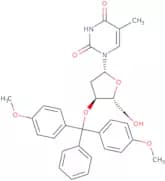
CAS:<p>3'-O-DMT-thymidine is a nucleoside analogue that is synthesized from thymidine. It has been shown to bind to the proviral dna of HIV and inhibit viral replication when present in a complex with the other nucleosides. 3'-O-DMT-thymidine is also stable at high temperatures and binds to carboxamide groups on proteins. This compound has been shown to be effective as a binder for surfaces and membranes, which may be due to its ability to form stable complexes with terminal phosphates. The stability of these complexes can be influenced by the presence of denaturants such as temperature, pH, or ionic strength parameters. 3'-O-DMT-thymidine also forms stable complexes with linkers that are sensitive to thermal denaturation.</p>Fórmula:C31H32N2O7Pureza:Min. 95%Peso molecular:544.6 g/mol2'-Deoxyadenosine-5'-carboxylic acid
CAS:dA oxidised at the 5'-position.Fórmula:C10H11N5O4Pureza:Min. 95%Peso molecular:265.23 g/mol6-O-Benzyl-2'-deoxyguanosine
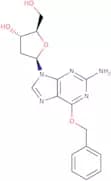
CAS:6-O-Benzyl-2'-deoxyguanosine is a synthetic nucleoside analog that inhibits the synthesis of DNA. It is used in animal studies as a pancreatic carcinogen, and has been shown to inhibit tumor growth in mice. This drug specifically binds to DNA at the O6 position of guanine and methylates the adjacent cytosine residue, thereby preventing synthesis of DNA. 6-O-Benzyl-2'-deoxyguanosine also inhibits the activity of an enzyme called methyltransferase, which converts S-adenosylmethionine into S-adenosylhomocysteine, an intermediate in one of the pathways that produce methionine from homocysteine. This inhibition leads to an accumulation of methionine and its metabolites, including homocysteine and cystathione beta synthase, which can cause cell death.Fórmula:C17H19N5O4Pureza:Min. 95%Peso molecular:357.36 g/molN4-Acetyl-2'-deoxy-3'-O-DMT-cytidine 5'-CE phosphoramidite
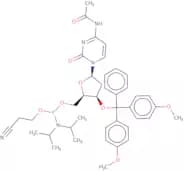
CAS:N4-Acetyl-2'-deoxy-3'-O-DMT-cytidine 5'-CE phosphoramidite is a novel nucleoside. It is a monophosphate and cytidine analog that has been shown to be effective in the treatment of cancer. N4-Acetyl-2'-deoxy-3'-O-DMT-cytidine 5'-CE phosphoramidite also inhibits viral replication by preventing the synthesis of DNA and RNA. This drug can be used as an activator for synthesis of modified oligonucleotides.Fórmula:C41H50N5O8PPureza:Min. 95%Peso molecular:771.84 g/molN1-Methyladenosine hydroiodide
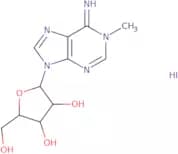
CAS:<p>N1-Methyladenosine hydroiodide is a novel nucleoside analogue that inhibits viral replication by preventing the formation of viral DNA. It also inhibits the growth of cancer cells and is used as an anticancer drug. N1-Methyladenosine hydroiodide has been shown to be an activator of RNA polymerase II, increasing the production of messenger RNA (mRNA) in human cells. The phosphoramidite form of this compound is used for the synthesis of oligodeoxyribonucleotides, which are chemically modified in order to improve their stability and inhibit degradation by nucleases. N1-Methyladenosine hydroiodide is highly pure and has CAS No. 34308-25-3.</p>Fórmula:C11H15N5O4·HIPureza:Min. 95%Peso molecular:409.18 g/molN6,5'-O-Dibenzoyl-2'-deoxy-adenosine
N6,5'-O-Dibenzoyl-2'-deoxy-adenosine is a monophosphate nucleoside that is used in the synthesis of DNA. It is synthesized from 2'-deoxyadenosine, which is an antiviral agent against influenza virus and anticancer agent. N6,5'-O-Dibenzoyl-2'-deoxy-adenosine has been shown to be a potent activator of the polymerase chain reaction with high purity and novel properties.Fórmula:C24H21N5O5Pureza:Min. 95%Peso molecular:475.45 g/molL-Ribose NAD
<p>L-Ribose NAD is a nucleoside that belongs to the group of ribonucleosides. It is a novel modified monophosphate and diphosphate nucleotide. L-Ribose NAD has antiviral, anticancer, and immunomodulatory activities. L-Ribose NAD can activate cells with DNA damage by inhibiting the synthesis of deoxyribonucleosides, which are needed for DNA repair. This product has a high purity level and high quality.</p>Pureza:Min. 95%Peso molecular:663 g/molN2-DMF-2'-O-methylguanosine
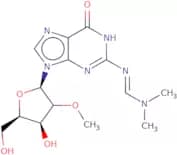
CAS:<p>N2-DMF-2'-O-methylguanosine is a nucleoside that is used as an antiviral agent and anticancer drug. It has been shown to inhibit the growth of human cancer cells in vitro and in vivo. N2-DMF-2'-O-methylguanosine has also been shown to inhibit viral replication by inhibiting DNA synthesis. This nucleoside is a novel compound that can be synthesized using phosphoramidites, which are high quality and yield high purity products.</p>Fórmula:C14H20N6O5Pureza:Min. 95%Peso molecular:352.35 g/mol5'-O-DMT-2'-O-hexylaminoadenosine
<p>5'-O-DMT-2'-O-hexylaminoadenosine is a modified nucleoside that has antiviral activity. It is the monophosphate form of 5'-O-DMT-2'-O-hexylaminoadenosine, and it is used in the synthesis of phosphoramidites for DNA and RNA. This nucleoside is also an activator for novel antiviral drugs.</p>Fórmula:C37H44N6O6Pureza:Min. 95%Peso molecular:668.8 g/mol
![Tert-Butyl 2-Phenyl-4-(P-Tolylsulfonyloxy)-7,8-Dihydropyrido[4,3-D]Pyrimidine-6(5H)-Carboxylate](/_next/image/?url=https%3A%2Fstatic.cymitquimica.com%2Fproducts%2F3D%2Fthumb-webp%2FNB57393.webp&w=3840&q=75)





![2-[2-(2-Naphthalenyl)ethoxy]adenosine](/_next/image/?url=https%3A%2Fstatic.cymitquimica.com%2Fproducts%2F3D%2Fthumb-webp%2FNN16559.webp&w=3840&q=75)